


Dutch Bros Inc. (BROS)
NYSEConsumer DiscretionaryRestaurantsSnapshot 2026-09-15
$41.98-4.70%
Close 2026-09-15 · 1-day change
NYSEConsumer DiscretionaryRestaurantsSnapshot 2026-09-15
Research Workspace
Put BROS beside peers and holdings, graph the same metric, and keep your notes with the evidence.
Daily closes. Earnings/event dots are placed inline.
Industries move in repeating boom-and-bust cycles. This shows where this stock’s industry sits in that cycle, stage by stage (recovery → expansion → supercycle → steady → deceleration → contraction), from its fundamentals (orders, revenue, capital spending), not the stock’s price.
A booming industry is a tailwind for the names in it; a contracting one is a headwind. Companies in the same industry tend to rise and fall together with the cycle, the way a tide lifts and lowers every boat in the harbor at once, so a large part of a stock’s swing can come from where its industry sits rather than from the company itself. It’s context for reading the company’s results, not a buy/sell call. Full explanation →
Restaurants is in steady. Describes the industry's cycle state, not a call on this stock.
The stage band shows the industry’s cycle over the chart’s timeline (each color a stage); a ▼ marks a quarter its growth inflected down — amber is an unconfirmed watch, red is confirmed the next quarter. Use “Overlay cycle on chart” to tint the price chart by stage. The industry’s fundamentals, not a signal on this stock.
Management is running behind on a stated commitment.
View ThesisRevenue is growing steadily — about 30% over the past year.
View GrowthMiddle-of-the-pack quality for its industry.
View QualityMiddle-of-the-pack management execution.
View ManagementExpectations look reasonable — what the market is pricing in sits in line with or below what analysts forecast.
View ValuationThis stock is volatile — it swings about 2% on a typical day and fell roughly 43% in its worst 12-month stretch.
View RiskDutch Bros' growth depends on expanding total system shop openings to at least 185. Revenue grew 32% year over year, and the last quarter beat expectations. It trades at 58× P/E versus a 17× peer median, indicating the price reflects less growth than forecast. Management is running behind on a stated commitment, which poses a risk. Peer multiples imply a price about 5% below where it trades. This read is provisional.
Trailing returns as of 2026-09-15. BROS is total return (includes dividends); the S&P 500 benchmark is price return (the index excludes dividends).
Based on 27 analysts currently covering BROS (as of Sep 2026).
Based on 7 Wall Street analysts offering 12-month price targets for BROS in the last 4 months.
Continue this research
Compare BROS with peers and holdings, graph the same reported metric, keep your questions beside the evidence, and return when the facts change.
Free account required to save the handoff. No credit card.
| Compare | Company | Living FV | P/E | Revenue % | Quality |
|---|---|---|---|---|---|
| BROS Selected company | Graph | Compare | Trend | Review | |
| Peer Add a competitor | Graph | Compare | Trend | Review | |
| Holding Compare a holding | Graph | Compare | Trend | Review |
Selected metric trend
Quarterly · checked companies · value or % of revenue
A consensus fair price across 11 valuation methods, at three horizons. As of 2026-09-15. Estimates are diagnostics, not price targets. Short-horizon estimates are close to coin-flips, so confidence is a method-agreement read, not a prediction.
Today's peer multiple on trailing earnings, with no growth credited. This is the headline read.
Adds projected growth, so it leans optimistic by design. Read it as upside context, not a base case.
A price-focused, side-by-side fair-value read versus Restaurants — fair value, gap to price, and forward P/E.


Our valuation methods disagree too much on this name right now. Rather than print a number we don't believe, we're holding it back until they converge.


Compare the value case
Put BROS next to peers and holdings, compare Living FV and multiples, then graph the driver behind the difference.
Threatens: Expand total system shop openings to at least 185
Loss of locations impacts growth expansion plans.
Not investment advice. Scores describe historical and current data; they are not forecasts of future returns. Consult a licensed advisor before making investment decisions.
End-of-day figures as of 2026-09-15. EPS is implied from price ÷ P/E. Not investment advice.
Current $41.98
The last 12 months of price, then the range of analyst 12-month targets from today’s $41.98.
Analyst ratings and price targets are third-party Wall Street estimates, not QuarterlyIQ’s view. Not investment advice.
A long-thesis check that carries the widest uncertainty of the three horizons.
Top 25% on quality vs scored peers
A second lens on the 12-month fair value: for companies that score high on measured quality (profitability, balance-sheet safety, earnings stability), this read trusts more of today's profit margins instead of averaging them toward their multi-year history the way the headline number does. Shown alongside the fair value above, not in place of it. A diagnostic, not a price target or a buy/sell signal.
Direction of the business behind the multiple. Bands are backend reads; trailing-12-month basis.

Increased competition may hinder Dutch Bros' expansion plans.

Threatens: Expand total system shop openings to at least 185
Local opposition may hinder shop expansion plans.

Increased competition may hinder shop expansion plans.
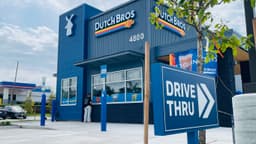
Advances: Expand total system shop openings to at least 185
Partnership could significantly enhance growth through new shop openings.

Advances: Expand total system shop openings to at least 185
New drive-thrus contribute to expansion goals.
Advances: Raise full-year revenue guidance to $2.05B-$2.08B
Positive stock target reflects growth outlook and revenue guidance.
Advances: Expand total system shop openings to at least 185
Opening in Chicago supports expansion objective.