

Fair Value Is a Range, Not a Precise Number
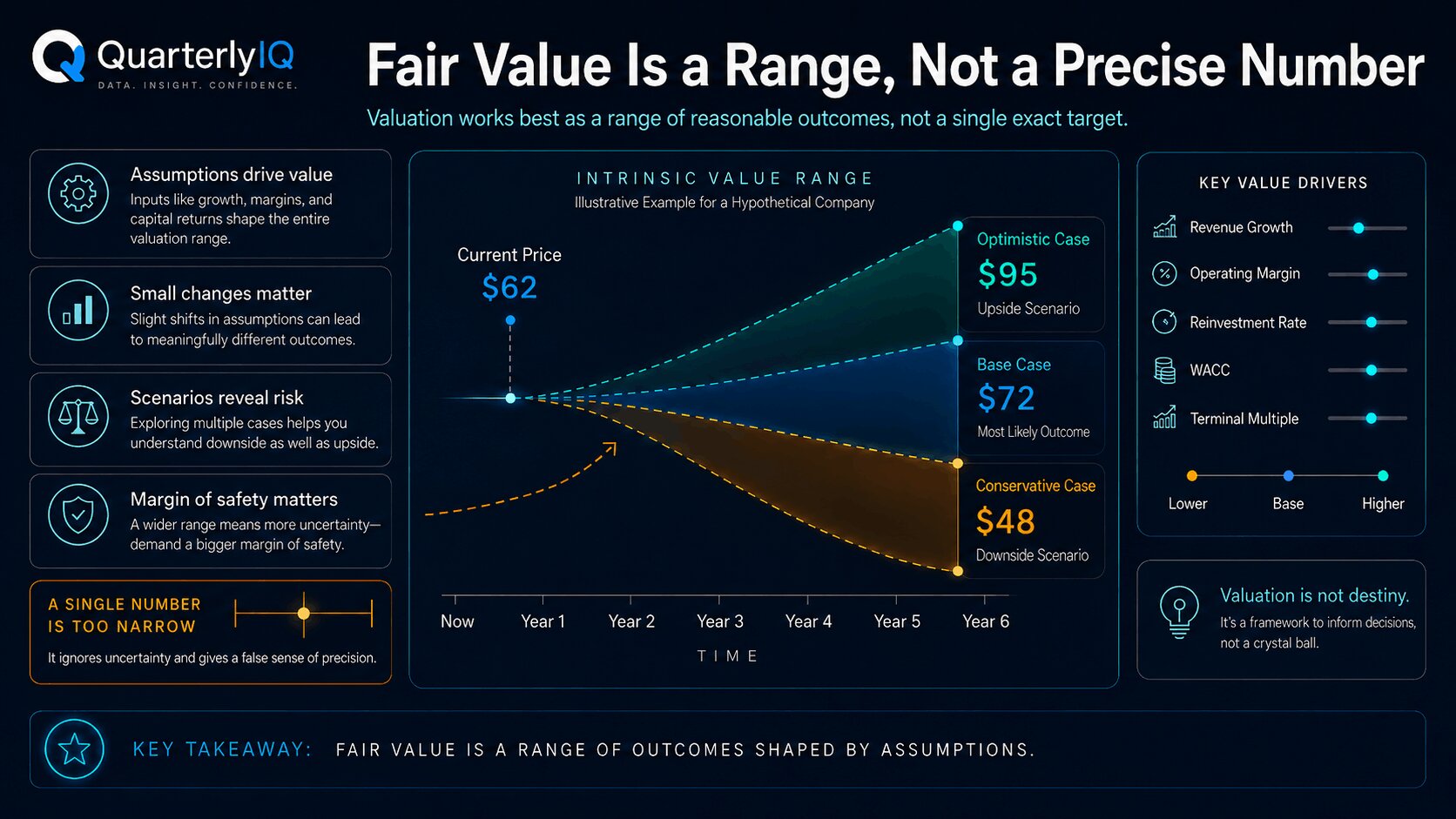
Investors often want valuation to produce a clean answer.
A stock is worth $82.40.
Anything below that is cheap.
Anything above that is expensive.
That kind of precision feels comforting, but it can be misleading.
Fair value is not a single exact number. It is an estimate built from assumptions about growth, margins, cash flow, risk, interest rates, competition, and management execution.
Change those assumptions slightly and the fair value estimate can move meaningfully.
That does not make valuation useless.
It means valuation should be treated as a range of reasonable outcomes, not a precise target.
A stock may look attractive in one scenario, fairly valued in another, and expensive in a third. The job is not to pretend one number has certainty. The job is to understand what the current price assumes, how realistic those assumptions are, and how much room remains for error.
Why investors want one fair value number
A single fair value number is easy to use.
It simplifies a difficult decision.
If the stock trades below the number, it appears undervalued. If it trades above the number, it appears overvalued. The conclusion feels objective.
The problem is that valuation depends on the future, and the future is uncertain.
Even a careful valuation may depend on assumptions such as:
- How fast revenue will grow
- How long growth will continue
- What profit margins will become
- How much cash the business will generate
- How much capital the company needs
- Whether customers remain loyal
- Whether competitors pressure pricing
- What interest rates will be
- What multiple investors will assign later
- How trustworthy management’s guidance is
No one knows those answers with precision.
A fair value estimate can be useful, but it should not be treated like a measurement of height or weight.
It is closer to a well-reasoned judgment about a range of possible futures.
Fair value depends on assumptions
Every valuation model contains assumptions.
Some are obvious. Others are hidden.
A discounted cash flow model may require estimates for revenue growth, margins, reinvestment needs, discount rate, and terminal value.
A multiple-based valuation may require assumptions about which peer group is relevant, what multiple is appropriate, and whether earnings are normal or temporarily distorted.
A sum-of-the-parts valuation may require assumptions about segment margins, growth rates, and comparable businesses.
Even a simple P/E comparison depends on assumptions.
A stock trading at 25 times earnings may be reasonable if earnings are durable and growing. It may be expensive if earnings are near a peak. It may be cheap if current earnings are temporarily depressed and likely to recover.
The number alone does not settle the question.
The assumptions behind the number matter more.
Small changes can create large valuation differences
Valuation can be sensitive to assumptions that appear small.
Imagine two investors value the same company.
Both agree the business is high quality. Both expect it to grow. Both believe margins can improve.
But one assumes revenue can grow 12 percent per year for several years. The other assumes 9 percent.
One assumes operating margins eventually reach 25 percent. The other assumes 21 percent.
One assumes investors will continue valuing the company at a premium multiple. The other assumes the multiple gradually declines as growth slows.
Those differences may sound modest, but they can lead to very different fair value estimates.
Neither investor has to be unreasonable.
They are simply assigning different probabilities to the future.
This is why fair value should be viewed as a range. A single number can hide how much uncertainty sits underneath the estimate.
A valuation range is more honest than a point estimate
A valuation range accepts uncertainty directly.
Instead of saying, “This stock is worth $82.40,” a range might say:
- Conservative case: $65 to $75
- Base case: $80 to $95
- Optimistic case: $105 to $125
The point is not that these numbers are perfectly knowable.
The point is that different reasonable assumptions produce different possible values.
A range helps investors see:
- How much depends on growth
- How much depends on margin expansion
- How much depends on valuation multiples
- How sensitive the stock is to disappointment
- Whether the current price already assumes an optimistic outcome
- Whether the downside case is severe or manageable
A range also helps prevent false confidence.
The question becomes less about whether one exact number is correct and more about whether the current price is reasonable across a range of likely outcomes.
Fair value should reflect scenarios
Scenario analysis is one of the most practical ways to think about fair value.
A useful valuation should usually include at least three scenarios.
Conservative case
This scenario assumes the company performs below your main expectations.
Growth may slow. Margins may improve less than expected. Competition may pressure pricing. Management may execute unevenly. Interest rates may remain less favorable.
The conservative case asks:
What might the business be worth if things are still acceptable, but not especially strong?
This is not necessarily a disaster case.
It is a reasonable downside case.
Base case
This scenario reflects what you believe is most likely based on the current evidence.
The base case should connect directly to the investment thesis.
If the thesis depends on customer growth, margin expansion, and stable competition, the base case should show what those assumptions look like in the numbers.
Optimistic case
This scenario assumes the company performs better than expected.
Growth may remain strong for longer. Margins may expand more. New products may gain adoption. The company may take share. Investors may continue assigning a premium multiple.
The optimistic case asks:
What could the stock be worth if the company executes unusually well?
The value of scenarios is not just the numbers they produce.
The value is seeing what has to happen for each outcome to be realistic.
The current price may already reflect one scenario
A stock price often tells you which scenario investors may already be paying for.
If the stock trades below your conservative case, the market may be assuming significant weakness.
If it trades near your base case, the stock may be fairly valued under reasonable assumptions.
If it trades near your optimistic case, the price may already require a lot to go right.
This is where fair value connects to priced-in expectations.
A stock is not overvalued simply because it trades above one analyst’s fair value estimate.
It becomes more vulnerable when the current price already assumes an optimistic scenario and the business evidence is not strong enough to support it.
For a deeper framework, read What Does “Priced In” Mean in the Stock Market?.
A fair value range helps separate quality from price
Great companies can deserve higher valuations.
They may have stronger brands, better margins, recurring revenue, pricing power, high returns on capital, and more predictable cash flow.
Those strengths matter.
But quality does not remove valuation risk.
A fair value range helps separate two questions:
- Is this a strong company?
- Is the stock price reasonable for the strength of the company?
A high-quality business may be worth more than an average business. But there is still a level of optimism that can make the stock fragile.
A fair value range helps show whether the current price reflects reasonable appreciation for quality or whether it already assumes years of near-perfect execution.
For more on this distinction, read Why Great Companies Can Still Be Fragile Investments.
Valuation ratios are shortcuts, not fair value
Ratios such as P/E, price-to-sales, EV/EBITDA, and price-to-free-cash-flow can be useful.
They give investors a quick way to compare companies.
But ratios are not fair value by themselves.
A high P/E may be reasonable if the company has durable earnings growth, strong margins, and high returns on capital.
A low P/E may be misleading if earnings are near a cyclical peak or about to decline.
A high price-to-sales ratio may be justified for a business that can eventually produce very high margins.
A low price-to-sales ratio may still be expensive if the company cannot convert revenue into profit or cash flow.
The ratio starts the conversation.
It does not finish it.
For more on this, read High P/E Does Not Always Mean Overvalued.
Fair value changes as evidence changes
Fair value is not permanent.
It should change when the business changes.
A company may deserve a higher fair value range when:
- Revenue growth becomes more durable
- Margins improve faster than expected
- Customer retention strengthens
- New products gain real adoption
- Competitive advantages become clearer
- Free cash flow improves
- Debt declines
- Management earns more credibility
- Estimates move higher for good reasons
A company may deserve a lower fair value range when:
- Growth slows more than expected
- Margins remain under pressure
- Customers spend less or leave
- Competition becomes more intense
- Cash flow weakens
- Debt becomes more important
- Management misses repeated commitments
- Estimates are revised lower
- The company needs more capital to support growth
This is why valuation and monitoring are connected.
A fair value range should respond to new evidence, not remain anchored to an old model.
Do not anchor to your original fair value estimate
One common mistake is treating the original valuation as if it remains true.
An investor buys a stock because they believe fair value is $100.
The stock falls to $70.
The investor continues saying it is worth $100, even though the company has since lowered guidance, margins have weakened, and estimates have moved lower.
The original valuation may no longer apply.
The reverse can also happen.
A stock rises above the original fair value estimate, but the company executes better than expected. Revenue becomes more durable. Margins expand. Cash flow improves. The fair value range may move higher.
The original estimate should be a starting point, not a permanent conclusion.
A useful question is:
Would the current evidence lead me to use the same assumptions today?
If not, the fair value range should change.
The margin of safety comes from uncertainty
A margin of safety exists because valuation is uncertain.
If fair value were a precise number, investors would only need to compare price with that number.
But because fair value is a range, investors often want a gap between the current price and their estimate of reasonable value.
That gap can help protect against:
- Overly optimistic assumptions
- Unexpected business weakness
- Interest-rate changes
- Estimate cuts
- Competitive pressure
- Management execution issues
- Valuation multiple compression
The amount of margin needed depends on the company.
A stable, predictable business may require less margin for error than a cyclical, highly leveraged, or uncertain business.
A fast-growing company with a wide range of possible outcomes may require more humility around valuation.
The more uncertain the future, the less useful a precise point estimate becomes.
The fair value range should match the business type
Different businesses require different valuation ranges.
Stable compounders
A predictable company with recurring revenue, strong cash flow, and steady growth may have a narrower fair value range.
The future is still uncertain, but the range of likely outcomes may be more contained.
Cyclical businesses
A cyclical company may require a wider range because earnings can swing significantly across economic cycles.
A low P/E near peak earnings can be misleading. A high P/E near trough earnings can also be misleading.
Normalized earnings matter.
Turnarounds
A turnaround often has a very wide fair value range.
If the strategy works, value may rise meaningfully. If it fails, downside may be severe.
The range should reflect both outcomes.
Early-stage growth companies
A young growth company may have a wide range because small changes in long-term growth, margins, or dilution can meaningfully affect value.
The company may become much more valuable, but the uncertainty is usually higher.
Asset-heavy businesses
Companies with heavy capital needs may require careful attention to reinvestment, depreciation, debt, and free cash flow.
Reported earnings may not fully capture the economics.
The right valuation method depends on what drives the business.
Fair value requires both numbers and judgment
Valuation is quantitative, but it is not purely mechanical.
The numbers matter.
So does judgment.
Investors need to assess:
- Whether management is credible
- Whether customers are likely to stay
- Whether margins are sustainable
- Whether competitors can copy the business
- Whether growth can continue
- Whether the balance sheet can support the strategy
- Whether reported earnings reflect real cash generation
- Whether the market opportunity is realistic
A spreadsheet can calculate a value from assumptions.
It cannot decide whether the assumptions are reasonable.
That judgment comes from understanding the business and monitoring the evidence over time.
Beware of false precision in valuation models
Detailed models can create the appearance of accuracy.
A spreadsheet may include five years of revenue forecasts, margin assumptions, discount rates, terminal values, and sensitivity tables.
The output may be a precise number.
But the precision of the output does not eliminate the uncertainty of the inputs.
A model can be useful when it helps you understand what drives value.
It becomes dangerous when it makes uncertain assumptions look certain.
A better use of valuation models is to ask:
- Which assumptions matter most?
- What has to go right?
- What would cause the value to fall?
- Which assumptions are supported by evidence?
- Which assumptions are mostly hope?
- How much does fair value change when key inputs move?
A model should help you think more clearly, not convince you that uncertainty has disappeared.
Sensitivity matters more than precision
A good valuation process should identify which assumptions move the estimate the most.
For many companies, fair value may be highly sensitive to:
- Revenue growth
- Terminal growth
- Operating margin
- Discount rate
- Exit multiple
- Free cash flow conversion
- Share dilution
- Capital intensity
If a small change in one assumption creates a large change in fair value, the investment may be more fragile than the headline estimate suggests.
For example, if the valuation only looks attractive when revenue growth remains high, margins expand, and the exit multiple stays elevated, the stock may depend on several things going right at once.
That does not automatically make the investment unattractive.
It means the thesis should be monitored carefully.
Fair value should include downside thinking
Investors often spend too much time on the base case.
The base case is important, but the downside case may be more revealing.
Ask:
- What happens if growth slows sooner?
- What happens if margins do not improve?
- What happens if the company needs more capital?
- What happens if competition increases?
- What happens if estimates move lower?
- What happens if the market assigns a lower multiple?
- What happens if interest rates stay higher than expected?
A stock may look attractive in the base case but unattractive once realistic downside outcomes are considered.
That is especially important for high-expectation stocks.
A great business may still be fragile if the downside scenario is not reflected in the price.
Fair value and market price are not the same thing
The market price is what investors are currently willing to pay.
Fair value is an estimate of what the business may reasonably be worth based on future evidence and assumptions.
The two can differ for many reasons.
A stock may trade above fair value because investors are overly optimistic, liquidity is strong, a narrative is popular, or risk appetite is high.
A stock may trade below fair value because investors are fearful, the company is misunderstood, short-term results are weak, or the market is demanding a larger return.
But the market price should not be ignored.
It provides information about expectations.
When price and fair value differ, the next question is not simply, “Is the market wrong?”
A more useful set of questions is:
- What is the market assuming?
- What am I assuming?
- Which assumptions are better supported by evidence?
- What could cause the gap to close?
- What could make my valuation wrong?
That keeps the analysis humble.
A stock can move inside the fair value range
Not every price movement changes the investment case.
If a stock moves from the lower end of your fair value range toward the middle, that may simply reflect the market recognizing some of the value you already saw.
If it moves beyond the upper end of your reasonable range, the stock may become more dependent on optimistic assumptions.
If it falls below the range, the market may be pricing in a worse scenario.
The key is understanding where the current price sits relative to the range and what evidence would justify a change in the range.
Price movement should prompt questions, not automatic conclusions.
For a broader monitoring framework, read How to Monitor a Stock After You Buy It.
Estimate revisions can shift fair value
Analyst estimates are not perfect, but they can help show whether expectations are changing.
If revenue and earnings estimates move higher because the company is executing better, the fair value range may rise.
If estimates move lower because growth is slowing or margins are weaker, the fair value range may fall.
Pay attention to:
- Revenue revisions
- Earnings revisions
- Margin assumptions
- Free cash flow estimates
- Long-term growth assumptions
- Changes across multiple forecast periods
Estimate revisions are most useful when they confirm business evidence.
One revision may not mean much.
A sustained direction can reveal that the expected path of the company is changing.
A practical fair value range framework
You do not need a complicated model to think more clearly about fair value.
A simple process can help.
1. Start with the investment thesis
What needs to be true for the company to create value from the current price?
Identify the main growth, profitability, cash flow, and competitive assumptions.
2. Build three scenarios
Create a conservative case, base case, and optimistic case.
Each scenario should be reasonable, not extreme.
3. Identify the key assumptions
Determine which assumptions matter most.
These may include revenue growth, margins, valuation multiples, discount rates, or free cash flow conversion.
4. Compare the current price with the range
Ask whether the stock is trading near the downside case, base case, or optimistic case.
This helps reveal what investors may already be assuming.
5. Look for a margin of safety
Consider whether the current price leaves room for your assumptions to be wrong.
The more uncertain the business, the more important this becomes.
6. Monitor the evidence
Track whether new results support or weaken the assumptions behind the range.
7. Update the range when the facts change
Do not hold onto an old fair value estimate when the business has changed.
A valuation range should evolve with the evidence.
Questions to ask before trusting a fair value estimate
Before relying on any fair value number, ask:
- What assumptions drive this estimate?
- Are those assumptions realistic?
- What would the conservative case look like?
- How wide is the range of reasonable values?
- How sensitive is the estimate to growth or margin assumptions?
- Does the current price already assume the optimistic case?
- Is the business becoming more or less predictable?
- Are estimates moving higher or lower?
- Has the company’s competitive position changed?
- Does the valuation leave room for disappointment?
These questions can prevent a fair value estimate from becoming a false anchor.
How this connects to overvaluation
A stock is not overvalued simply because it trades above one fair value estimate.
It may trade above a conservative estimate but still within a reasonable range.
It may also trade below a base-case estimate while still being risky if the downside case is severe.
Overvaluation becomes more convincing when:
- The stock trades above a reasonable range of outcomes
- The current price requires optimistic assumptions
- The business evidence is not improving enough to support those assumptions
- Estimates are flat or falling
- The margin for disappointment is small
- The investment thesis depends on too many things going right
That is why fair value ranges are more useful than single-value labels.
They help connect price with expectations, evidence, and risk.
For more on this broader question, read How to Tell if a Stock Is Overvalued Without One Magic Ratio.
Why this becomes difficult across a portfolio
Estimating fair value for one company is already uncertain.
Doing it across a portfolio is harder.
Each holding may require a different valuation approach.
One company may need a growth-based framework. Another may require normalized earnings. Another may depend on asset values. Another may be valued on free cash flow. Another may be priced around a turnaround.
The ranges also change at different speeds.
A software company’s range may change after retention and margin data. A bank’s range may change with credit quality and interest rates. A retailer’s range may change with inventory, traffic, and gross margin. An industrial company’s range may change with orders and backlog.
A portfolio can also become concentrated in the same valuation risk.
Several holdings may all depend on high growth, premium multiples, or lower interest rates.
That is why portfolio monitoring should include not only what each company is worth, but what each valuation depends on.
How QuarterlyIQ approaches fair value and valuation
QuarterlyIQ helps investors look beyond single-number valuation shortcuts.
For covered companies, we focus on practical questions such as:
- What assumptions appear reflected in the current valuation?
- Is the company delivering enough to support those assumptions?
- Are estimates moving higher or lower?
- Is the valuation becoming more demanding?
- How much room appears to remain for disappointment?
- Which evidence would raise or lower confidence in the valuation?
- What should be watched next?
The purpose is not to claim that one exact fair value number is correct.
It is to connect valuation with business evidence, expectations, and the investment thesis.
Explore the QuarterlyIQ stock research section to review covered companies.
The takeaway
Fair value is a range, not a precise number.
That range depends on assumptions about growth, margins, cash flow, risk, competition, management execution, and market conditions.
A single valuation estimate can be useful, but it should never hide the uncertainty behind it.
Instead of asking only, “What is this stock worth?” ask:
- What range of values is reasonable?
- What assumptions drive that range?
- Where does the current price sit inside the range?
- What evidence would move the range higher or lower?
- How much room is there for disappointment?
The goal is not perfect precision.
The goal is better judgment.
A fair value range helps investors stay honest about uncertainty, avoid false confidence, and connect valuation to the evidence that matters most.
For more on expectations and valuation, read What Does “Priced In” Mean in the Stock Market?.
For a broader valuation framework, read How to Tell if a Stock Is Overvalued Without One Magic Ratio.
For informational purposes only. Not investment advice. QuarterlyIQ provides descriptive, rules-based analysis of company fundamentals and does not recommend buying or selling any security.