How to Monitor a Stock After You Buy It
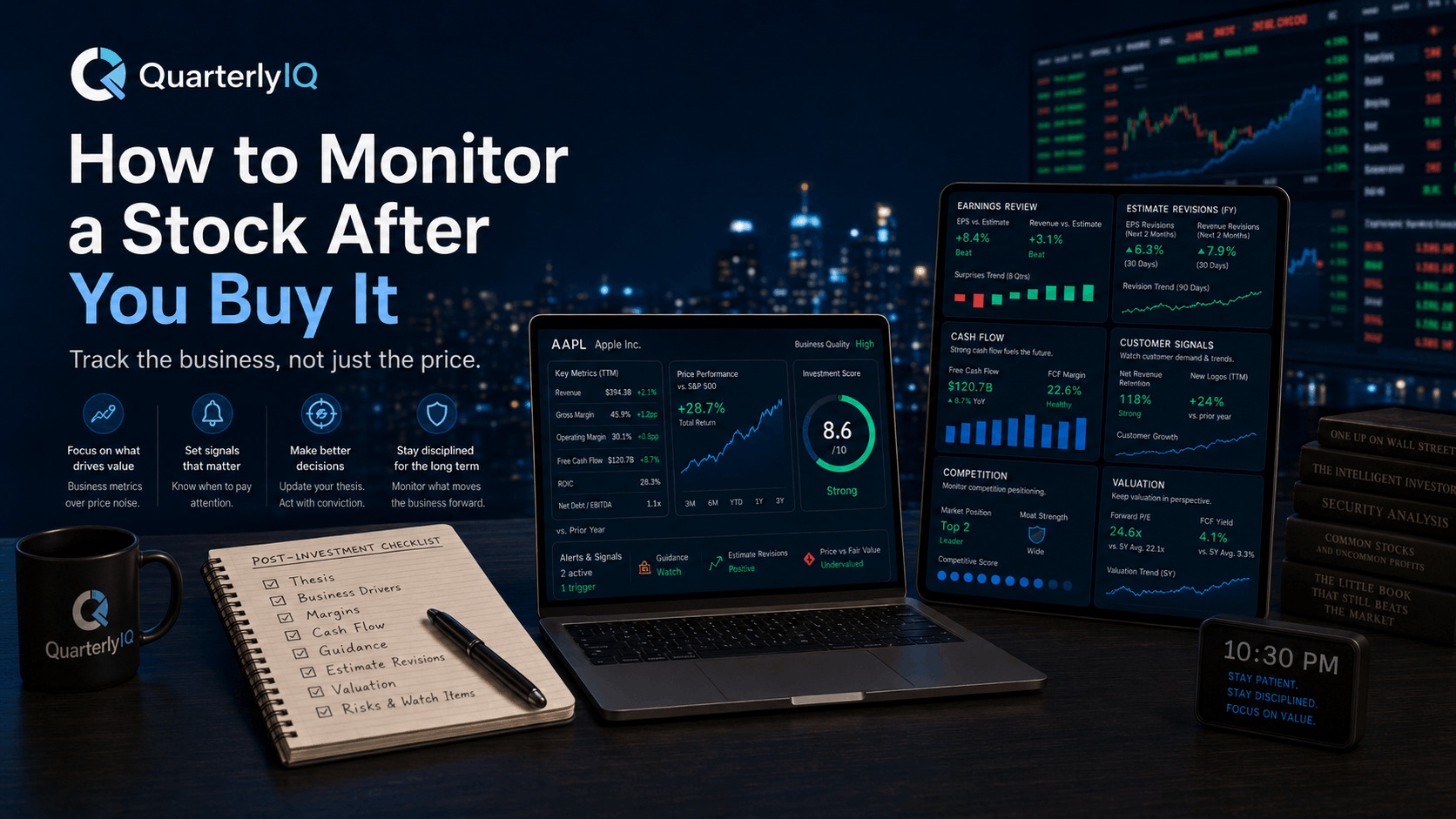
Buying a stock often feels like the end of a long research process.
You studied the company, reviewed its financial results, considered the risks, looked at the valuation, and decided the investment deserved a place in your portfolio.
Then the work changes.
You no longer need to decide whether the company is interesting enough to research. You need to determine whether it continues to behave like the business you believed you were buying.
That requires more than checking the share price.
A stock can rise while its underlying business weakens. It can fall while the original investment thesis remains broadly intact. It can report strong results that still fall short of market expectations.
Monitoring helps you separate those situations.
The purpose is not to watch every market movement or consume every piece of news. It is to follow the evidence that matters to your investment thesis and recognize when that evidence begins to change.
Monitoring begins before you buy
The most useful monitoring process starts with a written investment thesis.
A thesis explains:
- Why you believe the company may become more valuable
- What drives its growth or profitability
- What evidence currently supports the case
- Which risks matter most
- What developments would cause a fresh review
Without that foundation, monitoring can turn into a stream of disconnected information.
A new product launches. An analyst changes a price target. The stock falls 8 percent. Management appears on television. A competitor reports earnings.
Each event may feel important, but you have no clear standard for deciding whether it matters.
A written thesis gives every new development a question to answer:
Does this information strengthen, weaken, or leave the original investment case largely unchanged?
That is the heart of stock monitoring.
For help building that foundation, read What Is an Investment Thesis? A Simple Framework for Investors.
Decide what the thesis depends on
Not every company should be monitored in the same way.
A young software company, a regional bank, a retailer, and a regulated utility may all require different evidence.
The metrics you follow should reflect the reason you own the business.
If the thesis depends on customer adoption, you may monitor:
- New customer growth
- Retention
- Product usage
- Revenue per customer
- Sales efficiency
If the thesis depends on margin expansion, you may monitor:
- Gross margin
- Operating margin
- Cost growth
- Pricing
- Product mix
- Free cash flow
If the thesis depends on financial strength, you may monitor:
- Debt
- Interest expense
- Cash reserves
- Liquidity
- Credit quality
- Capital requirements
If the thesis depends on a new product, you may monitor:
- Launch timing
- Customer adoption
- Revenue contribution
- Production capacity
- Competitive response
- Management’s execution
The goal is not to follow every available number.
It is to identify the small group of business drivers that determine whether the thesis is working.
Create a simple monitoring record
You do not need a complicated research system.
A basic monitoring record can include:
The reason you own the company
Write the thesis in a few clear sentences.
Avoid vague claims such as “great company” or “strong long-term opportunity.”
Describe the actual business case.
The main drivers
List the two or three developments that need to occur for the thesis to work.
These may include revenue growth, customer retention, margin improvement, market-share gains, new products, or stronger cash generation.
The supporting evidence
Record the current evidence behind the thesis.
This gives you a baseline for future comparisons.
The important risks
Identify the risks most capable of challenging the investment case.
Focus on the risks that affect the thesis directly rather than every possible negative event.
The conditions that deserve a fresh review
Write down what would make you investigate more closely.
Examples might include:
- Revenue slowing for several quarters
- Management lowering guidance
- Customer retention weakening
- Margins failing to improve
- A major product delay
- Debt rising faster than cash flow
- Competitors gaining meaningful market share
These are not automatic instructions to sell.
They are signals that the original reasoning may need to be reassessed.
Separate the monitoring rhythm into three layers
A practical system can be divided into routine monitoring, event-driven monitoring, and deeper periodic reviews.
Routine monitoring
Routine monitoring helps you stay aware without constantly reacting.
Depending on the company, this may include:
- Reviewing major company announcements
- Following material estimate revisions
- Checking upcoming earnings dates
- Watching significant regulatory or competitive developments
- Reviewing meaningful changes in valuation
- Noting major industry or economic changes
This does not require staring at the stock throughout the day.
The objective is awareness, not constant attention.
Event-driven monitoring
Some developments deserve a timely review because they may affect the thesis directly.
Examples include:
- Quarterly earnings
- Changes in guidance
- A major acquisition
- A leadership change
- A regulatory decision
- A significant product delay
- The loss of a major customer
- An unexpected capital raise
- A competitor launching a disruptive product
- A credit downgrade
The question is not simply whether the news sounds positive or negative.
Ask which part of the investment thesis it affects.
Deeper periodic reviews
A more complete review can be completed quarterly or at another interval appropriate for the company.
This is where you step back from individual headlines and ask whether the overall direction of the business remains consistent with the original case.
A periodic review should cover:
- Business performance
- Changes in estimates
- Customer behavior
- Competition
- Management execution
- Financial strength
- Valuation
- The assumptions behind the thesis
This layered approach helps prevent two common mistakes: ignoring the company for too long and reacting to every small development.
Review each earnings report against the thesis
Quarterly earnings are one of the most important monitoring events, but they are often reviewed too narrowly.
Investors may focus on whether earnings per share beat or missed expectations.
That number matters, but it does not explain the entire quarter.
A more useful review begins with the business drivers.
Revenue
Ask:
- Is revenue growing as expected?
- What caused the growth or slowdown?
- Is the change broad or concentrated?
- Are prices, volume, acquisitions, or currency affecting the result?
- Is growth becoming more or less durable?
Profitability
Review:
- Gross margin
- Operating margin
- Expenses
- Operating leverage
- Product mix
- Pricing power
- Cash conversion
A company can beat earnings because it reduced spending while the underlying business slowed.
It can also miss earnings because it invested in an opportunity that strengthens the long-term case.
Context matters.
Customers
Look for changes in:
- Customer growth
- Retention
- Usage
- Order size
- Renewal activity
- Sales cycles
- Backlog
- Customer concentration
Customer behavior often provides an earlier view of business strength than reported earnings alone.
Guidance
Compare new guidance with:
- Previous guidance
- Analyst expectations
- The company’s longer-term goals
- The assumptions in your thesis
A company can report a strong past quarter while signaling that future conditions are weakening.
Forward guidance often matters more than the result that has already been reported.
Management commentary
Listen for consistency, clarity, and accountability.
Ask:
- Did management explain the quarter directly?
- Did the explanation match the numbers?
- Were earlier commitments addressed?
- Did executives change how they discuss important metrics?
- Are temporary explanations becoming repetitive?
Confidence is not the same as credibility.
Management communication is most useful when words and results support one another.
Compare what happened with what was expected
Stocks react to the gap between results and expectations, not to results in isolation.
A company can report strong growth and see its stock fall because investors expected even more.
A company can report weak results and see its shares rise because the market feared something worse.
Monitoring therefore requires tracking two different stories:
- What happened inside the business
- What investors expected to happen
This distinction helps explain why the stock price and the company’s results do not always move in the same direction.
Ask:
- Did the company improve or deteriorate?
- Were results above or below expectations?
- Did future expectations move higher or lower?
- Was the previous valuation already assuming exceptional performance?
- Did the price movement reflect a business change or an expectations reset?
For a deeper framework, read Stock Price Down, Business Intact: How to Tell the Difference.
Follow the direction of analyst estimates
Analysts are not always correct, but estimate revisions can reveal whether expectations are changing.
Monitor the direction of:
- Revenue estimates
- Earnings estimates
- Margin forecasts
- Free cash flow expectations
- Estimates for the current year
- Estimates for future years
One reduced estimate may reflect a temporary issue.
A sustained pattern of reductions may indicate that the business outlook is becoming harder to defend.
The strongest signal often comes when estimate revisions confirm changes already visible in company results.
For example, slower customer growth, weaker guidance, and repeated downward revisions together tell a more meaningful story than any one of those signals alone.
Estimates should support your research rather than replace it.
Watch customers before watching the stock chart
Many companies weaken first through changes in customer behavior.
The financial results may still look acceptable because reported revenue reflects earlier contracts, orders, or subscriptions.
Customer evidence may change sooner.
Monitor the measures that fit the business:
- Customer additions
- Retention
- Churn
- Usage
- Traffic
- Order frequency
- Average spending
- Backlog
- Bookings
- Renewal rates
- Sales-cycle length
A company may remain healthy when customers continue buying, renewing, and expanding.
The thesis deserves more attention when customers begin delaying purchases, reducing usage, demanding discounts, or switching to competitors.
The exact metric will differ by business.
The underlying question remains the same:
Are customers behaving in a way that supports the original investment case?
Monitor the competitive position
A company does not operate in isolation.
Competitors can change the investment thesis even when the company’s own results initially appear stable.
Watch for:
- Market-share changes
- New products
- Pricing pressure
- Technological advances
- Changes in distribution
- Customer switching
- New market entrants
- Regulatory advantages or disadvantages
- Competitor investments
- Changes in brand strength
A company may continue growing while losing share in a rapidly expanding market.
That may be acceptable temporarily, but it could also indicate that competitors are becoming more effective.
The strongest monitoring process compares the company with the environment in which it operates.
Ask whether it is:
- Gaining ground
- Holding its position
- Falling behind
- Spending more simply to defend the existing business
Competitive advantages usually erode gradually.
That makes them easy to overlook until the financial impact becomes more visible.
Track cash flow and financial flexibility
Revenue and adjusted earnings often receive the most attention.
Cash flow shows whether the business is producing resources it can actually use.
Monitor:
- Operating cash flow
- Free cash flow
- Capital expenditures
- Working capital
- Cash reserves
- Debt
- Interest expense
- Share issuance
- Share repurchases
- Dividends
- Acquisitions
A company with a strong balance sheet has more flexibility when demand weakens or investments take longer than expected.
A company with high debt and weak cash flow may have less room to recover from a temporary setback.
Pay particular attention when reported earnings improve but cash generation does not.
That difference may be explainable, but it deserves investigation.
Review management’s follow-through
A monitoring system should track what management said it would do.
Consider recording important commitments such as:
- Revenue targets
- Margin goals
- Product launch dates
- Cost reductions
- Capital spending plans
- Debt reduction
- Customer goals
- Acquisition targets
- Cash flow objectives
Then compare those commitments with later results.
One missed target may not matter.
A repeated pattern of missed goals, changed definitions, and revised timelines can weaken confidence in management’s ability to execute.
Also review how capital is allocated.
Ask:
- Are acquisitions strengthening the core business?
- Is debt being managed responsibly?
- Are repurchases occurring at sensible valuations?
- Is share-based compensation causing substantial dilution?
- Are investments producing visible results?
- Is management acting consistently with its stated priorities?
Management quality becomes clearer through repeated actions rather than polished presentations.
Do not ignore valuation after you buy
Valuation is not only a question for the day you purchase the stock.
The business and the share price continue changing after the investment is made.
A company may execute well while its valuation becomes increasingly demanding.
That can make the investment more fragile even though the business remains healthy.
Review:
- How the valuation compares with the purchase date
- Whether growth expectations have risen
- Whether earnings estimates support the current price
- How the company compares with peers
- Whether interest rates have changed
- How much future success appears reflected in the valuation
- How much room remains for disappointment
A rising stock price can change the balance between the strength of the company and the expectations embedded in the price.
You do not need to react to every valuation change.
You should understand when the market begins asking the business to deliver much more than your original thesis required.
For more on this distinction, read How to Tell if a Stock Is Overvalued Without One Magic Ratio.
Put price alerts in their proper place
Price alerts can be helpful.
They can show that something unusual is happening and prompt you to investigate.
They cannot explain why the stock moved or whether the business changed.
A stock may cross a price threshold because of:
- Broad market weakness
- Sector rotation
- Interest-rate changes
- An earnings reaction
- A valuation reset
- Forced selling
- A genuine deterioration in the business
The alert identifies movement.
It does not provide meaning.
A better response to a price alert is not immediate action. It is a short review:
- What appears to have caused the move?
- Did anything material change in the business?
- Which part of the thesis is affected?
- Are expectations changing?
- Is further evidence needed?
Price can open the investigation.
It should not complete it.
Avoid monitoring through headlines alone
Headlines are designed to attract attention.
They often emphasize surprise, conflict, urgency, and the largest available number.
A monitoring process built around headlines can make every day feel important.
Instead, prioritize source material such as:
- Earnings releases
- Regulatory filings
- Investor presentations
- Earnings-call transcripts
- Company announcements
- Competitor results
- Industry data
- Estimate revisions
Secondary analysis can help provide context, but it should not replace the underlying evidence.
Ask whether a headline affects the thesis before allowing it to affect your confidence.
Most news will not materially change the long-term case.
Know the difference between noise and evidence
Noise is information that attracts attention without materially changing the investment case.
Examples may include:
- Routine price volatility
- A single analyst opinion
- Minor short-term estimate changes
- Social media speculation
- Headlines repeating known information
- Market-wide movements unrelated to the company
Evidence affects the assumptions behind the thesis.
Examples may include:
- Several quarters of slowing growth
- A sustained decline in customer retention
- A meaningful loss of market share
- Repeated guidance reductions
- Persistent margin deterioration
- A major regulatory change
- Rising debt without stronger cash flow
- Management failing to deliver on important commitments
The distinction is not always obvious.
Persistence and confirmation help.
One concerning data point may be noise.
Several related signals moving in the same direction may deserve a deeper review.
Watch for thesis drift
Sometimes the business changes.
Sometimes the investor quietly changes the thesis to avoid admitting that the evidence has changed.
Growth slows, so the focus shifts to profitability.
Profitability weakens, so the focus shifts to market share.
Market share falls, so the focus shifts to a future product.
The thesis has become difficult to test because it keeps moving.
Updating a thesis when new facts arrive is reasonable.
Replacing every failed assumption with a new one simply to preserve the conclusion is not.
Ask:
Would the current evidence lead me to write the same thesis if I were researching the company today?
This question can expose emotional attachment, confirmation bias, and reasoning that depends too heavily on the original purchase decision.
Use a three-state monitoring framework
A stock does not need to be classified as either completely healthy or completely broken.
A more useful monitoring framework recognizes three broad conditions.
The thesis remains supported
The company is developing broadly as expected.
Temporary setbacks may exist, but the main growth drivers, competitive advantages, financial position, and management execution remain consistent with the original case.
The thesis deserves closer monitoring
One or more assumptions are under pressure.
The concern is meaningful, but the evidence is not yet persistent or broad enough to reach a strong conclusion.
This is the time to define what you need to see next.
The thesis has materially weakened
Several central assumptions have deteriorated.
The company is no longer developing in a way that resembles the original investment case.
These descriptions help organize the evidence.
They are not buy, hold, or sell recommendations.
For a fuller discussion of early warning signs, read How to Know When an Investment Thesis Is Weakening.
Build a quarterly monitoring checklist
A repeatable checklist can make the process more consistent.
After each earnings report, ask:
Business performance
- Did revenue develop as expected?
- Are the main growth drivers strengthening or weakening?
- Are margins improving, stable, or deteriorating?
- Is cash flow consistent with reported earnings?
Customers and competition
- Are customers joining, renewing, and spending?
- Has the company gained or lost market share?
- Are competitors becoming more effective?
- Is pricing power holding up?
Management
- Did management meet prior commitments?
- Was guidance raised, maintained, or reduced?
- Did the explanation match the results?
- Is capital allocation supporting the thesis?
Expectations and valuation
- Are analyst estimates moving higher or lower?
- Has the valuation become more demanding?
- What assumptions appear reflected in the price?
- Is the company delivering enough to support those assumptions?
Thesis status
- Which part of the thesis strengthened?
- Which part weakened?
- What remains uncertain?
- What should be watched before the next review?
Keep the answers brief.
The value comes from comparing them over time.
Monitoring a portfolio is harder than monitoring one stock
A disciplined process may feel manageable when applied to one company.
The difficulty increases quickly across 10, 20, or 40 holdings.
Each business has:
- Different reporting dates
- Different drivers
- Different risks
- Different competitors
- Different economic sensitivities
- Different valuation expectations
Important information also arrives in different forms.
One company changes guidance. Another loses a customer. A third experiences a margin problem. A fourth becomes more exposed to interest rates.
A full portfolio can generate more information than most investors have time to review carefully.
That is why monitoring should be selective and structured.
You do not need every update.
You need the changes most likely to affect the reason you own each company.
How QuarterlyIQ approaches stock monitoring
QuarterlyIQ helps investors follow the stocks, funds, and portfolios they already own or are researching.
For covered companies, the focus is on practical questions:
- What changed?
- Why might it matter?
- Which part of the investment thesis does it affect?
- Is the change isolated or persistent?
- Are several signals reinforcing one another?
- What should be watched next?
The purpose is not to predict the next price movement or issue a buy, hold, or sell recommendation.
It is to organize meaningful business changes so investors can keep their decisions connected to the reasons they own each company.
Explore the QuarterlyIQ stock research section to review covered companies.
The takeaway
Buying a stock is a decision.
Monitoring it is a process.
Begin with a written thesis. Identify the business drivers that matter. Review earnings against those drivers. Follow customers, competition, estimates, cash flow, management execution, and valuation.
Use price movements as a reason to investigate, not as a conclusion.
Look for persistence and confirmation rather than reacting to one difficult quarter.
Most importantly, define in advance what evidence would cause you to take a closer look.
A good monitoring process will not eliminate uncertainty.
It will help you spend less time reacting to noise and more time following the evidence that determines whether the original investment case remains supported.
For informational purposes only. Not investment advice. QuarterlyIQ provides descriptive, rules-based analysis of company fundamentals and does not recommend buying or selling any security.