Stock Price Down, Business Intact: How to Tell the Difference
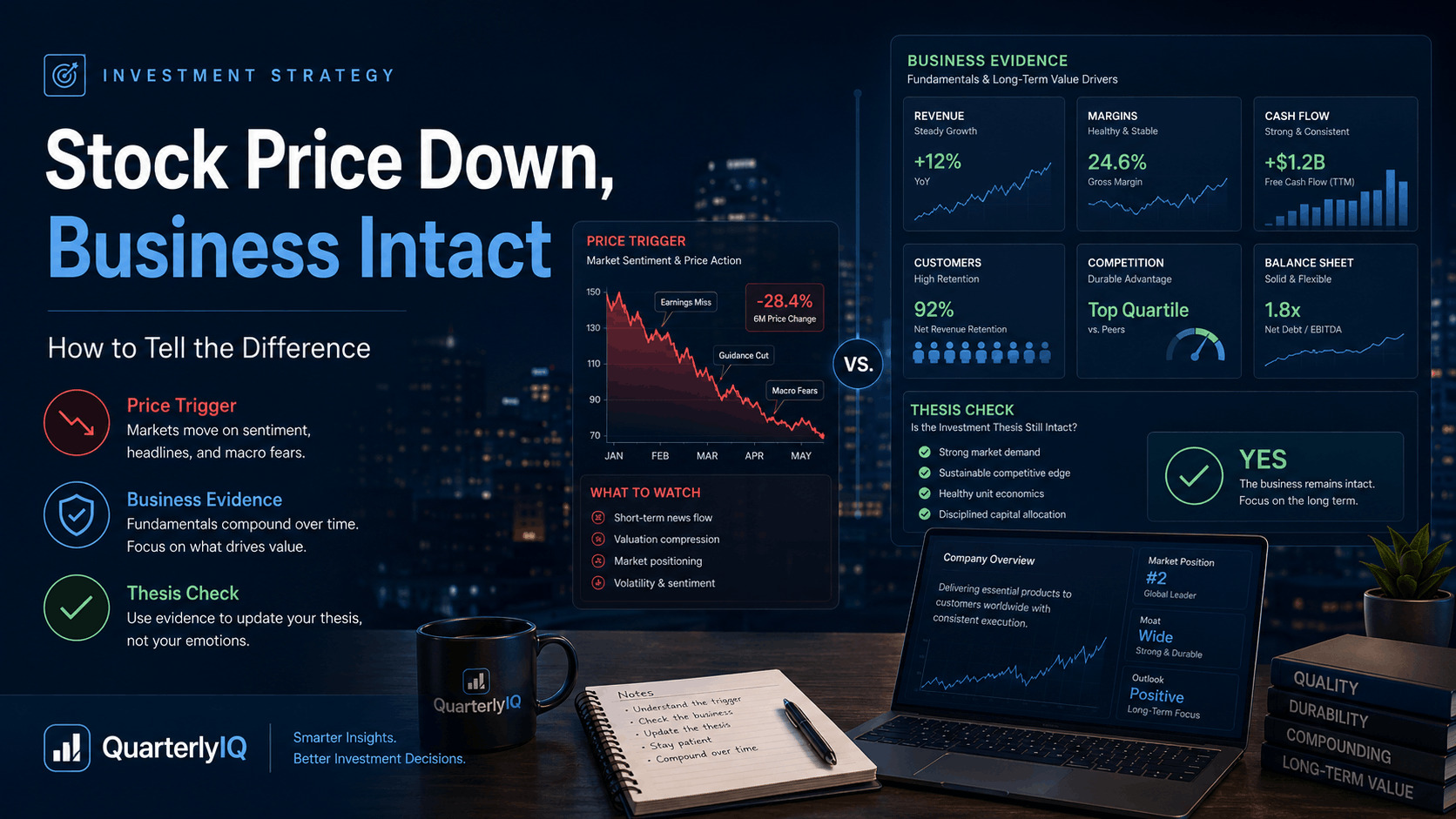
Watching a stock you own fall can feel deeply personal.
Even when you understand that markets move every day, a sharp decline can make you question your research, your judgment, and the reasons you invested in the first place.
Sometimes that concern is justified.
Other times, the share price is reacting to expectations, sentiment, interest rates, positioning, or a temporary disappointment while the underlying business remains broadly healthy.
The challenge is separating those two situations.
A falling price tells you that buyers and sellers are reassessing the stock. It does not tell you, by itself, whether the company’s competitive position, financial strength, or long-term opportunity has changed.
To understand that, you need to return to the business.
Price and business performance are connected, but they are not the same thing
A stock price reflects what investors are willing to pay for a company’s future results.
That means the price is influenced by more than the company’s current performance.
It may react to:
- Expectations that were already built into the valuation
- Changes in interest rates
- Broad market fear
- Sector rotation
- Forced selling
- Analyst revisions
- Investor positioning
- Short-term guidance
- A change in the amount of risk investors are willing to accept
The business itself moves on a different schedule.
Revenue develops over quarters. Customer relationships take time to strengthen or weaken. Competitive advantages can erode gradually. New products may require years to prove themselves.
This is why the stock and the company can appear to move in opposite directions for a while.
A healthy company can experience a falling share price.
A weakening company can experience a rising one.
The price is important, but it needs context.
Start with the reason you own the company
Before studying the decline, return to your investment thesis.
What did you originally expect from the company?
Perhaps you believed:
- Revenue would continue growing
- Margins would improve as the company scaled
- Customers would remain loyal
- A new product would expand the market opportunity
- Management would allocate capital effectively
- The company’s competitive advantage would remain durable
- Cash flow would strengthen over time
Those expectations create the standard against which new information should be judged.
The issue is not simply that the stock fell.
The issue is whether the evidence supporting those expectations has changed.
A clear thesis makes that review much easier.
Without one, every price move can feel like a new story.
Find out what triggered the decline
Begin by identifying why the market appears to be reacting.
The cause may be company-specific, industry-wide, or market-wide.
Common triggers include:
- An earnings miss
- Lower guidance
- Slower revenue growth
- Weaker margins
- An analyst downgrade
- A competitor’s announcement
- Regulatory news
- A broader sector selloff
- Rising interest rates
- A general market correction
The trigger matters because different events carry different implications.
A stock falling because an entire sector is being repriced is not the same as a stock falling because its largest customer left.
A stock falling after strong earnings may indicate that expectations were even higher.
A stock falling after weak guidance may point to a more meaningful change in the company’s outlook.
Understanding the trigger gives you a place to begin. It does not complete the analysis.
Ask whether the business evidence changed
Once you understand the immediate cause, review the company’s operating evidence.
Focus on the parts of the business that support the investment thesis.
Revenue growth
Is revenue still growing at a pace consistent with the original case?
One quarter of slower growth may reflect timing, seasonality, or a difficult comparison.
Several quarters of deceleration may deserve more attention.
Look beneath the headline number:
- Is customer growth still healthy?
- Are existing customers spending more?
- Is pricing supporting growth?
- Are order volumes changing?
- Is backlog strengthening or weakening?
- Is growth concentrated in one product or customer?
- Are acquisitions masking weakness in the core business?
A company may still report revenue growth even as the quality of that growth begins to deteriorate.
Profit margins
Are margins developing as expected?
A temporary decline may reflect investment in a product launch, manufacturing expansion, or customer acquisition.
Persistent pressure can suggest something more structural.
Review:
- Gross margin
- Operating margin
- Cost growth
- Pricing power
- Product mix
- Sales incentives
- Management’s explanation
- The expected timing of any recovery
The central issue is whether the margin change fits the company’s strategy or challenges it.
Cash flow
Reported earnings do not always tell the full story.
A business can show accounting profits while cash generation weakens.
Look at:
- Operating cash flow
- Free cash flow
- Capital spending
- Working capital
- Stock-based compensation
- Debt payments
- Cash reserves
Healthy cash generation gives a company more flexibility to invest, manage setbacks, and avoid expensive financing.
Weakening cash flow can make a temporary operating problem more difficult to absorb.
Customer behavior
Customers often reveal changes before they become obvious in reported earnings.
Watch for:
- Lower retention
- Reduced order sizes
- Slower renewals
- Longer sales cycles
- Increased discounting
- Customer concentration
- Higher acquisition costs
- Fewer new customers
- Lower usage or engagement
If customers continue renewing, expanding, and adopting new products, the underlying business may remain healthier than the stock price suggests.
If customers are leaving or spending less, the decline may be reflecting a genuine concern.
Competitive position
A company’s advantage can remain intact even during a weak quarter.
It can also begin eroding while headline results still look acceptable.
Consider:
- Market-share changes
- Competitor pricing
- Product quality
- Switching costs
- Brand strength
- Distribution reach
- Technology leadership
- Customer satisfaction
- New entrants
The business may remain intact when the company is still winning customers, maintaining pricing power, and protecting its position.
The thesis deserves closer attention when competitors are consistently gaining ground.
Separate a missed expectation from a broken business
Stocks often fall after earnings even when the company reports growth and profitability.
This can happen because markets react to the difference between results and expectations.
Imagine a company reports strong revenue growth, but investors expected even more.
The business may still be performing well. The stock can fall because the valuation had already assumed an exceptional outcome.
This distinction matters.
An expectations miss means the company delivered less than the market anticipated.
A business deterioration means the company’s operating strength, competitive position, or financial quality has materially weakened.
Sometimes both occur together.
Sometimes only the first occurs.
Review what changed in:
- Actual business performance
- Management guidance
- Analyst estimates
- Valuation
- Investor expectations
A decline caused by excessive expectations may not change the long-term thesis.
It may still change how much investors are willing to pay for the business.
Compare the company with its peers
Context can help reveal whether the problem is broad or company-specific.
Compare the company with businesses exposed to similar customers, products, and economic conditions.
Ask:
- Are competitors also slowing?
- Are competitors maintaining margins?
- Is the entire industry experiencing weaker demand?
- Is the company gaining or losing market share?
- Are peers raising guidance while this company lowers it?
- Are sector valuations falling together?
If most companies in the industry are experiencing similar pressure, the business may be dealing with a shared cycle.
If competitors are performing well while one company struggles, the issue may be more specific.
Broad conditions provide context, but they should not become a permanent excuse for weak execution.
Look at the direction of estimates
Analyst estimates are not always accurate, but their direction can show how expectations are changing.
Pay attention to whether revenue, earnings, and cash flow estimates are:
- Holding steady
- Moving higher
- Being reduced once
- Being reduced repeatedly
A stock may fall while future estimates remain stable. That can suggest the decline is being driven more by valuation or sentiment.
A stock may also fall while estimates continue moving lower. That may indicate the market is adjusting to a weaker business outlook.
The number of upward and downward revisions can be helpful, especially when the trend continues across several periods.
Estimates should support your analysis, not replace it.
Listen carefully to management
Management’s response can be as important as the disappointing result.
A credible response usually includes:
- A clear explanation of what happened
- Specific evidence
- Recognition of the problem
- A realistic plan
- Measurable next steps
- Consistency with earlier communication
Be more cautious when management:
- Changes the subject
- Introduces new metrics without explaining old ones
- Blames external conditions that competitors handled better
- Repeats temporary explanations quarter after quarter
- Lowers expectations without acknowledging prior commitments
- Focuses heavily on adjusted results while cash flow weakens
The question is not whether management sounds confident.
It is whether the explanation matches the evidence.
Decide whether the issue is temporary or structural
Temporary problems can be painful without changing the long-term case.
Examples may include:
- A delayed shipment
- A short-term inventory adjustment
- A temporary cost increase
- Foreign exchange pressure
- A customer purchase moving into the next quarter
- A planned period of heavy investment
Structural problems affect the company’s ability to deliver over a longer period.
Examples may include:
- A lasting loss of market share
- Lower customer retention
- Reduced pricing power
- Technological disruption
- A permanently smaller market opportunity
- An unsustainable balance sheet
- Repeated management failures
- A business model becoming less profitable
A useful test is to ask what would need to happen for the problem to resolve.
If the answer depends on a normal business cycle, a known delivery date, or a measurable cost reduction, the issue may be temporary.
If the answer depends on competitors disappearing, customers returning without evidence, or management suddenly executing differently, the concern may be more structural.
Watch for confirmation over time
You do not need to reach a final conclusion immediately.
Sometimes the available evidence is mixed.
That is where monitoring becomes useful.
Write down what would support the thesis:
- Revenue growth stabilizes
- Customer retention remains healthy
- Margins recover
- Guidance holds
- Cash flow improves
- Competitors do not gain further ground
Also write down what would weaken it:
- Growth slows again
- Guidance falls further
- Customer losses continue
- Margins remain depressed
- Estimates are reduced again
- Management misses another commitment
This creates a clear set of conditions to follow.
You are no longer reacting to the stock price alone. You are waiting for the business to provide more evidence.
Consider what the valuation was expecting
A stock can fall even when the business remains intact because the previous valuation was too demanding.
The company may still be growing, profitable, and competitively strong.
Investors may simply decide they are no longer willing to pay the same multiple.
Review:
- The current valuation
- The valuation before the decline
- Historical valuation ranges
- Peer valuations
- Growth expectations
- Interest-rate conditions
- The amount of optimism previously reflected in the price
A falling valuation does not necessarily mean the business weakened.
It may mean the market is assigning a lower price to the same level of earnings or growth.
This distinction is especially important for companies with high expectations.
The business can remain healthy while the stock adjusts to a more realistic valuation.
Be aware of your emotional response
Price declines can create urgency even when the facts remain incomplete.
That pressure can lead investors to:
- Search only for negative information
- Defend the company without reviewing the evidence
- Focus on the purchase price
- Assume a recovery is owed
- Treat every decline as an opportunity
- Treat every decline as proof of failure
Your purchase price is emotionally important to you.
It is not important to the business.
Try to review the company as it exists today.
A helpful question is:
If I did not already own this stock, what would the current evidence tell me about the business?
This can reduce the influence of regret, fear, and attachment.
A practical review checklist
When a stock falls, work through these questions:
- What triggered the decline?
- Was the trigger company-specific or broad?
- Did revenue, margins, or cash flow materially change?
- Are customers behaving differently?
- Has the competitive position weakened?
- Did management change guidance?
- Are analysts reducing future estimates?
- Is the balance sheet still healthy?
- Was the previous valuation unusually demanding?
- Which part of the original thesis is affected?
- Is the concern isolated or persistent?
- What evidence should be watched next?
The checklist will not produce a perfect answer.
It can keep the review grounded in evidence rather than emotion.
Three possible conclusions
After reviewing the company, you may arrive at one of three broad conclusions.
The business remains broadly intact
The price declined, but the main drivers of the thesis remain in place.
Growth, customer behavior, competitive position, cash flow, and management execution are still broadly consistent with the original case.
The decline may reflect valuation, expectations, sentiment, or a temporary issue.
The business deserves closer monitoring
Some evidence has weakened, but the conclusion is not yet clear.
One or more assumptions are under pressure. Further results, guidance, or customer evidence may help determine whether the issue is temporary.
The business has materially weakened
Several central assumptions have deteriorated.
Growth, margins, customers, competition, management execution, or financial strength no longer resemble the original thesis.
These descriptions organize the evidence.
They are not automatic instructions to buy, hold, or sell.
Why this is difficult across a portfolio
Reviewing one decline carefully is manageable.
Repeating the process across many holdings is much more demanding.
Each company has different drivers, risks, reporting schedules, competitors, and valuation expectations.
That is why investors often rely heavily on price alerts.
A price alert tells you something moved.
It does not tell you what changed inside the business.
How QuarterlyIQ approaches the difference
QuarterlyIQ helps investors follow the companies they own and research by organizing the evidence behind the price.
For covered stocks, we focus on questions such as:
- What changed?
- Was it company-specific or market-wide?
- Does it affect the original investment thesis?
- Are the company’s fundamentals still developing as expected?
- Are estimates and expectations changing?
- What evidence should be watched next?
The goal is not to predict the next price movement.
It is to make it easier to see whether the business is still behaving like the company you originally chose to own.
Explore the QuarterlyIQ stock research section to review covered companies.
The takeaway
A falling stock price deserves attention.
It does not deserve an automatic conclusion.
Return to the investment thesis.
Review growth, margins, cash flow, customers, competition, guidance, estimates, and valuation.
Look for persistence and confirmation.
A business can remain healthy while its stock falls because expectations were too high or market conditions changed.
A business can also weaken before the full problem appears in the financial statements.
The difference becomes clearer when you follow the evidence behind the price.
For more on building that foundation, read What Is an Investment Thesis? A Simple Framework for Investors.
To recognize when several small concerns begin forming a larger pattern, see How to Know When an Investment Thesis Is Weakening.
For the valuation side of the question, read How to Tell if a Stock Is Overvalued Without One Magic Ratio.
For informational purposes only. Not investment advice. QuarterlyIQ provides descriptive, rules-based analysis of company fundamentals and does not recommend buying or selling any security.