

What Is an Investment Thesis? A Simple Framework for Investors
Most of us can remember the name of a stock we own. We can usually remember what the share price has done, too.
It is surprisingly easy to lose track of the reason we bought it.
Maybe the company was growing quickly. Maybe it had a product customers loved, an unusually strong competitive position, or a management team with a history of delivering. Over time, those original reasons can blur together with headlines, market moves, and opinions from other investors.
An investment thesis helps keep the story clear.
It gives you a written explanation of why you believe a company may become more valuable, what needs to happen for that belief to hold up, and what evidence would cause you to reconsider it.
You do not need a complicated financial model or a twenty-page research report. A useful investment thesis can often fit into a short paragraph.
What is an investment thesis?
An investment thesis is a clear, evidence-based statement explaining why you believe an investment may be worthwhile.
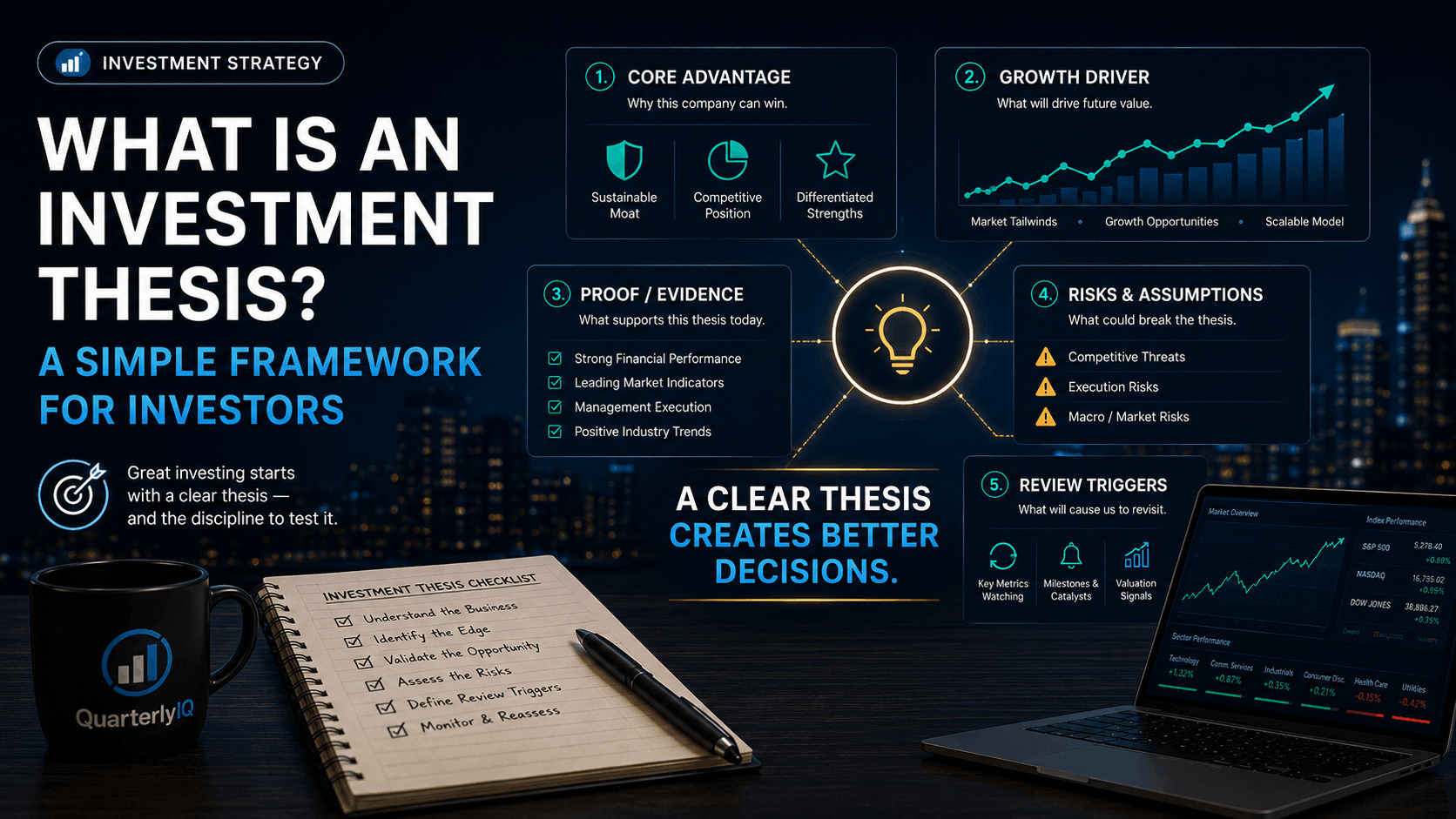
For an individual company, it usually answers five questions:
- What does the company do especially well?
- What is expected to drive future growth or profitability?
- Why might the company be able to sustain an advantage?
- What assumptions need to remain true?
- What evidence would weaken the original case?
A simple thesis might sound like this:
I own this company because it has a strong position in a growing market, recurring customer demand, and an opportunity to improve profitability as it scales. I expect revenue and cash flow to grow over the next several years. I would revisit the thesis if customer growth slows materially, margins fail to improve, or competitors begin taking meaningful market share.
That statement does not predict a stock price. It describes the business case and the evidence that matters.
Why an investment thesis matters
Without a written thesis, it is easy to react to whatever happened most recently.
A stock falls after earnings, and fear takes over.
A stock rises sharply, and confidence turns into certainty.
A well-defined thesis gives you something more stable to evaluate. It creates a reference point between the company you originally believed you were investing in and the company that exists today.
It can help you avoid several common mistakes:
- Reacting to every price move
- Holding simply because a stock has already risen
- Refusing to reconsider a company because you feel attached to it
- Changing your reasoning after the facts change
- Confusing a popular product with a strong investment
- Forgetting which assumptions were already reflected in the price
The thesis does not make the decision for you. It keeps the decision connected to evidence.
A good company is not automatically a good investment
An investment thesis needs to cover more than whether you like the business.
A company can have excellent products, loyal customers, and impressive leadership while its stock price already assumes years of near-perfect execution.
The opposite can also happen. A business may be facing obvious challenges, but the stock price may already reflect a very pessimistic outcome.
This is why a complete thesis should consider both:
- The quality and direction of the business
- The expectations already reflected in the valuation
A strong business thesis with no view of valuation is incomplete. A valuation thesis with no understanding of the business is equally fragile.
The five parts of a useful investment thesis
1. The company’s core advantage
Begin with what the company does unusually well.
This might include:
- A trusted brand
- Proprietary technology
- Network effects
- Low production costs
- High switching costs
- Regulatory advantages
- Distribution strength
- A large installed customer base
- Specialized knowledge or intellectual property
Try to be specific.
“People like the company” is not enough.
“The company’s software is deeply integrated into customer operations, making it costly and disruptive to switch providers” is much more useful.
The advantage should explain why customers choose the company and why competitors may struggle to take that business away.
2. The expected growth or profit driver
Next, identify what you expect to create value.
Possible drivers include:
- More customers
- Higher customer spending
- New products
- Expansion into new markets
- Improved pricing
- Greater operating efficiency
- Rising profit margins
- Recurring revenue
- Lower debt
- Better use of capital
A thesis becomes easier to monitor when the expected driver is clear.
If your thesis depends on international expansion, you can follow international revenue, customer adoption, and operating costs.
If it depends on margin improvement, you can monitor gross margin, operating expenses, and cash generation.
Vague expectations are difficult to test. Specific drivers give you evidence to follow.
3. The proof already visible in the business
A thesis should be based on more than what might happen.
Look for evidence that the company is already moving in the expected direction.
That evidence may include:
- Consistent revenue growth
- Improving customer retention
- Expanding margins
- Rising free cash flow
- Market-share gains
- Strong demand for a new product
- Growing order backlogs
- Improving returns on invested capital
- Management meeting prior commitments
The strongest theses usually combine a future opportunity with evidence that the company is already capable of pursuing it.
Hope is not evidence. A plan becomes more credible when progress is visible.
4. The assumptions and risks
Every thesis depends on assumptions.
The market may continue growing. Customers may keep buying. Competitors may remain behind. Management may execute well. Costs may stay under control.
Writing those assumptions down makes the thesis more honest.
Common risks include:
- Slower demand
- Stronger competition
- Customer concentration
- Regulatory changes
- Product delays
- Rising costs
- Excessive debt
- Share dilution
- Management turnover
- Technological disruption
- A valuation that leaves little room for disappointment
The goal is not to list every possible thing that could go wrong. Focus on the risks that would directly challenge the reason you own the company.
A useful test is:
Which two or three developments would most seriously damage this investment case?
Those deserve your attention.
5. The evidence that would cause a fresh review
This is the part many investors leave out.
A thesis should include conditions that would cause you to revisit it.
Examples might include:
- Revenue growth falls below the level needed to support the strategy
- Margins deteriorate for several quarters
- A major customer leaves
- Management repeatedly misses its own guidance
- A key product launch is delayed or poorly received
- Competitors begin gaining meaningful market share
- Debt rises faster than cash generation
- The valuation increases while business expectations weaken
These are not automatic instructions to act. They are signals that the original reasoning deserves another look.
It is much easier to review a company calmly when you decided in advance which evidence would matter.
What an investment thesis is not
It is not a price target
A price target is an estimate of what a stock may be worth under a set of assumptions.
A thesis explains the business reasoning behind those assumptions.
The target may change as interest rates, estimates, and market conditions change. The thesis should remain focused on the underlying drivers and evidence.
It is not a company description
“Company X makes electric vehicles” describes the business.
It does not explain why that business may create more value, what advantage it has, or what could weaken the case.
It is not a slogan
“This company is the future of AI” may sound exciting, but it is not testable.
A useful thesis identifies what the company must deliver, how progress will be measured, and where the risks sit.
It is not a permanent belief
A thesis is meant to be tested.
Changing your view when the evidence changes is not a failure. Continuing to repeat an old story after the facts have moved is far more dangerous.
It is not a prediction of the next price move
A company can report strong business results while its stock falls because investors expected even more.
A company can struggle operationally while its stock rises because expectations were already very low.
The thesis helps you evaluate the business and its valuation. It cannot tell you exactly what the market will do next.
How to write an investment thesis in five sentences
You can use this template for any company:
I am interested in this company because [describe its main advantage or opportunity].
I expect its results to improve because [identify the main growth or profitability drivers].
The evidence supporting this view includes [list the strongest current proof].
The most important risks are [identify the risks that could challenge the case].
I would take a fresh look if [describe the evidence that would materially weaken the original reasoning].
Here is a generic example:
I am interested in this company because its product is deeply embedded in customer operations and produces recurring revenue. I expect growth to continue as existing customers use more of the platform and new customers adopt additional products. The evidence includes strong retention, rising revenue per customer, and improving free cash flow. The main risks are increasing competition, slower customer spending, and a valuation that assumes continued rapid growth. I would take a fresh look if retention weakens, growth slows for several quarters, or cash generation fails to improve.
This is brief enough to remember and specific enough to monitor.
How often should you review your thesis?
A thesis does not need to be rewritten every time the stock price moves.
It should be reviewed when meaningful evidence arrives, including:
- Quarterly earnings
- Changes in management guidance
- Major product announcements
- Acquisitions or divestitures
- Regulatory developments
- Significant changes in competition
- Material estimate revisions
- Changes in debt or capital allocation
- A large shift in valuation
A regular quarterly review is a practical starting point for many investors.
Between earnings reports, focus on developments that affect the assumptions behind the thesis. Most daily headlines will not meet that standard.
How to tell whether the thesis is still intact
When new information arrives, compare it with the original case.
Ask:
- Is the company’s main advantage still present?
- Are the expected growth drivers developing?
- Is the supporting evidence becoming stronger or weaker?
- Have any important risks become more likely?
- Is management delivering on prior commitments?
- Has the valuation become more demanding?
- Do the original assumptions still make sense?
The answer may not be completely positive or negative.
Sometimes the evidence remains broadly supportive.
Sometimes one or two conditions deserve closer attention.
Sometimes several central assumptions begin weakening at once.
The purpose of monitoring is not to force every company into an immediate decision. It is to notice when the character of the investment begins to change.
Why monitoring becomes difficult across a portfolio
Writing a thesis for one company is manageable.
Keeping it current across 10, 20, or 40 holdings requires much more work.
Each company releases earnings, revises guidance, faces new competitors, changes strategy, and responds differently to economic conditions. The information arrives at different times and in different formats.
Investors often fall back on price alerts because price is easy to track.
Price can tell you that the market is reacting. It cannot tell you whether the company’s underlying thesis has strengthened, weakened, or remained largely unchanged.
That requires following the business evidence.
How QuarterlyIQ supports thesis monitoring
QuarterlyIQ is built to help investors follow the companies they already own or are researching.
For covered stocks, we organize the evidence around questions such as:
- What changed?
- Why might it matter?
- Is recent performance still consistent with the investment case?
- Which conditions deserve closer attention?
- What should be watched next?
The goal is not to issue a buy, hold, or sell recommendation.
It is to make the underlying changes easier to see, so investors can keep their decisions connected to the reasons they own each company.
You can explore the research available for covered companies in the QuarterlyIQ stock research section.
A thesis should become clearer over time
A useful investment thesis is not judged by how confident it sounds.
It is judged by whether it helps you understand the company, follow the relevant evidence, and recognize when your original assumptions need to be reconsidered.
Keep it short enough to revisit.
Make it specific enough to test.
Write down the risks while you are still thinking calmly.
Then let the business results, not the daily price chart, show you whether the original case is holding up.
For a related discussion, read When Should You Sell a Stock? A Thesis-First Framework.
You may also find How to Tell if a Stock Is Overvalued Without One Magic Ratio helpful when adding valuation expectations to your thesis.
For informational purposes only. Not investment advice. QuarterlyIQ provides descriptive, rules-based analysis of company fundamentals and does not recommend buying or selling any security.