QuarterlyIQ vs. Seeking Alpha: Which Is Better for Portfolio Monitoring and Stock Research?
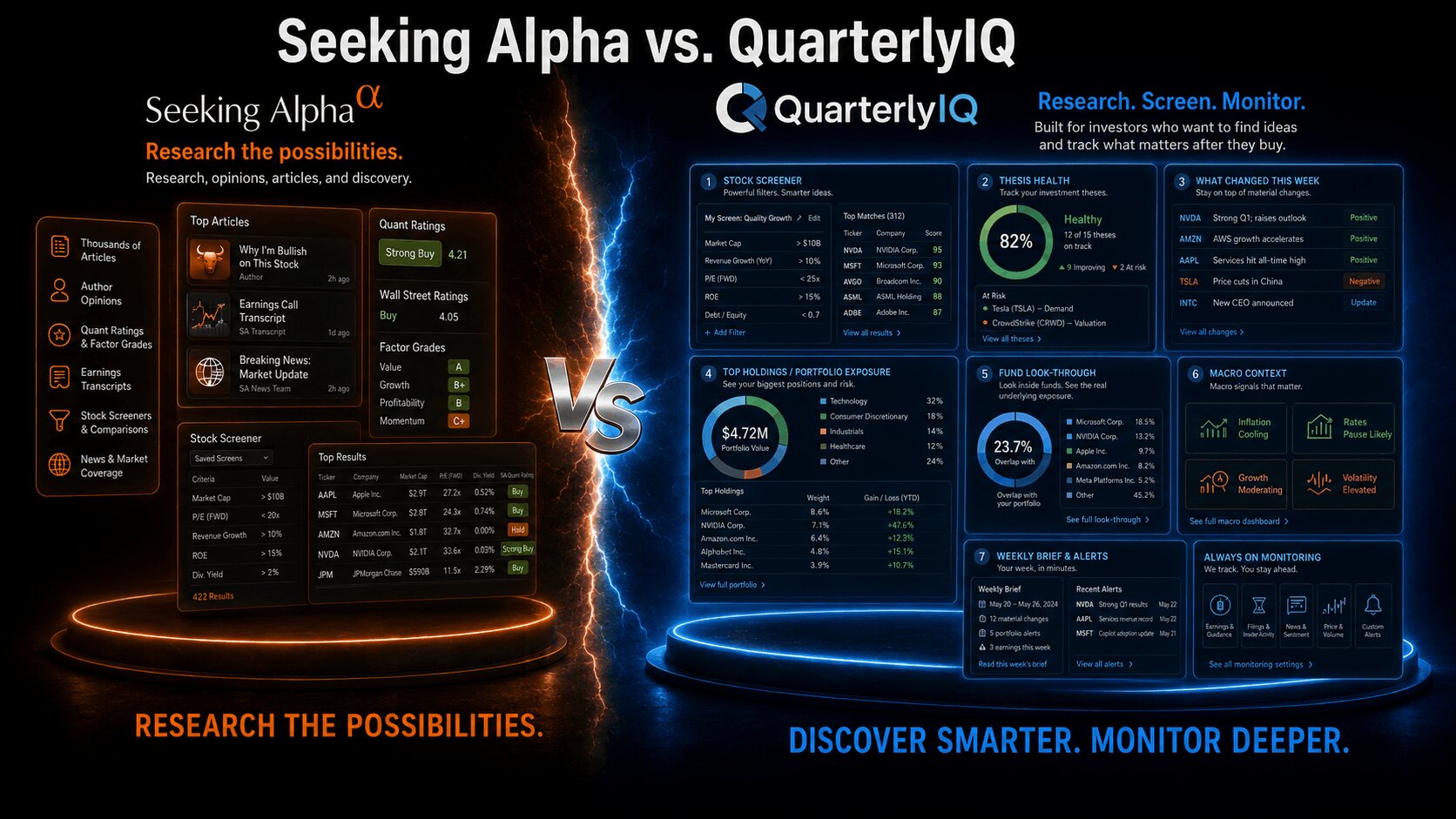
The most dangerous change in a portfolio is often not the one that makes headlines. It is the one that quietly weakens the reason you own a company while its stock price, analyst ratings, and news coverage distract you from what is happening underneath.
That is where the difference between QuarterlyIQ and Seeking Alpha becomes important.
Seeking Alpha is built to help investors discover, compare, rate, and debate investment ideas. It surrounds stocks with articles, Quant Ratings, screeners, earnings-call transcripts, analyst opinions, financial data, news, and community discussion.
QuarterlyIQ is built to help investors discover opportunities, research companies, and continue monitoring them after they enter the portfolio. It combines an extensive stock screener, structured company Reports, investment thesis monitoring, portfolio analysis, fund look-through, macroeconomic context, Weekly Briefs, and alerts.
Both platforms can help investors research securities and follow their holdings. The difference is how they organize the investing process.
Seeking Alpha helps investors find, rate, and debate investment ideas. QuarterlyIQ helps investors find companies through business evidence, understand what they own, identify what changed, and determine whether the reasons behind their investments still hold.
For investors who primarily want a large library of opinions, transcripts, conventional ratings, and community-driven stock ideas, Seeking Alpha remains a strong platform.
For self-directed investors who want idea discovery, company research, and portfolio monitoring connected through one consistent analytical system, we believe QuarterlyIQ is the stronger overall choice.
QuarterlyIQ vs. Seeking Alpha at a glance
| Capability | QuarterlyIQ | Seeking Alpha | Stronger choice |
|---|---|---|---|
| Primary purpose | Stock discovery, company research, portfolio intelligence, and ongoing investment monitoring | Investment content, ratings, quantitative research, and idea discovery | QuarterlyIQ for a connected ownership workflow |
| Company research | One consistent Report covering thesis, condition, growth, quality, management, valuation, risk, and macro context | Financial data, Quant analysis, contributor articles, analyst ratings, and AI summaries | QuarterlyIQ for one coherent read |
| Contributor opinions | Not a central part of the product | Large contributor and analyst network | Seeking Alpha |
| Monitoring after purchase | Thesis states, material changes, upcoming events, portfolio impact, and what to watch | News, ratings, grades, articles, earnings, and alerts | QuarterlyIQ |
| Brokerage connections | Supported through SnapTrade | Supported for eligible Premium and PRO accounts | Both |
| Multi-portfolio analysis | Book-level value, performance, concentration, risk, thesis health, fund exposure, and attention items | Holdings, ratings, grades, performance, warnings, and portfolio health | QuarterlyIQ |
| ETF and fund look-through | Direct and indirect company exposure with available company research and thesis states | ETF ratings, grades, screens, holdings, and articles | QuarterlyIQ for ownership look-through |
| Investment thesis monitoring | Explicit thesis condition and supporting evidence | Strong Buy through Strong Sell ratings | QuarterlyIQ |
| Earnings-call transcripts | Used as company research inputs | Large searchable transcript library | Seeking Alpha |
| Stock screening and idea discovery | Extensive screening by company condition, growth, quality, management, valuation, risk, thesis, cycle, macro sensitivity, and price versus fair value | Extensive screening by Quant Ratings, Factor Grades, analyst ratings, revisions, dividends, and market data | Different strengths |
| Portfolio prioritization | Weekly Brief and holdings that need attention | Portfolio alerts, rating changes, headlines, and health indicators | QuarterlyIQ |
| Mobile experience | Primarily web based | Established iOS and Android applications | Seeking Alpha |
| Dividend research | Company context and portfolio income calendar | Dividend Yield, Consistency, Safety, and Growth Grades | Different strengths |
| Macro context | Connected to sectors and holdings in the portfolio | Broad macroeconomic articles and commentary | QuarterlyIQ for portfolio relevance |
| Research philosophy | Evidence, separate business dimensions, and thesis condition | Ratings, opinions, quantitative rankings, and recommendations | QuarterlyIQ for investors making their own decisions |
QuarterlyIQ covers thousands of US stocks and supported funds. Covered companies are reanalyzed after each market close, and the same research framework flows through the company Reports, stock screener, portfolio analysis, fund exposure, and Weekly Brief.
Seeking Alpha Premium also provides research across thousands of stocks and ETFs, together with articles, transcripts, Quant Ratings, screeners, AI research tools, portfolio syncing, and related features.
QuarterlyIQ is not only a portfolio monitor
It is easy to describe QuarterlyIQ primarily as a portfolio-monitoring platform because that is one of its strongest points of differentiation.
That description is incomplete.
QuarterlyIQ also includes an extensive stock screener designed to help investors find companies based on the same business characteristics that drive its company Reports.
Investors can filter companies using:
- Business condition
- Growth
- Quality
- Management performance
- Valuation
- Risk
- Thesis state
- Sector
- Market capitalization
- Business-cycle position
- Price relative to fair value
- Macroeconomic sensitivity
- Signs that company conditions are rolling over
The screener also provides curated idea groups such as:
Robust Condition
Companies showing stronger overall business fundamentals.
Deep Discount to Fair Value
Companies trading meaningfully below QuarterlyIQ’s estimate of fair value.
Cheap and Up-Cycle
Companies trading below fair value while conditions in their sub-industry cycle appear to be improving.
Quality Compounders
Higher-quality companies that continue to grow.
Rolling Over
Companies whose recent conditions appear to be weakening.
Under Pressure
Companies showing fragile or impaired business conditions.
This gives investors several ways to begin.
They can start with a broad investment idea, such as finding high-quality companies at reasonable valuations, or build a more precise screen combining quality, management, risk, valuation, thesis health, and industry-cycle conditions.
That makes QuarterlyIQ’s screening process more than a basic financial-ratio filter.
It is a direct extension of the research system.
A company found in the screener can be opened into a complete Report using the same definitions and evidence. If the company later enters a portfolio, the same research follows it into the portfolio-monitoring workflow.
The most important difference appears after you buy
Many investment platforms are organized around the decision to buy.
They help investors search for stocks, compare metrics, review ratings, read bullish and bearish arguments, and decide whether an opportunity looks attractive.
Seeking Alpha is particularly strong at that stage.
Its Premium stock research can include:
- Quant Ratings
- Seeking Alpha author ratings
- Wall Street ratings
- Factor Grades
- Financial statements
- Earnings estimates and revisions
- News and analysis
- Earnings-call transcripts
- Dividend information
- Screening and comparison tools
Seeking Alpha’s Quant Ratings evaluate stocks using more than 100 metrics. Stocks receive Factor Grades for Value, Growth, Profitability, Momentum, and EPS Revisions, followed by a rating from Strong Sell to Strong Buy.
That is useful for identifying and comparing potential investments.
But owning a stock creates a different set of questions:
- What changed after the original decision?
- Is the business still performing?
- Is management executing?
- Are earnings supporting the thesis?
- Are expectations becoming too demanding?
- Is the latest price movement market noise, or did the company actually weaken?
- Which holding deserves attention now?
- What should be monitored before the next earnings report?
QuarterlyIQ is built around those ownership questions.
Every covered company receives a structured Report that separates the business thesis, condition, growth, quality, management performance, valuation, risk, financials, earnings, industry conditions, material events, and macro sensitivity.
You can see this structure in a public QuarterlyIQ company Report. Conclusions about company quality, business growth, management execution, valuation, risk, market expectations, and thesis condition remain separate rather than being compressed into one recommendation.
For investors managing an existing portfolio, we believe that structure is more useful than receiving another blended rating or additional stream of opinions.
Ratings are useful, but they are not thesis monitoring
Seeking Alpha prominently presents three stock-rating perspectives:
- Quant Rating
- Seeking Alpha Authors rating
- Wall Street or Sell-Side rating
This gives investors several ways to evaluate the same stock.
It can also create a reconciliation problem.
A stock may receive a bullish Quant Rating, a more cautious Wall Street rating, and a bearish contributor article. Those conclusions are not necessarily mistakes. They may reflect different assumptions, methods, time horizons, or definitions of risk.
The investor still has to determine:
- Why do the conclusions disagree?
- Which evidence matters most?
- Is the disagreement about company quality, valuation, momentum, or timing?
- Has anything changed inside the business?
- Does the new evidence affect the original reason for owning the stock?
Seeking Alpha exposes its ratings and Factor Grades clearly, but the investor is responsible for deciding how the conclusions fit together.
QuarterlyIQ approaches the problem differently.
Rather than issuing one overall Buy, Hold, or Sell instruction, QuarterlyIQ evaluates whether the evidence continues to support the investment thesis.
It separates:
- Business condition from stock-price momentum
- Company quality from valuation
- Management execution from market sentiment
- Recent growth from long-term durability
- Fundamental risk from temporary price volatility
QuarterlyIQ uses thesis states such as:
Intact
The current evidence continues to support the reason for owning the company.
Watch
Something meaningful has weakened or become less certain. The thesis has not necessarily failed, but the company deserves closer review.
Broken
The evidence behind the original reason for owning the company has materially deteriorated.
These states are not price predictions or trading instructions.
A stock can remain Intact after its price falls when the business evidence remains sound. A stock can move to Watch while its price rises when execution, earnings quality, valuation support, or another important thesis condition deteriorates.
QuarterlyIQ’s research process evaluates these business dimensions separately and updates the Report as new evidence arrives.
Seeking Alpha tells investors how its Quant model, contributors, and Wall Street analysts rate a stock.
QuarterlyIQ focuses on whether the evidence behind owning it has changed.
The two screeners solve different discovery problems
Seeking Alpha’s screener is a substantial part of its value proposition.
It allows investors to find securities through:
- Quant Ratings
- Factor Grades
- Valuation metrics
- Growth measures
- Profitability
- Momentum
- Earnings revisions
- Analyst ratings
- Dividend characteristics
- Market and trading data
This is especially useful for investors who want to rank securities through established quantitative factors or identify stocks that currently score well within Seeking Alpha’s model.
QuarterlyIQ’s screener solves a different problem.
It helps investors search for companies based on how the underlying business is behaving.
An investor can ask:
- Which companies have the strongest business fundamentals?
- Which high-quality companies continue to grow?
- Which companies have strong management but weak valuations?
- Which companies are trading below fair value while their business cycle improves?
- Which businesses appear fragile despite attractive prices?
- Which companies are beginning to roll over?
- Which stocks have intact theses but elevated risk?
- Which companies are expensive relative to QuarterlyIQ’s fair-value analysis?
- Which businesses are exposed to unfavorable macro conditions?
Seeking Alpha is stronger when the investor wants conventional quantitative rankings, ratings, analyst signals, and a large ecosystem of idea-oriented content.
QuarterlyIQ is stronger when the investor wants to combine business condition, quality, management, valuation, risk, thesis health, macro sensitivity, and cycle position in one search.
Neither platform has a lightweight screener.
They simply emphasize different kinds of evidence.
QuarterlyIQ provides stronger portfolio context
Seeking Alpha includes a capable portfolio tracker.
Premium and PRO subscribers can link supported brokerage accounts, consolidate holdings, review cost basis and account values, and see ratings and Factor Grades across positions. Seeking Alpha also provides performance tracking, portfolio warnings, alerts, and a Portfolio Health Score.
QuarterlyIQ approaches the portfolio as more than a container for stock symbols.
Its portfolio analysis can include:
- Total value
- Gains and losses
- Dollar-weighted performance
- Performance relative to the S&P 500
- Portfolio volatility
- Position concentration
- Sector concentration
- Diversification
- Thesis health
- Holdings requiring attention
- Upcoming earnings and events
- Dividend expectations
- Tax and unrealized gain or loss information
- Direct and indirect company exposure
- Macro conditions affecting the portfolio
The QuarterlyIQ portfolio experience brings the same company research used in the screener and company Reports into the investor’s complete book.
That creates a fundamental difference.
Seeking Alpha adds ratings, articles, headlines, warnings, and financial data to the securities in a portfolio.
QuarterlyIQ applies one connected research system across the entire portfolio.
For an investor asking, “What changed across everything I own?” QuarterlyIQ provides the more direct answer.
QuarterlyIQ shows what you are really holding
A brokerage account tells you which securities appear in that account.
It does not necessarily tell you which companies you own across the entire book.
Consider an investor who owns Microsoft directly, holds QQQ in a retirement account, and owns another large-cap fund elsewhere.
At the ticker level, those appear to be separate investments.
Economically, the investor may own Microsoft several times.
QuarterlyIQ looks through supported funds and combines their underlying companies with directly held positions.
It can show:
- Total economic exposure to a company
- The portion held directly
- The portion held through funds
- Which funds create the indirect exposure
- Companies owned both directly and indirectly
- Thesis condition for covered underlying companies
- Fund value resolved into tracked companies
- Remaining foreign equity, bonds, cash, or other exposure
Seeking Alpha provides ETF pages, ETF comparisons, screeners, holdings information, and ETF Factor Grades for Momentum, Expenses, Dividends, Risk, and Liquidity.
Those capabilities are useful for evaluating an ETF as an investment product.
QuarterlyIQ’s advantage is showing how the companies inside supported funds affect the investor’s entire portfolio, including company exposure that overlaps with directly held positions.
For investors combining stocks, ETFs, and mutual funds, this creates a more complete ownership picture.
Company research becomes more valuable when it follows the portfolio
Seeking Alpha offers an enormous amount of research content.
An investor can review contributor analysis, Wall Street ratings, Quant Ratings, financial data, earnings revisions, transcripts, news, valuation metrics, and community discussion.
This breadth is a genuine advantage.
But breadth and continuity are not the same thing.
QuarterlyIQ uses one structured research framework for every covered company. That framework follows the company throughout the product.
The same research can appear in:
- The stock screener
- The company Report
- The investor’s portfolio
- The book-level portfolio overview
- Fund look-through
- The Weekly Brief
- Thesis-change alerts
- Macro and sector context
A company does not become a disconnected ticker after it enters the portfolio.
The research stays attached to the holding.
The platform can continue answering:
- What changed?
- Why does it matter?
- Which part of the business weakened?
- Is valuation still supported?
- What should be watched next?
- Does the evidence still support the thesis?
This creates a connected workflow:
- Find a company using the screener.
- Open the complete Report.
- Review its condition, growth, quality, management, valuation, risk, and thesis.
- Add it to a portfolio.
- Continue monitoring it through Briefs and alerts.
- Understand how it affects the rest of the portfolio.
For investors who already have enough information but need a more disciplined process, we believe this continuity matters more than adding another source of commentary.
QuarterlyIQ separates company quality from stock valuation
A common problem with overall stock ratings is that several different questions become compressed into one conclusion.
A company can be:
- Operationally strong but expensive
- Growing quickly but financially fragile
- Well managed but facing worsening industry conditions
- Cheap because the business is deteriorating
- High quality with demanding expectations already reflected in its price
- Temporarily weak while its long-term thesis remains intact
QuarterlyIQ separates its conclusions across condition, quality, growth, management, valuation, risk, and thesis state.
This separation is also reflected in the stock screener. Investors can filter for a particular combination rather than accepting one overall score as the complete answer.
For example, an investor can search for:
- Strong quality with an attractive valuation
- Expanding growth with moderate risk
- Strong management within an improving business cycle
- A discounted stock whose fundamentals remain fragile
- A high-quality company whose price is far above fair value
- A Watch thesis with strengthening growth
- A business that is rolling over despite a seemingly attractive valuation
QuarterlyIQ also compares valuation using several methods and time horizons while stating clearly that the results are diagnostics, not guaranteed price targets.
Seeking Alpha exposes the components behind its Quant Rating through separate Factor Grades. Those grades are useful for comparing a stock with sector peers.
The difference is how the conclusion is used.
Seeking Alpha’s factors contribute to a conventional directional rating.
QuarterlyIQ keeps the business dimensions visible and connects them to the evidence supporting or challenging the investment thesis.
For investors who want to make their own decisions rather than follow a rating, QuarterlyIQ provides a more inspectable framework.
QuarterlyIQ connects macroeconomic conditions to actual holdings
Macroeconomic information is often presented as a separate stream of inflation releases, Federal Reserve decisions, labor reports, GDP data, and market commentary.
The investor is then expected to determine which developments matter to the portfolio.
QuarterlyIQ connects rates, growth, inflation, and labor conditions to the sectors represented in the investor’s actual holdings. It also allows investors to consider macro sensitivity while screening for companies.
This means macro conditions can influence both parts of the workflow:
- Finding companies whose conditions may benefit from the current environment
- Understanding how economic changes may affect companies already owned
The platform can describe those conditions as potential headwinds, tailwinds, or neutral influences, while making clear that the result is context rather than a return forecast.
Seeking Alpha offers extensive macroeconomic news and contributor commentary. Its strength is the range of interpretations available.
QuarterlyIQ’s strength is relevance.
Rather than treating the economy as a separate news category, QuarterlyIQ connects economic conditions to company characteristics, sector exposure, and the investor’s portfolio.
Both platforms use AI, but they use it differently
Seeking Alpha’s Summary Reports use a language model to compile company descriptions, rating explanations, analyst positives, and analyst concerns from information available through Seeking Alpha.
Seeking Alpha states that its Summary Reports are based on content available on its website, including third-party analysis, its Quant system, and official company information.
QuarterlyIQ uses a controlled research process grounded in SEC filings, earnings-call transcripts, market data, analyst estimates, fund holdings, and government economic data.
The same process supports:
- Company Reports
- Stock screening
- Thesis monitoring
- Portfolio analysis
- Fund look-through
- Weekly Briefs
The distinction is important:
Seeking Alpha’s AI summarizes information and opinions available within Seeking Alpha. QuarterlyIQ’s system evaluates structured evidence and carries the resulting research through stock discovery, company analysis, and portfolio monitoring.
Neither approach removes the need for investor judgment.
QuarterlyIQ’s advantage is continuity. The same analytical framework follows a company from discovery to ownership.
Monitoring should reduce work, not create another feed
The investment industry has become very good at producing information.
It is less effective at helping investors decide what deserves attention.
Seeking Alpha can notify investors about price changes, rating changes, news, earnings, articles, and portfolio developments. It also gives users access to a large stream of analysis and commentary related to followed securities.
That breadth is valuable, but it requires the investor to interpret more inputs.
QuarterlyIQ is designed to filter those inputs into a smaller set of portfolio questions:
- Did a thesis change?
- Which holding weakened?
- What evidence caused the change?
- Is there a material company event?
- Which upcoming earnings report matters?
- Did the portfolio become more concentrated?
- Is a flagged company hidden inside a fund?
- Which macro condition is most relevant?
- What needs attention before the next Brief?
The QuarterlyIQ Weekly Brief summarizes what changed across tracked holdings, which companies need attention, what remains quiet, and what is coming next.
QuarterlyIQ also supports delivered Briefs and Telegram alerts for time-sensitive developments.
The goal is not to make investors check QuarterlyIQ more often.
The goal is to make each check more useful.
Where Seeking Alpha is genuinely stronger
QuarterlyIQ is not the stronger platform in every category.
Contributor opinions and content breadth
Seeking Alpha provides a much larger collection of articles, perspectives, and analyst opinions.
Investors who want to compare many bullish and bearish arguments will find more variety there.
QuarterlyIQ does not attempt to recreate a contributor marketplace.
Earnings-call transcripts
Seeking Alpha Premium includes searchable access to earnings-call and event transcripts.
QuarterlyIQ uses earnings calls as inputs to company Reports, but it is not designed to replace a dedicated transcript archive.
Conventional quantitative rankings
Seeking Alpha’s Quant Ratings and Factor Grades are well suited to investors who want securities ranked according to a single quantitative system.
QuarterlyIQ offers extensive screening, but it does not convert its entire research framework into a Buy, Hold, or Sell leaderboard.
Native mobile applications
Seeking Alpha provides established iOS and Android applications with portfolio views, ratings, Factor Grades, earnings, dividends, performance, ownership, alerts, and other company information.
Investors who require a mature native mobile application may prefer Seeking Alpha.
Dividend security research
Seeking Alpha’s Dividend Grades assess Dividend Yield, Consistency, Safety, and Growth. It also provides dividend histories, payout information, and analyst estimates.
QuarterlyIQ’s dividend advantage is more portfolio oriented. It shows expected dividend income across holdings through a month-by-month payout calendar and connects each dividend payer to the broader company thesis.
Investment communities and specialist subscriptions
Seeking Alpha offers Investing Groups and Alpha Picks in addition to Premium.
These products provide communities, specialist strategies, and model-driven stock selections that QuarterlyIQ does not attempt to reproduce.
Some of these services are separately priced and are not automatically included with Seeking Alpha Premium.
These are meaningful Seeking Alpha advantages.
They address a different primary investor need.
Which platform is better for common investor situations?
Finding new investment ideas
Different strengths
Seeking Alpha is strong for investors seeking Quant-ranked stocks, contributor recommendations, Wall Street ratings, earnings revisions, Top Stocks lists, and large volumes of idea-oriented content.
QuarterlyIQ is strong for investors who want to find ideas through business condition, growth, quality, management execution, valuation, thesis state, risk, sub-industry cycle, macro sensitivity, and price relative to fair value.
For investors who want conventional rankings and many outside opinions, Seeking Alpha may be the better fit.
For investors who want to screen for specific combinations of business strength, valuation, cycle conditions, and thesis health, QuarterlyIQ offers the more differentiated discovery process.
Monitoring 20 individual stocks
Stronger choice: QuarterlyIQ
An investor with 20 positions does not necessarily need 20 more opinions.
The more urgent need is identifying which company weakened, what changed, whether the thesis remains supported, and what deserves attention before the next earnings report.
Seeking Alpha provides useful ratings, news, articles, earnings information, and alerts.
QuarterlyIQ brings company changes, thesis condition, portfolio exposure, upcoming events, and supporting evidence into one monitoring workflow.
Researching an unfamiliar stock
Seeking Alpha for opinion breadth, QuarterlyIQ for analytical structure
Seeking Alpha offers more contributor opinions, transcripts, ratings, historical articles, and community discussion.
QuarterlyIQ offers one consistent Report that separates the business, management, growth, quality, valuation, risk, expectations, and thesis.
QuarterlyIQ also allows the investor to compare that company with others using the same screening dimensions.
The better choice depends on whether the investor wants many perspectives or one structured analytical framework.
Managing stocks and funds across several accounts
Stronger choice: QuarterlyIQ
Both platforms support brokerage-linked portfolios for eligible plans and institutions.
QuarterlyIQ’s advantage is what happens after the accounts are combined. It analyzes book-level concentration, risk, thesis health, direct and indirect company exposure, macro sensitivity, and attention items across the portfolio.
Understanding companies hidden inside ETFs
Stronger choice: QuarterlyIQ
Seeking Alpha is stronger for evaluating an ETF through ratings, Factor Grades, screens, comparisons, and published analysis.
QuarterlyIQ is stronger for looking through supported funds, combining indirect exposure with directly held positions, and attaching available company Reports and thesis states to the underlying businesses.
Finding high-quality companies at reasonable valuations
Stronger choice: QuarterlyIQ
QuarterlyIQ allows investors to combine quality, management, business condition, growth, risk, fair value, cycle position, and thesis state.
This makes it possible to avoid treating “cheap,” “high quality,” or “fast growing” as complete investment arguments by themselves.
Seeking Alpha offers powerful Value, Growth, Profitability, Momentum, and Revisions filters, but QuarterlyIQ’s framework provides more direct visibility into business condition, thesis health, and price relative to its fair-value analysis.
Finding companies that may be deteriorating
Stronger choice: QuarterlyIQ
QuarterlyIQ includes dedicated screening dimensions and curated groups for companies that are Rolling Over or Under Pressure.
Investors can combine those signals with condition, growth, management, valuation, risk, macro sensitivity, and thesis state.
This can support both idea discovery and portfolio risk review.
Managing a portfolio in 30 minutes per week
Stronger choice: QuarterlyIQ
Seeking Alpha’s breadth can be valuable, but reviewing articles, ratings, headlines, transcripts, and competing opinions takes time.
QuarterlyIQ’s Weekly Brief is designed to prioritize what changed across holdings, identify positions needing attention, and show what is coming next.
Building a dividend portfolio
The choice depends on the task
Seeking Alpha is stronger for researching the dividend characteristics of an individual security.
QuarterlyIQ is stronger for viewing expected dividend income across the portfolio and connecting dividend-paying companies to their business condition, valuation, risk, and investment thesis.
Maintaining a passive ETF portfolio
The choice is closer
Seeking Alpha provides broad ETF analysis, ratings, screening, comparison tools, and commentary.
QuarterlyIQ provides greater visibility into the companies collectively owned through supported funds, particularly when those companies are also held directly.
Passive investors choosing among funds may prefer Seeking Alpha. Investors examining what their funds collectively contain may prefer QuarterlyIQ.
Pricing and value
Seeking Alpha Premium currently costs $299 per year, plus applicable taxes. Premium includes articles, transcripts, Quant Ratings, Factor Grades, screeners, Summary Reports, portfolio syncing, and related research tools.
Alpha Picks and Investing Groups are separate offerings.
QuarterlyIQ pricing currently includes:
- Free at $0 per month: one portfolio and five tracked stocks
- Plus at $25 per month or $250 per year: three portfolios, 25 tracked stocks, portfolio import, and delivered Weekly Briefs
- Premium at $39 per month or $390 per year: ten portfolios, more than 100 tracked stocks, portfolio import, and delivered Weekly Briefs
Every QuarterlyIQ plan includes the same underlying company Reports, stock-screening framework, portfolio analysis, fund look-through, and Weekly Brief.
Paid plans primarily increase capacity and add portfolio import and Brief delivery.
QuarterlyIQ Plus and Seeking Alpha Premium are close in annual list price.
The more important question is what the investor is paying to accomplish.
Seeking Alpha provides stronger value when the investor wants:
- A large article library
- Searchable earnings-call transcripts
- Many contributor opinions
- Conventional ratings
- Quantitative rankings
- Community participation
- Native mobile access
QuarterlyIQ provides stronger value when the investor wants:
- Extensive screening based on business condition and thesis evidence
- Company Reports connected to actual holdings
- Investment thesis monitoring
- Multi-portfolio analysis
- Direct and indirect fund exposure
- Portfolio-level attention ranking
- Macro context tied to companies and portfolios
- Weekly summaries of what changed
- A free way to test the research system on a small portfolio
For investors who want one platform to support discovery, research, and ongoing ownership monitoring, we believe QuarterlyIQ delivers more connected value.
Final verdict
Seeking Alpha is one of the strongest platforms for investment content, quantitative ratings, earnings-call transcripts, contributor opinions, and conventional stock discovery.
It gives investors access to a large amount of information and a wide range of perspectives.
But more information does not automatically create better investment awareness.
The investor still needs to answer:
- Which companies fit the characteristics I actually care about?
- Is the business strong, or does the stock merely appear cheap?
- Is management executing?
- Is the company improving or rolling over?
- What expectations are reflected in the valuation?
- Does the thesis still hold?
- How does the position affect the rest of the portfolio?
- Is the same company hidden inside several funds?
- Which development deserves attention now?
QuarterlyIQ is built around those questions.
Choose QuarterlyIQ when you want:
- Extensive screening across business condition, growth, quality, management, valuation, risk, thesis, cycle, macro sensitivity, and price versus fair value
- Curated idea groups based on combinations of business and valuation evidence
- A structured Report on every covered company
- Company research connected to your portfolio
- Investment thesis monitoring
- Multi-account and multi-portfolio analysis
- Direct and indirect fund exposure
- Portfolio-wide attention ranking
- Macro context tied to actual holdings
- Weekly explanations of what changed
- Evidence rather than a simple directional rating
Choose Seeking Alpha when you want:
- A large range of contributor and analyst opinions
- Searchable earnings-call transcripts
- Quant Ratings and Factor Grades
- Community discussion
- Conventional Buy, Hold, and Sell ratings
- Model-oriented stock rankings
- A mature native mobile experience
- Specialist communities and separate stock-picking services
The strongest reason to choose QuarterlyIQ is not that it publishes more content.
It does not.
The reason is that QuarterlyIQ provides a more coherent system for finding companies, understanding them, and continuing to monitor them after they enter a portfolio.
Seeking Alpha tells you what its models, contributors, and Wall Street analysts think. QuarterlyIQ helps you find companies through business evidence, understand what changed, and determine whether the reasons behind your investments still hold.
Frequently asked questions
Is QuarterlyIQ a Seeking Alpha alternative?
Yes.
QuarterlyIQ is a particularly strong Seeking Alpha alternative for investors looking for stock screening, structured company research, portfolio monitoring, investment thesis tracking, fund look-through, and ongoing ownership analysis.
Investors primarily seeking a large article library, analyst marketplace, or transcript archive may still prefer Seeking Alpha.
Does QuarterlyIQ have a stock screener?
Yes.
QuarterlyIQ includes an extensive stock screener covering thousands of companies.
Investors can filter by company condition, growth, quality, management, valuation, risk, thesis state, sector, market capitalization, cycle position, price relative to fair value, macro sensitivity, and signs that company conditions may be rolling over.
The screener also includes curated groups such as Robust Condition, Deep Discount to Fair Value, Cheap and Up-Cycle, Quality Compounders, Rolling Over, and Under Pressure.
Which platform has the better stock screener?
The platforms have different strengths.
Seeking Alpha is strong for Quant Ratings, Factor Grades, analyst ratings, earnings revisions, dividend criteria, and conventional quantitative rankings.
QuarterlyIQ is strong for investors who want to screen companies using business condition, growth, quality, management, valuation, risk, thesis health, industry-cycle position, macro sensitivity, and price relative to fair value.
Which is better for finding stock ideas?
Seeking Alpha is stronger for investors who want large volumes of contributor ideas, conventional stock rankings, ratings, and community discussion.
QuarterlyIQ is stronger for investors who want to build ideas around combinations of business quality, management execution, valuation, thesis state, risk, macro exposure, and cycle conditions.
Which is better for stock research?
QuarterlyIQ is stronger for investors who want one consistent, evidence-linked Report separating company condition, quality, growth, management, valuation, risk, and thesis state.
Seeking Alpha is stronger for investors who want many opinions, searchable transcripts, conventional ratings, and community discussion.
Which is better for portfolio monitoring?
We believe QuarterlyIQ is the stronger portfolio-monitoring platform.
It applies company research across holdings, analyzes direct and indirect exposure, connects macro conditions to the portfolio, prioritizes attention items, and produces a Weekly Brief.
Seeking Alpha provides useful holdings, ratings, grades, performance, alerts, warnings, and health tools, but its workflow remains more focused on security ratings and content.
Do both platforms connect to brokerage accounts?
Yes.
QuarterlyIQ connects supported institutions through SnapTrade’s secure portal. The connection is read-only, and brokerage credentials do not pass through QuarterlyIQ’s servers.
Seeking Alpha supports broker linking for eligible Premium and PRO subscribers, subject to institution and account compatibility.
Which platform is better for ETFs?
Seeking Alpha is stronger for ETF ratings, screens, comparisons, articles, and fund idea discovery.
QuarterlyIQ is stronger for looking through supported funds, combining indirect exposure with directly held stocks, and applying available company Reports and thesis states to the underlying businesses.
Which platform is better after buying a stock?
QuarterlyIQ.
Seeking Alpha provides useful ongoing news, ratings, articles, earnings information, and alerts.
QuarterlyIQ is specifically designed to monitor what changed in the company, whether the investment thesis remains supported, and how the holding affects the broader portfolio.
Which platform has more analyst opinions?
Seeking Alpha.
Its contributor network, Wall Street ratings, community discussion, and article library provide substantially more opinion diversity.
QuarterlyIQ deliberately focuses on consistent, inspectable research rather than maximizing the number of opinions around each stock.
Can QuarterlyIQ and Seeking Alpha be used together?
Yes.
An investor could use Seeking Alpha to read competing perspectives and search earnings-call transcripts, while using QuarterlyIQ to screen for companies, evaluate them through one consistent Report, and monitor selected holdings within the complete portfolio.
For investors primarily focused on a connected discovery, research, and ownership workflow, QuarterlyIQ can serve as the central portfolio-intelligence platform.
Methodology and disclosure
This comparison is written and published by QuarterlyIQ. It is not presented as an independent third-party review.
We reviewed QuarterlyIQ’s current public product pages, company Reports, portfolio examples, pricing, research methodology, stock screener, and Weekly Brief. We also reviewed Seeking Alpha’s official documentation covering Premium, Quant Ratings, Factor Grades, stock screeners, portfolio tracking, brokerage linking, alerts, mobile applications, ETF tools, Dividend Grades, AI Summary Reports, and subscription structure.
We gave both platforms credit for capabilities supported by current public evidence. We also identified areas where Seeking Alpha provides features QuarterlyIQ does not attempt to reproduce.
Seeking Alpha did not review or approve this article. Features, prices, coverage, plan limits, and supported institutions may change.
This article is for informational purposes only. QuarterlyIQ does not provide personalized investment advice or recommend buying or selling any security.