

How to Tell if a Stock Is Overvalued Without One Magic Ratio
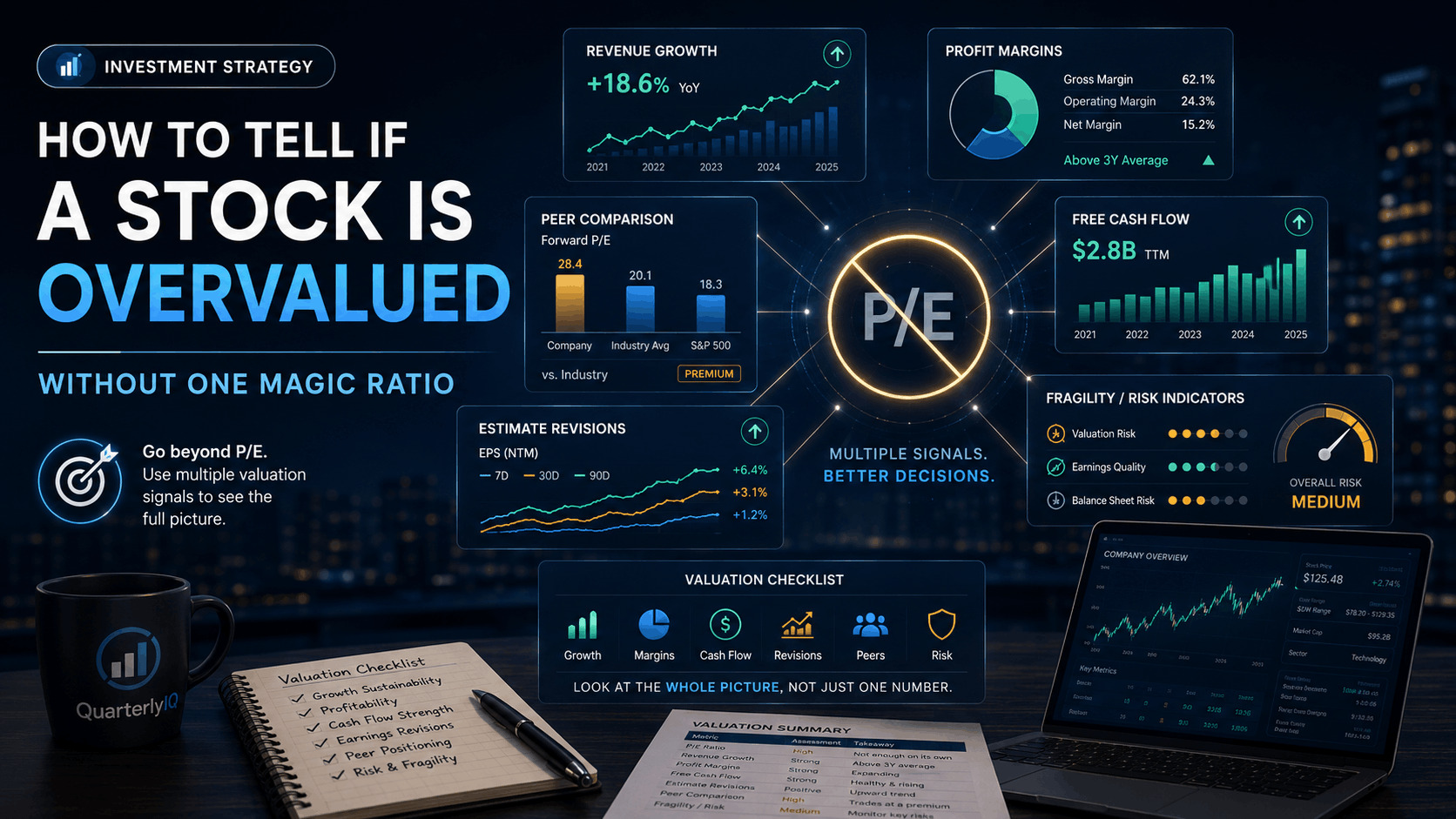
“Is this stock overvalued?” sounds like a question that should have a simple answer.
Pull up the price-to-earnings ratio, compare it with a few competitors, and decide whether the number looks high.
That is often where the analysis stops. It is also where a lot of confusion begins.
A high valuation ratio does not automatically mean a stock is overvalued. Some companies earn higher valuations because they are growing faster, producing stronger margins, or building businesses that investors believe can become much larger.
A low ratio is not proof that a stock is inexpensive either. Sometimes the market is assigning a low valuation because the business is slowing, losing relevance, carrying too much debt, or facing problems that have not yet shown up clearly in reported earnings.
Valuation begins with the number, but it does not end there.
What does “overvalued” actually mean?
A stock is overvalued when its price appears to require more from the business than the company is reasonably positioned to deliver.
That definition matters because a stock price reflects expectations about the future, not only what the company earned last quarter.
Investors may already be paying for:
- Several years of rapid revenue growth
- Expanding profit margins
- New products becoming successful
- Market share gains
- Lower costs
- Stronger cash flow
- Continued confidence in management
When many favorable assumptions are already reflected in the price, there is less room for disappointment.
The most useful way to think about valuation is not:
Is this stock expensive?
It is:
What would this company need to achieve for today’s price to make sense?
That shifts the focus away from a single ratio and toward the expectations supporting it.
Why a high P/E ratio does not settle the issue
The price-to-earnings ratio compares a company’s share price with its earnings per share.
It is useful, but it leaves out a lot of context.
Imagine two companies that both trade at 35 times earnings.
One is growing revenue rapidly, expanding margins, and generating more cash each year. The other is growing slowly and relying on cost reductions to support earnings.
The ratios are identical, but the businesses are not.
The first company may grow into its valuation. The second may struggle to justify it.
A P/E ratio also depends on which earnings number you use:
- Trailing earnings reflect the past.
- Forward earnings depend on analyst estimates.
- Adjusted earnings may remove costs that still matter economically.
- Temporary gains or losses can make the ratio misleading.
This does not make P/E useless. It means the ratio needs a story behind it.
Start with what the price appears to expect
Every valuation contains an implied view of the future.
You do not need to build a complex model to begin thinking this way. Start with a few practical questions:
- How quickly does the company need to grow?
- Does it need to maintain unusually high margins?
- Is the valuation relying on a new product or market?
- How much execution is already assumed?
- Are analysts raising or lowering their expectations?
- Does the company have a history of delivering what investors expect?
A company can deserve a high valuation and still be vulnerable if the price assumes nearly everything will go right.
That is why an excellent business is not always an attractive investment at every price.
Compare expectations with the company’s actual trajectory
Once you understand what the price appears to require, compare those expectations with the evidence.
Look at the direction of the business rather than one isolated quarter.
Revenue growth
Is growth accelerating, holding steady, or slowing?
A company priced for rapid expansion has less room for repeated deceleration.
Profit margins
Are margins improving as the company grows, or is growth becoming more expensive?
Revenue growth supported by falling profitability may be less valuable than it first appears.
Free cash flow
Are reported profits turning into cash?
A company can show attractive earnings while consuming cash through heavy capital spending, rising working capital needs, or stock-based compensation.
Estimate revisions
Are analysts gradually raising their expectations or reducing them?
The direction of revisions can be more informative than the headline estimate itself. A valuation becomes more difficult to support when expectations are moving lower while the stock price still reflects a strong outcome.
Management execution
Has management generally delivered on its guidance and strategic priorities?
A demanding valuation leaves little room for missed commitments, delayed products, or unexplained changes in direction.
Compare the company with the right peers
Peer comparisons can help, but they need to be thoughtful.
A stock trading above its sector average is not necessarily overvalued. The company may have stronger growth, better margins, a healthier balance sheet, or a more durable competitive position.
The comparison becomes more useful when the businesses share similar:
- Growth rates
- Profitability
- Capital requirements
- End markets
- Competitive risks
- Business models
Comparing a fast-growing software company with a mature hardware company may produce a dramatic valuation gap without telling you much.
The real question is whether the premium is supported by a meaningful difference in business quality and future growth.
Compare the stock with its own history
A company’s historical valuation can provide another reference point.
Has the stock usually traded at a premium? Was that premium earned through consistent growth and execution? Are the conditions that supported the old valuation still present?
Historical comparisons also have limits.
A company may deserve a different valuation today because:
- Its growth rate has changed
- Interest rates are different
- Competition has increased
- Its business mix has shifted
- The market opportunity has expanded or narrowed
- Its financial quality has improved or weakened
The past can provide context, but it should not become an automatic target.
Pay attention to fragility
Two stocks can appear similarly expensive while carrying very different levels of risk.
One company may be supported by recurring revenue, steady demand, strong cash generation, and conservative expectations.
Another may depend on a single product cycle, one major customer, aggressive forecasts, and continued investor enthusiasm.
Both can trade at high multiples. The second is more fragile because fewer things need to go wrong before the valuation comes under pressure.
Signs of valuation fragility may include:
- Expectations well above the company’s recent performance
- Heavy dependence on one product or customer
- Falling estimates alongside a high valuation
- Weak cash conversion
- Narrow margins for error
- A rapidly changing industry
- A valuation supported mainly by distant future profits
Fragility does not mean a stock will fall. It describes how sensitive the current valuation may be to disappointing evidence.
Overvalued does not automatically mean “sell”
Valuation is one part of an investment decision.
A stock can appear richly valued and continue performing well because the business keeps exceeding expectations. It can also become even more expensive before the market begins to question the assumptions.
This is why valuation is not a timing tool.
It helps you understand:
- How much optimism may already be reflected in the price
- What the company needs to deliver
- How much room exists for disappointment
- Which assumptions deserve continued monitoring
It does not tell you what the stock will do next week or next quarter.
Can the whole stock market be overvalued?
The same framework can be applied to the broader market.
Market-wide valuation measures can show whether investors are paying more or less than usual for earnings, revenue, or cash flow.
Those measures are useful as context, but they do not provide a reliable countdown to a correction.
A broadly expensive market may remain expensive for a long time. Strong earnings growth, falling interest rates, investor demand, and changes in the companies that dominate an index can all affect market valuation.
Instead of treating a high market valuation as an immediate action signal, view it as evidence that expectations may be elevated and future returns may depend more heavily on continued execution.
A practical valuation checklist
When reviewing a stock, ask:
- What growth does the current price appear to require?
- Is the company currently delivering at that pace?
- Are margins and cash flow supporting the growth?
- Are expectations being revised higher or lower?
- Does management have a strong execution record?
- Is the stock expensive relative to truly comparable companies?
- Is the valuation high relative to the company’s history for a valid reason?
- How many favorable assumptions need to remain true?
- What evidence would make the valuation more difficult to defend?
No single answer settles the matter. Together, they provide a clearer picture of what investors may already be paying for.
How QuarterlyIQ approaches valuation
QuarterlyIQ looks beyond a single multiple.
For covered companies, we organize valuation around several connected ideas:
- What appears to be priced into the stock
- What the company is currently positioned to deliver
- Whether expectations look justified or stretched
- How fragile those expectations may be
- What evidence investors should continue watching
This does not produce a prediction or a buy-and-sell instruction. It provides a structured way to understand the assumptions behind the price.
For a company such as NVIDIA, that means looking beyond the headline multiple and reviewing growth expectations, earnings revisions, business quality, valuation context, and the conditions that matter to the investment thesis.
The purpose is not to replace judgment. It is to make the evidence easier to follow.
The takeaway
A stock is not overvalued simply because its P/E ratio looks high.
Valuation depends on what the price expects, what the business can realistically deliver, and how vulnerable those expectations are if the evidence changes.
Begin with the ratio. Then look underneath it.
The most valuable part of valuation analysis is not finding one perfect number. It is understanding what needs to go right and recognizing when the assumptions supporting the price begin to change.
For a related perspective, read When Should You Sell a Stock? A Thesis-First Framework.
For informational purposes only. Not investment advice. QuarterlyIQ provides descriptive, rules-based analysis of company fundamentals and does not recommend buying or selling any security.