

When Should You Sell a Stock? A Thesis-First Framework
Most investing content focuses on finding stocks.
The harder problem begins after you already own one.
The price falls. Earnings disappoint. Management changes its guidance. A competitor gains ground. Or perhaps nothing obviously goes wrong, but the company slowly stops delivering what you originally expected.
That is when investors ask:
When should I sell my stock?
There is no universal price decline, valuation multiple, or quarterly result that answers that question. A more useful starting point is to ask whether the evidence supporting your original investment thesis has materially changed.
This does not make the decision automatic. It gives you a disciplined reason to review the holding instead of reacting only to the stock chart.
Start with the reason you own the stock
Every stock in your portfolio should have a reason for being there.
That reason may be that:
- The company has a durable competitive advantage.
- Revenue is expected to grow faster than its market.
- Margins should improve as the business scales.
- Management has a credible expansion plan.
- The company is gaining market share.
- The current price does not fully reflect the company’s potential.
Together, those expectations form your investment thesis.
You may never have written the thesis down, but it still exists. It is the set of assumptions you are relying on when you decide that the company deserves a place in your portfolio.
Before asking whether you should sell a stock, write down the reasons you still own it.
A useful thesis should answer four questions:
- What does the company need to accomplish?
- What evidence would show that it is succeeding?
- What evidence would suggest the thesis is weakening?
- How much success does the current stock price already assume?
Without those answers, investors often substitute the latest price movement for actual analysis.
A falling price is not the same as a weakening business
A stock price can fall for many reasons.
The broad market may be declining. Interest-rate expectations may have changed. Investors may be reducing exposure to an entire sector. A company may have reported a strong quarter that still fell short of unusually high expectations.
The price decline matters, but it does not tell you by itself whether the business deteriorated.
The reverse is also true. A stock can hold steady or continue rising while important parts of the underlying business weaken.
That is why price alerts alone are incomplete. They tell you that the market moved. They do not explain whether the reason you own the company changed.
Long-term investing still requires attention to corporate fundamentals rather than relying only on short-term market fluctuations.
A better response to a sudden price change is:
What new information is the market reacting to, and does that information materially affect my thesis?
What a weakening thesis actually looks like
An investment thesis rarely collapses because of one isolated number.
It usually weakens through a pattern of evidence.
Growth persistently slows
A single slow quarter may reflect timing, seasonality, or a difficult comparison. Repeated deceleration is more meaningful, particularly when the company is also lowering guidance or losing market share.
Questions to ask include:
- Is the slowdown temporary or structural?
- Is demand weakening across the industry or only at this company?
- Are analysts reducing future estimates?
- Is management changing how it describes the opportunity?
Margins deteriorate without a clear path to recovery
Falling margins are not automatically a broken thesis. A company may be investing heavily in a new product, expanding capacity, or entering a new market.
The concern grows when:
- Costs rise faster than revenue.
- Management repeatedly misses margin targets.
- Pricing power weakens.
- The company needs continuing promotions to sustain demand.
- Management cannot explain when or why margins should recover.
Management stops delivering on its priorities
A thesis often depends on management doing what it said it would do.
Warning signs may include:
- Repeatedly delayed product launches
- Frequent changes in strategic direction
- Unexpected executive turnover
- Guidance that is repeatedly reduced
- Capital-allocation decisions that conflict with prior promises
One missed goal does not necessarily invalidate the thesis. A pattern of missed commitments deserves closer review.
The balance sheet becomes less resilient
A company can remain operationally promising while its financial position becomes more fragile.
Watch for:
- Rapidly increasing debt
- Weakening free cash flow
- Growing refinancing needs
- Share dilution used to fund ordinary operations
- Reduced flexibility during an industry downturn
Several independent indicators weaken together
A single unfavorable signal is often ambiguous. Several related signals moving in the same direction deserve more attention.
For example:
- Revenue growth slows.
- Margins compress.
- Forward estimates fall.
- Management lowers guidance.
- Competitors continue growing.
The combined pattern is more important than any one item.
Think in states, not instant verdicts
Investors often approach a holding as though it must always be either good or bad.
Reality is usually less precise.
A more useful framework is to place the thesis into one of three descriptive states.
Intact
The company’s recent evidence remains broadly consistent with the reasons for owning it.
That does not mean the stock is certain to rise. It means the underlying business evidence has not materially contradicted the thesis.
Watch
Important evidence has become mixed or weaker, but the case is not conclusive.
This state should lead to specific monitoring questions, not an automatic action. What must improve? What would confirm the concern? When will the next relevant evidence arrive?
Weakened
Several important assumptions supporting the thesis have deteriorated.
This is a reason for a deeper review of the holding. It is not a mechanical instruction to sell. An investor’s taxes, time horizon, portfolio role, risk tolerance, and other circumstances still matter.
QuarterlyIQ uses this kind of state-based framework because uncertainty should be visible. Ambiguous evidence should not be forced into a confident yes-or-no answer.
Real examples from QuarterlyIQ
The following examples use QuarterlyIQ snapshots dated June 16, 2026. They are included to demonstrate the framework, not to recommend buying, holding, or selling any security.
$NVDA: an intact thesis can still contain something worth watching
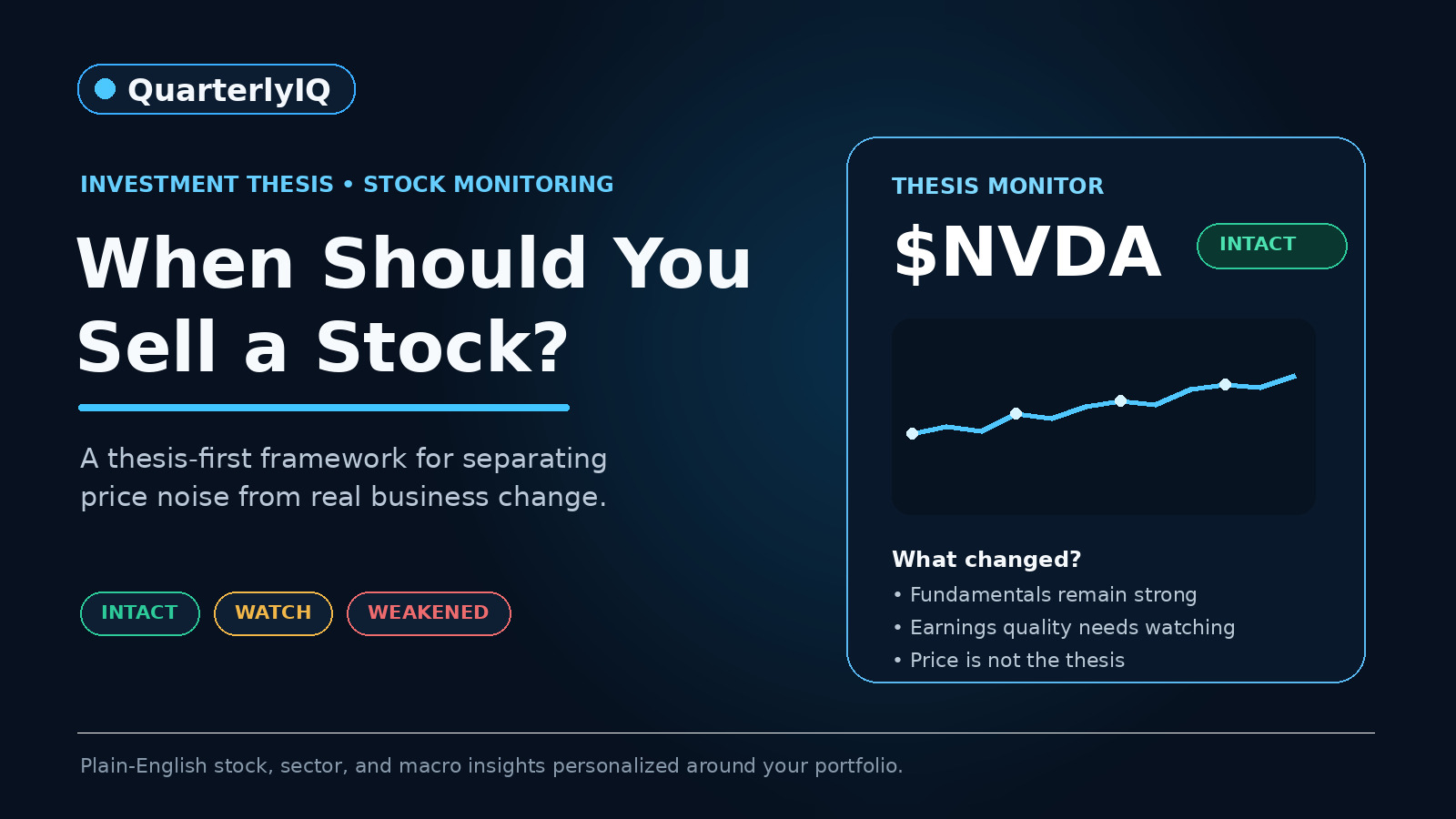
QuarterlyIQ classified NVIDIA, $NVDA, as Intact.
The supporting reason was that recent financial performance remained in the upper half of its industry cohort. The company also had a strong recent financial-performance status and a favorable technology-sector backdrop.
That did not mean every signal was positive.
QuarterlyIQ separately characterized $NVDA’s earnings quality as fragile. The distinction matters:
- The broad operating thesis could remain intact.
- One supporting dimension could still deserve closer attention.
- The investor should know which evidence would confirm or contradict the concern.
The snapshot also showed strongly positive analyst estimate revisions ahead of the next reported period, with 34 upward EPS revisions and three downward revisions over the preceding 30 days.
This creates a better monitoring question than “Is the stock up or down?”
Are future results continuing to support the growth expectations, and is reported profitability being converted into durable cash generation?
An intact thesis does not mean “nothing can go wrong.” It means the available evidence has not yet materially contradicted the central case.
$INTC: a stock can deserve attention even when the price is not collapsing
QuarterlyIQ placed Intel, $INTC, in Watch status.
Recent financial performance was below its industry cohort, management execution was characterized as volatile, and the company’s earnings quality could not be assessed normally because it had been unprofitable over the relevant period.
At the same time, the technology-sector environment remained favorable, and analysts had made substantially more upward than downward EPS revisions during the previous 30 days.
That mixture is exactly why a watch state is useful.
The evidence was neither uniformly negative nor strong enough to ignore. The important issues included:
- Progress in the Intel 18A production ramp
- Factory output
- Leadership stability
- Delivery of planned products
- Development of AI-related business
Notice what the framework does not say.
It does not convert mixed evidence into a buy, sell, or hold rating. It identifies the conditions that deserve attention and waits for additional evidence.
The $INTC snapshot also illustrates why price movement can mislead. Since the beginning of the recorded watch state, the stock had risen modestly rather than collapsing. A stable or rising price did not remove the underlying questions about execution.
$TSLA: a business thesis and a valuation thesis are not the same thing
QuarterlyIQ classified Tesla, $TSLA, as Intact based on its recent financial performance and robust earnings quality.
At the same time, QuarterlyIQ characterized the valuation as expensive and its priced-in expectations as unjustified by the model’s forecast.
That is not a contradiction.
It reflects two different questions:
- Is the company currently delivering enough evidence to support the operating thesis?
- How much future success does the current stock price already require?
A company can continue executing while its valuation becomes increasingly demanding.
For $TSLA, the snapshot suggested that the market price reflected substantial optionality beyond the company’s current financial results. QuarterlyIQ also assigned low confidence to its valuation estimate because a conventional multiple-based model cannot fully value uncertain future businesses.
That uncertainty is important. A low-confidence valuation should not be presented as a precise answer.
The useful investor question is not simply:
Is Tesla a good company?
It is:
Which future outcomes does today’s price depend on, and what evidence would show that those outcomes are becoming more or less likely?
This is why “good company” and “good investment at any price” are not interchangeable conclusions.
Separate business deterioration from valuation risk
Investors often blend two different reasons for reviewing a stock.
The business thesis changed
Examples:
- Demand weakened.
- Competitive position deteriorated.
- Management repeatedly missed important targets.
- Cash generation failed to follow reported earnings.
- A major product or strategic initiative stalled.
The expectations became too demanding
Examples:
- The price assumes unusually high future growth.
- The valuation leaves little room for execution problems.
- The business remains healthy, but future results must be nearly perfect.
- The stock depends heavily on uncertain new markets or products.
The distinction matters because the evidence is different.
A weakening business thesis concerns what the company is doing.
A fragile valuation concerns what the market already expects the company to do.
QuarterlyIQ evaluates both because either can change the risk surrounding a holding, but neither automatically determines what an individual investor should do.
Define what would make you reconsider the thesis
A useful thesis includes predetermined review conditions.
These are sometimes called “kill criteria,” but a less absolute description is thesis reconsideration conditions.
Examples might include:
- Revenue growth remains below a defined level for several quarters.
- A major product misses its adoption milestones.
- Gross margin declines without an investment-related explanation.
- Management lowers guidance repeatedly.
- A key customer leaves.
- Debt rises beyond the level the business can comfortably support.
- A competitive advantage becomes less durable.
- The valuation requires growth far beyond the company’s demonstrated trajectory.
These conditions should be established before emotion takes over.
They also need to be company-specific.
A 10% revenue decline may be alarming for a high-growth software company but normal for a cyclical manufacturer during an industry downturn. A lower margin may indicate deterioration in one company and deliberate expansion spending in another.
The context determines what the number means.
Look for proof and disproof
Every important thesis condition should have two sides:
- What evidence would support the thesis?
- What evidence would weaken it?
Suppose your thesis depends on a new product becoming a meaningful source of growth.
A supporting signal might be:
The company reports growing adoption, higher revenue contribution, and repeat customers.
A weakening signal might be:
Launch timelines slip again, management removes prior targets, or adoption remains immaterial.
This approach is better than monitoring vague headlines because it forces the investor to identify observable evidence.
It also reduces confirmation bias. You are not only looking for facts that support what you already believe.
One disappointing quarter usually is not enough
Quarterly results are noisy.
Revenue can shift between reporting periods. Customers can delay orders. Foreign-exchange movements can affect reported growth. A temporary expense can reduce margins. Management may deliberately invest ahead of future demand.
A weak quarter becomes more concerning when it:
- Confirms an existing negative trend
- Contradicts a central thesis assumption
- Is accompanied by reduced guidance
- Appears alongside competitive deterioration
- Continues for several reporting periods
- Is poorly explained by management
The question is not merely whether the company missed expectations.
It is whether the miss changes what you reasonably believe about the business.
Do not let a price target replace the thesis
A price target can create the illusion of precision.
But a target depends on assumptions about:
- Future revenue
- Margins
- Interest rates
- Valuation multiples
- Competitive position
- Capital needs
- Investor sentiment
Small changes in those assumptions can produce very different estimates.
A fair-value range can be useful as one input, particularly when accompanied by a confidence assessment and an explanation of the assumptions. It should not replace ongoing review of the business.
The more uncertain the company’s future opportunities are, the less believable a single exact value becomes.
How often should you review a stock?
The answer depends on what changed.
A practical monitoring rhythm includes:
After each earnings report
Review:
- Revenue growth
- Margins
- Cash generation
- Guidance
- Estimate revisions
- Management priorities
- Progress against previous commitments
When a material event occurs
Examples include:
- Leadership changes
- Acquisitions
- Regulatory decisions
- Major customer losses
- Product delays
- Capital raises
- Significant guidance changes
When the industry changes
A company’s results should be interpreted relative to its environment.
Weak results during an industry-wide downturn may mean something different from weak results while competitors are thriving.
When valuation assumptions move materially
Even when the business remains healthy, review how much future success the market price appears to require.
The challenge is doing this across an entire portfolio
Reviewing one stock in detail is manageable.
Repeating the process across 10, 20, or 40 holdings is much harder.
Each company has different:
- Earnings dates
- Financial drivers
- Management priorities
- Competitive threats
- Valuation assumptions
- Industry conditions
- Thesis reconsideration conditions
This is the problem QuarterlyIQ is designed to address.
QuarterlyIQ continuously organizes company evidence into a plain-language monitoring framework:
- What changed
- Why it matters
- Whether the thesis appears Intact, on Watch, or Weakened
- What evidence to monitor next
- What expectations appear to be reflected in the price
It does not tell you to buy or sell. It helps you see when the facts supporting your original decision may deserve another look.
A practical framework to remember
When you are wondering whether to sell a stock, work through these questions:
- Why do I own this company?
- Which facts support that thesis today?
- What has materially changed?
- Is the change company-specific or market-wide?
- Is it temporary, or has it persisted?
- Are several independent signals confirming the concern?
- How much success is already reflected in the price?
- What new evidence would strengthen or weaken the thesis from here?
A stock-price movement may prompt the review.
The evidence should guide it.
See what changed in your stocks
QuarterlyIQ monitors the business evidence, expectations, and watch items behind the stocks you follow, so you can spend less time searching for updates and more time understanding what matters.
See what changed in your stocks.
For informational and educational purposes only. This article does not provide individualized investment advice or recommend buying, holding, or selling any security. The QuarterlyIQ examples are descriptive model outputs as of June 16, 2026, and may change as new information becomes available.