Why Great Companies Can Still Be Fragile Investments
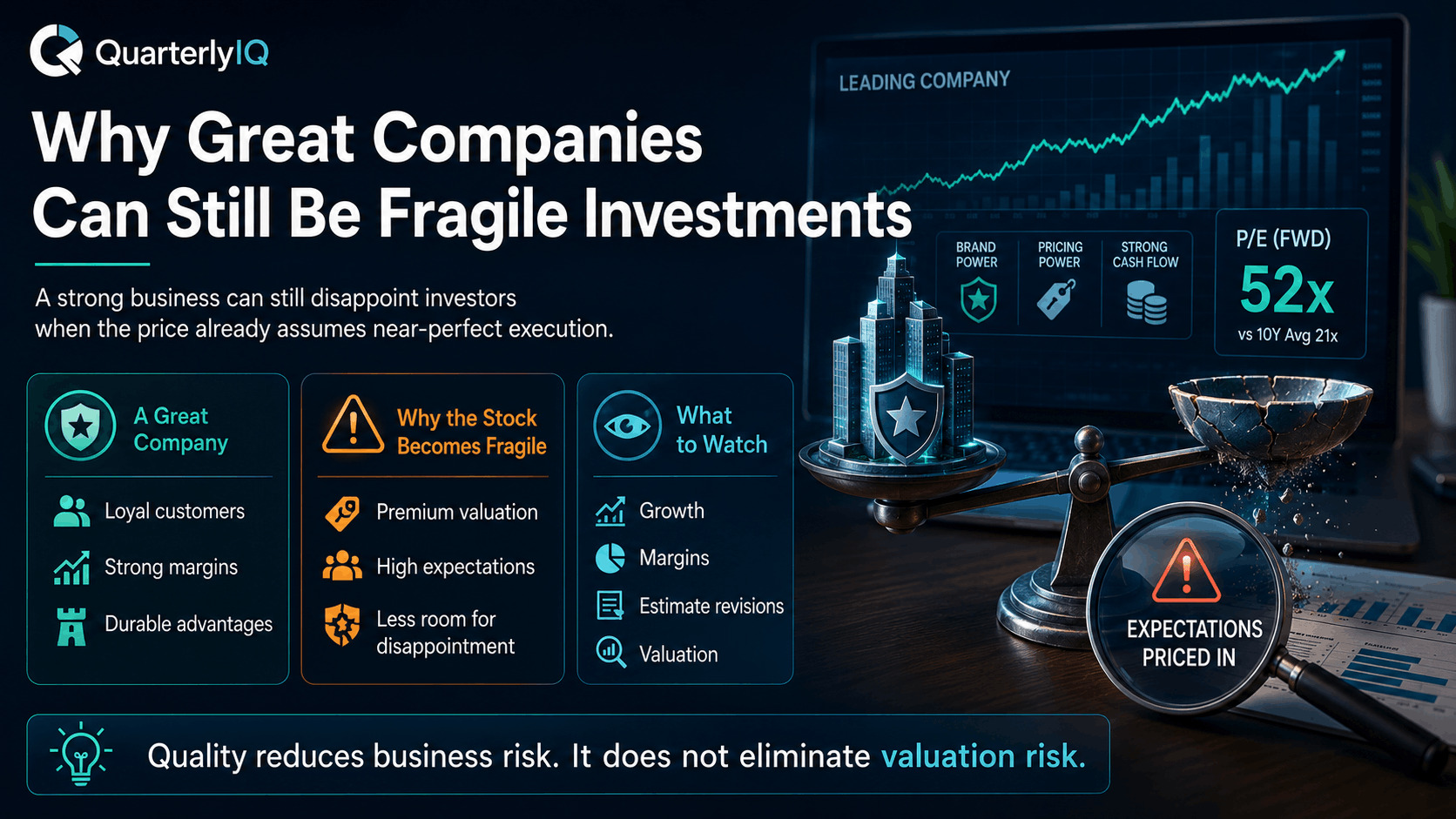
Some of the hardest investment mistakes happen with companies that are genuinely excellent.
The product is strong. The brand is admired. Customers are loyal. Revenue is growing. Management seems capable. The business may even keep performing well.
And yet the stock can still disappoint.
That can feel confusing because investors often assume that a great company should automatically make a great investment.
It does not.
A company can be high quality while its stock is fragile.
That fragility usually comes from expectations. If the market is already pricing in years of strong growth, margin expansion, and near-perfect execution, the business may have very little room to disappoint.
The company does not need to fail for the stock to struggle.
It may only need to be slightly less exceptional than investors expected.
A great company and a great investment are not the same thing
A great company usually has strong business characteristics.
It may have:
- Loyal customers
- High margins
- Durable competitive advantages
- Strong cash flow
- A trusted brand
- Recurring revenue
- Pricing power
- A long growth runway
- Capable management
- A strong balance sheet
These qualities matter. They can make the company more resilient, more profitable, and more valuable over time.
But an investment also depends on the price paid for those qualities.
A great business can become a fragile investment when the stock price already assumes the business will keep delivering excellent results for many years.
That does not mean quality is unimportant.
It means quality must be compared with expectations.
The question is not only, “Is this a great company?”
The question is, “What does the current price already require this great company to deliver?”
Fragility comes from expectations
A fragile investment is one where a small change in expectations can create a large change in the stock price.
This can happen when investors are already assuming:
- Rapid revenue growth will continue
- Margins will keep expanding
- Competition will remain manageable
- Customer demand will stay strong
- New products will succeed
- Management will execute well
- Interest rates will remain supportive
- Earnings estimates will keep moving higher
When those assumptions are embedded in the price, even a good result may not be good enough.
A company can report strong revenue growth and still see its stock fall if investors expected even stronger growth.
It can raise guidance and still disappoint if the new outlook is below the market’s hoped-for scenario.
It can remain profitable and cash-generative while the valuation falls because investors are no longer willing to pay the same multiple.
That is what makes high-quality stocks difficult.
The risk is often not obvious business failure.
The risk is that the business performs well, but not well enough to justify what was already priced in.
For more on this idea, read What Does “Priced In” Mean in the Stock Market?.
Quality can reduce business risk, but not valuation risk
A strong business may be less likely to collapse.
That does not mean the stock price is protected.
Quality can reduce certain risks:
- Customer demand may be more reliable
- Margins may be more durable
- Cash flow may be stronger
- The balance sheet may be safer
- Management may have more flexibility
- Competitors may struggle to catch up
But quality does not eliminate valuation risk.
Valuation risk appears when the market pays so much for quality that future returns become more dependent on flawless execution.
A high-quality company can still face:
- A lower valuation multiple
- Slower growth
- Margin pressure
- Estimate cuts
- A less favorable interest-rate environment
- Investor rotation into cheaper stocks
- A reassessment of long-term expectations
The business may remain excellent while the stock becomes less forgiving.
The stock may already be asking for perfection
The more optimistic the valuation, the more the company may need to deliver.
A great company with a modest valuation may have room for temporary setbacks.
A great company with an extremely demanding valuation may not.
When a stock price already assumes near-perfect execution, investors may react sharply to:
- A small revenue miss
- Slightly weaker guidance
- Margin pressure
- Slower customer growth
- Higher spending
- Delayed product adoption
- A competitor gaining ground
- Earnings estimates moving lower
None of these developments necessarily means the company is broken.
But they may suggest that the current valuation is harder to defend.
This is one reason a stock can fall sharply after news that does not look terrible on the surface.
The market may not be saying the company is bad.
It may be saying the prior expectations were too demanding.
Great companies often attract crowded optimism
The best businesses are usually easy to admire.
Investors can see the product. Customers talk about it. Revenue growth is visible. The market opportunity sounds large. Management tells a compelling story.
That visibility can attract a lot of capital.
As more investors agree that the company is excellent, the stock price may begin reflecting that consensus.
At some point, the idea is no longer overlooked.
It is widely owned, widely admired, and widely expected to succeed.
That can create a new kind of risk.
When optimism becomes crowded, the stock may become more sensitive to any evidence that challenges the story.
Crowded optimism can show up through:
- A valuation well above peers
- A stock that rises faster than estimates
- Heavy media attention
- Investor confidence that seems one-sided
- Little tolerance for normal business volatility
- A narrative that assumes the company will dominate for many years
Popularity does not make a stock wrong.
But it can reduce the margin for error.
A high P/E may reflect quality, but also pressure
High-quality companies often trade at higher valuation multiples.
That can be reasonable.
A company may deserve a premium if it has faster growth, stronger margins, better cash flow, lower financial risk, or more predictable earnings than peers.
But a high P/E ratio also raises the standard of proof.
Investors should ask:
- Is earnings growth strong enough to support the multiple?
- Are estimates moving higher or lower?
- Are margins still improving?
- Is revenue growth durable?
- Is customer behavior still healthy?
- Is the competitive advantage strengthening or weakening?
- Is the valuation premium expanding faster than the business?
A high multiple does not automatically mean overvalued.
It does mean the business needs to support the expectations behind the multiple.
For a deeper look, read High P/E Does Not Always Mean Overvalued.
Growth can slow without the company becoming weak
Even excellent companies eventually face harder comparisons.
A company growing from a small base may sustain very high growth for a while. As it becomes larger, maintaining the same percentage growth rate becomes more difficult.
This slowdown can be natural.
The company may still be gaining customers, expanding revenue, and producing strong cash flow.
The issue is whether the stock price already assumed the earlier growth rate would continue.
A great company can become fragile when investors confuse:
- Strong growth with permanently accelerating growth
- A large market with guaranteed market capture
- High margins with endlessly expanding margins
- A leading position with permanent dominance
- Good execution with flawless execution
Slower growth does not automatically break the investment thesis.
It does matter if the valuation depends on growth staying unusually high.
Margin expectations can become too optimistic
Many great-company investment theses depend on margin expansion.
The idea is often that as the business scales, costs will grow more slowly than revenue. That can be true for some companies.
But margin improvement is not automatic.
Margins may come under pressure from:
- Higher labor costs
- More expensive customer acquisition
- Product investment
- International expansion
- Competition
- Discounting
- Input costs
- Regulatory compliance
- Lower-margin product mix
A company may still be strong while margins stop expanding as quickly as expected.
The stock may struggle if investors were paying for a much more profitable future.
When reviewing a great company, ask whether the margin story is still supported by evidence.
Are margins actually improving?
Is cash flow improving with them?
Is the company becoming more efficient, or simply spending more to maintain growth?
New products can create valuation risk before they create earnings
Great companies often earn premium valuations because investors expect future products, markets, or platforms to become meaningful.
That future may be real.
But the stock price may begin reflecting the opportunity before the financial evidence appears.
This creates a gap between story and proof.
Investors may already be pricing in:
- Successful product adoption
- A large addressable market
- Strong future margins
- Cross-selling into existing customers
- New revenue streams
- A longer growth runway
The risk is not only that the product fails.
The risk is that it succeeds, but more slowly or less profitably than expected.
A product can be impressive without producing enough earnings to justify the valuation built around it.
That is why great-company narratives should still be monitored against measurable evidence.
Competitive advantages can weaken slowly
Strong companies often have real advantages.
But few advantages are permanent without continued investment and execution.
A company can remain a leader while its advantage begins to narrow.
Warning signs may include:
- Competitors matching important features
- Customers using multiple vendors
- Lower pricing power
- Rising sales incentives
- Slower customer growth
- Longer sales cycles
- Reduced retention
- Market share stabilizing or declining
- More spending required to maintain growth
The company may still look excellent compared with most businesses.
But the stock may have been priced for a wider, more durable advantage than the evidence now supports.
Great companies do not need to become weak for their stocks to reprice.
Sometimes the market only needs to believe the gap between them and competitors is narrowing.
Estimate revisions can reveal changing expectations
Analyst estimates are imperfect, but they can help show whether expectations are improving or deteriorating.
For a great company, watch the direction of:
- Revenue estimates
- Earnings estimates
- Margin forecasts
- Free cash flow estimates
- Long-term growth assumptions
A high-quality stock can remain supported when estimates continue moving higher alongside the price.
The setup becomes more fragile when the stock remains expensive while estimates flatten or move lower.
The relationship between price and estimates matters.
A rising stock with rising estimates may reflect improving business expectations.
A rising stock with flat estimates may reflect investors paying a higher multiple for the same expected results.
A falling stock with falling estimates may indicate both the business outlook and valuation are being reset.
The concern grows when the price still assumes excellence while the estimates begin reflecting a less exceptional path.
Interest rates can change what investors are willing to pay
A great company can be affected by interest rates even if its operations remain strong.
When interest rates are low, investors may be more willing to pay high valuations for earnings expected far in the future.
When rates rise, those future earnings may become less valuable in today’s terms.
This can pressure long-duration growth stocks, including many high-quality companies.
The business may still be growing.
Margins may still be strong.
Customers may still be loyal.
But the valuation multiple may decline because investors demand a higher return for waiting.
This is another way a great company can become a fragile investment.
The weakness may not come from the company.
It may come from the price investors are willing to pay for future success.
Fragility increases when the thesis depends on too many things going right
A strong investment thesis should identify the key drivers that matter.
A fragile thesis often depends on several demanding assumptions at once.
For example:
- Revenue must grow rapidly for many years
- Margins must expand at the same time
- Competition must remain limited
- New products must succeed
- Customer retention must stay high
- Interest rates must remain supportive
- Estimates must keep rising
- The valuation multiple must stay elevated
Each assumption may be reasonable on its own.
Together, they can create a narrow path.
The more things that need to go right, the more fragile the investment becomes.
This does not mean the stock should be avoided.
It means the evidence should be monitored carefully.
A great company can be fragile after a large price increase
Sometimes a stock becomes fragile because it has worked too well.
The company may have executed beautifully. The stock may have risen sharply. Investors may feel more confident because the position has been successful.
But the price increase itself can change the setup.
After a major rally, ask:
- Has the business improved as much as the stock price?
- Have estimates risen enough to support the new valuation?
- Is the company now priced for a more demanding future?
- Does the stock have less room for disappointment?
- Would the current evidence support a new investment at today’s price?
A winning stock should still be reviewed.
Success can increase conviction.
It can also hide the fact that the valuation has become more fragile.
Do not confuse brand admiration with investment discipline
Some companies become part of everyday life.
Customers love the product. Employees admire the mission. The brand feels culturally important. The company may seem obvious in hindsight.
That familiarity can make investors less demanding.
They may assume the stock deserves a premium because the company feels exceptional.
But admiration is not analysis.
A beloved company still needs to be evaluated through:
- Revenue growth
- Earnings durability
- Cash flow
- Margins
- Competitive position
- Management execution
- Valuation
- Expectations
The product can be excellent while the stock is priced for too much.
The brand can be strong while future returns become less attractive.
Good investing requires respecting the company without ignoring the price.
A practical fragility checklist
When reviewing a great company, use the following questions.
1. What does the current valuation appear to assume?
Identify the growth, margins, cash flow, and execution required to justify the stock price.
2. Are estimates moving higher or lower?
A premium valuation is easier to defend when future expectations are improving.
3. Is the business still exceeding expectations?
Strong results matter, but the stock may require exceptional results.
4. Is growth slowing naturally or unexpectedly?
A gradual slowdown may be normal. A sharper slowdown may challenge the valuation.
5. Are margins improving as expected?
If margin expansion was part of the thesis, it should appear in the evidence over time.
6. Is the competitive advantage widening or narrowing?
A premium valuation often depends on durable separation from competitors.
7. Is cash flow supporting the earnings story?
Reported earnings are more convincing when cash generation is improving too.
8. Has the stock risen faster than the business?
A great company can become a more fragile investment after a large price increase.
9. How much room is there for disappointment?
The less room there is, the more important even small disappointments become.
10. Would you write the same thesis today?
Review the current evidence, not only the original decision or past success.
How to monitor a great but fragile investment
A fragile investment does not necessarily require immediate action.
It requires disciplined monitoring.
Watch for:
- Revenue growth relative to expectations
- Margin progress
- Customer retention
- Competitive pressure
- Estimate revisions
- Free cash flow
- Management guidance
- Valuation relative to growth
- Interest-rate sensitivity
- Signs that the thesis depends on more assumptions than before
The goal is not to react to every price move.
It is to recognize whether the business continues to support the expectations embedded in the stock.
For a broader monitoring framework, read How to Monitor a Stock After You Buy It.
How this connects to the investment thesis
A strong investment thesis should not simply say, “This is a great company.”
It should explain why the company can create value from today’s price.
That means the thesis should include:
- The company’s advantage
- The growth or profitability driver
- The evidence supporting that driver
- The expectations already reflected in the valuation
- The risks that could make the stock fragile
- The developments that would require a fresh review
A thesis that ignores valuation may describe the company well, but it does not fully evaluate the investment.
A thesis that ignores quality may focus too narrowly on price.
Both matter.
For more on building the foundation, read What Is an Investment Thesis? A Simple Framework for Investors.
Why this becomes harder across a portfolio
Most investors do not own just one great company.
They may own several stocks that look attractive for different reasons.
One may be a high-growth compounder. Another may be a cyclical recovery. Another may be a quality business at a premium valuation. Another may be a turnaround.
Each holding can become fragile in a different way.
Across a portfolio, investors need to track:
- Which stocks depend on high growth
- Which depend on margin expansion
- Which depend on valuation multiples staying elevated
- Which depend on new products or market share gains
- Which have estimates moving lower
- Which have less room for disappointment
A portfolio can look diversified by ticker while still being concentrated in the same kind of expectation risk.
Several holdings may all depend on strong growth, high valuation multiples, or a favorable interest-rate environment.
That is why portfolio monitoring should include not only what each company is, but what each stock already assumes.
How QuarterlyIQ approaches fragile investments
QuarterlyIQ helps investors look beyond simple labels such as “great company,” “cheap stock,” or “expensive stock.”
For covered companies, we focus on questions such as:
- What does the current valuation appear to assume?
- Is the business still delivering enough to support those assumptions?
- Are estimates moving higher or lower?
- Is the investment thesis becoming more or less fragile?
- Are growth, margins, cash flow, and customer behavior still aligned?
- What evidence should be watched next?
The purpose is not to predict the next stock movement or issue a buy, hold, or sell rating.
It is to connect business quality, valuation, expectations, and thesis monitoring so investors can understand where fragility may be building.
Explore the QuarterlyIQ stock research section to review covered companies.
The takeaway
Great companies can still be fragile investments.
That does not mean quality is irrelevant.
It means quality is only one side of the analysis.
The other side is expectation.
A company can have strong products, loyal customers, high margins, and a large opportunity while the stock price already assumes years of excellent execution.
When that happens, even a good business result may not be enough.
Before assuming a great company is automatically a great investment, ask:
- What does the price already assume?
- How much future success is already reflected?
- How much room is there for disappointment?
- Are estimates supporting the valuation?
- Is the business still delivering enough evidence?
A great company can deserve admiration.
A great investment still has to be supported by the price, the evidence, and the expectations built into both.
For more on the valuation side of this question, read High P/E Does Not Always Mean Overvalued.
For a broader framework on valuation and expectations, read How to Tell if a Stock Is Overvalued Without One Magic Ratio.
For informational purposes only. Not investment advice. QuarterlyIQ provides descriptive, rules-based analysis of company fundamentals and does not recommend buying or selling any security.