What Does “Priced In” Mean in the Stock Market?
A company reports record revenue, raises its earnings guidance, and announces strong customer growth.
The stock falls.
Another company reports declining sales, weaker profits, and cautious guidance.
The stock rises.
These reactions can seem irrational until you consider one of the most important ideas in investing:
The market does not respond only to whether the news is good or bad.
It responds to how the news compares with what investors already expected.
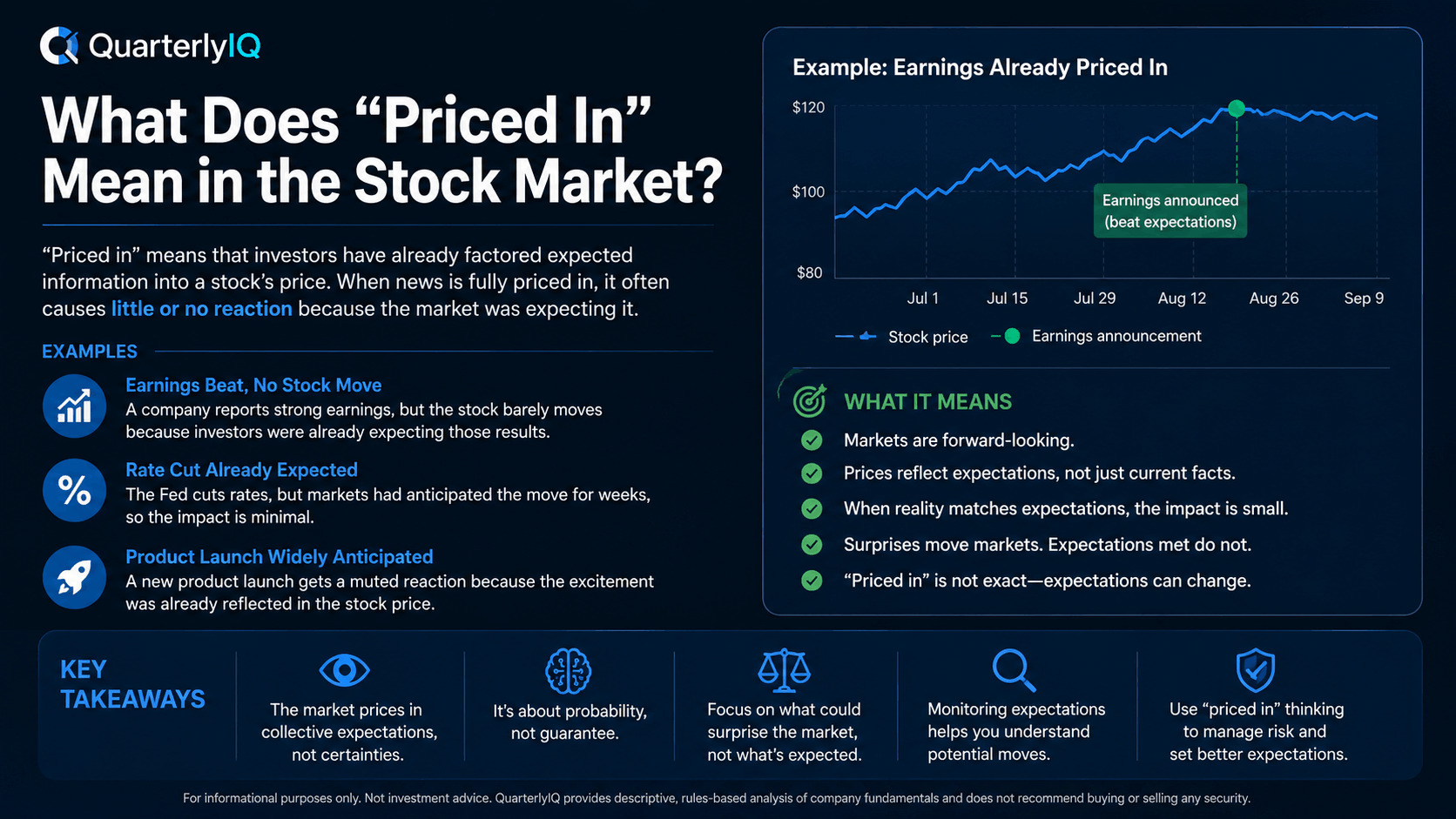
When people say something is “priced in,” they mean that investors have already incorporated an expectation into the stock’s current price.
The event may still matter.
The question is whether it was better, worse, or roughly equal to what the market had already assumed.
Understanding that distinction can help explain why stocks react in ways that appear disconnected from the headlines.
What does “priced in” mean?
A stock price reflects what investors collectively believe the company may earn, grow, and become in the future.
That price includes expectations about:
- Revenue growth
- Profit margins
- Cash flow
- Interest rates
- Competition
- New products
- Economic conditions
- Regulatory changes
- Management execution
- The amount of risk investors are willing to accept
When an expectation is priced in, investors are already paying for some version of that future outcome.
Suppose a company is expected to grow revenue by 25 percent.
If it reports 25 percent growth, the result may be objectively strong. But it may not give investors a reason to value the company more highly because the expected growth already helped support the existing price.
If the company reports 30 percent growth and raises its outlook, the result may exceed what was priced in.
If it reports 20 percent growth, the business may still be growing quickly, but the result may fall short of the assumptions behind the valuation.
The stock can decline even though the company remains profitable and healthy.
Price reflects expectations, not just current results
Investors do not usually value a company based only on what it earned last quarter.
They try to estimate what it may earn in the future.
That makes stock prices forward-looking.
A company’s current price may reflect expectations for:
- Several years of growth
- Future margin expansion
- A successful product launch
- A recovery in demand
- Lower interest rates
- Regulatory approval
- Improved capital allocation
- A future economic cycle
This is why a company can appear expensive based on current earnings while investors believe those earnings will grow rapidly.
It is also why a statistically cheap company may continue falling if investors expect profits to deteriorate.
The current numbers matter.
The expected direction of the numbers often matters more.
A simple example of expectations and price
Imagine two companies each report 10 percent revenue growth.
Company A was expected to grow 6 percent.
Company B was expected to grow 15 percent.
The same reported growth rate can produce very different reactions.
Company A exceeded expectations.
Company B disappointed investors.
The market is not judging the 10 percent result in isolation. It is comparing the result with the growth already assumed in each stock’s price.
This comparison between expected performance and actual performance is often called a surprise.
The surprise can be positive or negative even when the reported number appears strong on its own.
“Priced in” is not the same as “known”
An event can be widely known without being fully reflected in the price.
Investors may know that a company is releasing a new product, but they may disagree about:
- How many customers will buy it
- What price the company can charge
- Whether it will generate attractive margins
- Whether competitors will respond
- How quickly adoption will occur
- Whether the product will strengthen the existing business
The event is known.
Its financial impact remains uncertain.
Similarly, investors may know that interest rates are likely to fall. The disagreement may be about when rates will fall, how far they will fall, and whether the economic conditions behind the rate cuts will help or hurt corporate earnings.
Markets price probabilities, not just events.
The more uncertain the outcome, the wider the range of expectations may be.
Expectations are not priced in perfectly
Saying something is priced in can make the market sound more precise than it really is.
There is no single market expectation.
Different investors may hold very different views.
One investor may expect a company to grow rapidly for ten years. Another may believe growth will slow within two years. A third may be focused on short-term earnings, while a fourth is buying because of a possible acquisition.
The stock price reflects the interaction of those views, along with:
- Investor positioning
- Liquidity
- Risk tolerance
- Time horizon
- Forced buying or selling
- Index flows
- Short interest
- Macroeconomic uncertainty
The market can misjudge an outcome.
Investors can become too optimistic or too pessimistic.
An expectation being reflected in the price does not mean the expectation is correct.
It means the expectation is influencing what investors are currently willing to pay.
What can be priced into a stock?
Almost anything that may affect future earnings, cash flow, risk, or investor demand can influence the price.
Growth expectations
A high-growth company may be valued as if rapid growth will continue for years.
If growth slows slightly, the stock may fall sharply because the price depended on a much stronger path.
Margin improvement
Investors may tolerate weak current profits if they expect margins to expand as the company scales.
If those improvements fail to appear, the valuation may become harder to defend.
A business recovery
A struggling company may rise before its reported results improve because investors expect a recovery.
By the time the recovery appears in the financial statements, much of the potential improvement may already be reflected in the stock.
New products
A promising product can support a higher valuation before it generates meaningful revenue.
The market may be pricing in successful adoption, stronger customer demand, or future profits.
Interest-rate changes
Lower interest rates can increase the value investors place on future earnings.
Stocks may rise before a central bank begins cutting rates if investors already expect those cuts.
Economic conditions
Cyclical companies may rise before economic data improves because investors expect demand to recover.
They may also fall before a recession becomes visible in reported earnings.
Regulatory outcomes
A stock may move in anticipation of an approval, legal decision, policy change, or government contract.
The final announcement may have a smaller effect if investors had already assigned it a high probability.
Risks
Negative expectations can also be priced in.
A stock may trade at a low valuation because investors expect declining demand, rising competition, weak management, or financial stress.
If the outcome is less severe than feared, the stock may rise even though the business results remain weak.
Why good news can send a stock lower
A positive headline does not guarantee a positive stock reaction.
There are several common reasons.
The result was good, but expectations were higher
A company may report impressive growth while missing the level investors had assumed.
The disappointment exists relative to expectations, not relative to the prior year.
The past was strong, but the future outlook weakened
Earnings reports contain both historical results and forward guidance.
A company can beat expectations for the completed quarter while warning that future growth may slow.
Investors may focus more heavily on the outlook.
The valuation required exceptional execution
A highly valued stock may need to produce results far above average simply to support its existing price.
A solid quarter may not be enough.
Investors were positioned for a larger surprise
A stock may rise before earnings as investors anticipate strong results.
When the results arrive, some investors may take profits, especially if the report does not create a stronger future outlook.
This is sometimes described as “buy the rumor, sell the news.”
The phrase is imperfect, but it captures the idea that anticipation can influence the price before the event occurs.
Why bad news can send a stock higher
The reverse can also happen.
A company may report weak results and still see its shares rise.
Investors feared something worse
If the market expected a severe decline and the actual result was only moderately weak, the outcome may be better than what was priced in.
Guidance stabilizes
The current quarter may be poor, but management may indicate that conditions are no longer deteriorating.
A possible turning point can matter more than the weak historical result.
The valuation already reflected substantial pessimism
A stock may have fallen so far that investors were already assuming a deeply negative outcome.
Even modest evidence of stability can lead to a reassessment.
A major uncertainty is removed
Markets often dislike uncertainty more than a clearly defined negative outcome.
Once investors understand the size and duration of a problem, they may be more willing to value the business.
Expectations can change without the business changing
A stock can move sharply even when the company does not release meaningful new information.
That may happen because investors change how they value the same expected results.
For example:
- Interest rates rise
- Risk appetite declines
- A competing investment becomes more attractive
- Investors rotate out of a sector
- The market demands a larger return for uncertainty
- Similar companies report weaker results
The expected earnings may remain unchanged.
The price investors are willing to pay for those earnings may fall.
This is a valuation change rather than an immediate change in the company’s operations.
For a deeper discussion of this distinction, read Stock Price Down, Business Intact: How to Tell the Difference.
How valuation reveals what may be priced in
Valuation can provide clues about the expectations embedded in a stock.
A high valuation may imply that investors expect:
- Rapid growth
- Durable competitive advantages
- Rising margins
- Reliable cash generation
- Low business risk
- A long period of strong execution
A low valuation may imply expectations for:
- Slower growth
- Falling profits
- Cyclical weakness
- Financial risk
- Competitive pressure
- Poor capital allocation
- Greater uncertainty
The valuation ratio does not reveal the entire market view.
It gives you a starting point for asking what performance may be necessary to justify the price.
A high price-to-earnings ratio does not automatically mean a stock is overvalued.
It may be reasonable if earnings grow quickly and reliably.
A low ratio does not automatically make a stock attractive.
It may reflect a realistic expectation that earnings will decline.
For a fuller framework, read How to Tell if a Stock Is Overvalued Without One Magic Ratio.
Think in terms of required performance
One way to evaluate what may be priced in is to ask what the company needs to deliver for the current valuation to make sense.
That may include:
- A certain rate of revenue growth
- Margin expansion
- Strong customer retention
- Successful product adoption
- Higher free cash flow
- Reduced debt
- Continued market-share gains
The more demanding the required performance, the more fragile the investment may become.
The business does not need to fail for the stock to struggle.
It may only need to deliver less than the price assumed.
This is one reason great companies can become difficult investments at certain valuations.
The quality of the company and the attractiveness of the stock are related, but they are not identical.
Look at the direction of estimates
Analyst estimates can help show how expectations are changing.
Pay attention to revisions in:
- Revenue
- Earnings
- Margins
- Free cash flow
- Current-year results
- Longer-term results
A stock may continue rising while estimates move higher because expectations are improving along with the price.
A stock may become more vulnerable when the price rises but estimates remain unchanged.
A stock may fall while estimates remain stable because investors are paying a lower valuation multiple.
A stock may fall while estimates are also being reduced, indicating that both business expectations and valuation may be deteriorating.
The relationship between price and estimates can be more informative than either one alone.
Compare expectations with peers
A company’s valuation should be considered within the context of its industry and business model.
Compare:
- Growth rates
- Profit margins
- Cash generation
- Balance-sheet strength
- Competitive position
- Estimate revisions
- Valuation multiples
One company may deserve a higher valuation because it is growing faster, producing stronger cash flow, or operating with less risk.
The important question is whether the difference in valuation is supported by a difference in expected performance.
If two similar companies have very different valuations, the more expensive company may need to deliver much stronger results.
That does not make it automatically unattractive.
It means the expectations are likely more demanding.
Watch how the stock reacts to new information
Price reactions can provide clues about what investors expected before an announcement.
Suppose a company reports results that appear strong, but the stock falls.
Possible interpretations include:
- Expectations were even higher
- Guidance disappointed
- The valuation was already demanding
- Important operating details were weaker than the headline
- Investors were heavily positioned for a positive surprise
Suppose the stock rises after a weak report.
Possible explanations include:
- The results were better than feared
- Management provided reassuring guidance
- The valuation already reflected severe pessimism
- Investors believe the worst may be passing
The reaction does not reveal the market’s entire reasoning.
It can help identify which expectations may have been wrong.
“Priced in” is usually a range, not a switch
Expectations are rarely either fully priced in or not priced in at all.
A more realistic view is that the market assigns probabilities to different outcomes.
For example, investors may believe:
- There is a high probability of moderate growth
- A smaller probability of exceptional growth
- A meaningful risk of slower demand
- A low probability of severe disruption
The stock price reflects some combination of those possible outcomes.
New information changes those probabilities.
A stronger product launch may increase the probability of rapid growth.
A competitor’s success may increase the probability of margin pressure.
A regulatory decision may remove one possible outcome entirely.
Thinking in ranges can be more useful than treating “priced in” as a yes-or-no conclusion.
The market can price in the right event but the wrong magnitude
Investors may correctly anticipate what will happen while misjudging how important it will be.
They may expect:
- A slowdown, but underestimate its severity
- A recovery, but overestimate its speed
- A successful product, but overestimate its profitability
- Lower interest rates, but underestimate economic weakness
- Strong demand, but overlook the cost of serving it
This is why a widely expected event can still produce a large price move.
The direction may have been anticipated.
The magnitude was not.
The market can price in the right outcome at the wrong time
Timing also matters.
Investors may correctly identify a long-term opportunity but expect it to arrive too soon.
A company may eventually produce strong growth, but the stock can struggle if revenue, margins, or cash flow take longer to develop than investors expected.
Delays can reduce the present value of future results.
They can also create additional financing needs, competitive risk, or uncertainty.
An investment thesis should therefore include not only what may happen, but also a realistic view of when it needs to happen.
Common mistakes when using the phrase “priced in”
The concept is useful, but it is often used too casually.
Treating it as a complete explanation
Saying “it was priced in” can become a way to explain any price reaction after it happens.
A useful analysis should identify what expectation appears to have been reflected in the price and how the new information differed.
Assuming the market is always right
Markets can become excessively optimistic or pessimistic.
Investors can misjudge growth, risk, competition, and valuation.
Being priced in does not make an expectation accurate.
Ignoring the valuation
An event may be expected, but the valuation determines how much success investors are already paying for.
The same business result can have very different implications at different prices.
Focusing only on consensus estimates
Published estimates are useful, but the stock may reflect expectations above or below the official consensus.
Management commentary, investor positioning, recent price performance, and market narratives can all influence the effective expectation.
Confusing business quality with stock attractiveness
A high-quality company may be priced for near-perfect execution.
A troubled company may be priced for an outcome that is even worse than what eventually occurs.
The business and the investment must be evaluated separately.
Assuming every price reaction is rational
Short-term price movements can be influenced by liquidity, positioning, risk management, and trading activity.
A single reaction does not always provide a reliable verdict on the long-term thesis.
A practical framework for identifying what may be priced in
You cannot know the market’s exact expectations.
You can build a reasonable picture by working through the following steps.
1. Identify the prevailing story
What do investors currently appear to believe about the company?
The story may focus on:
- Rapid growth
- Margin expansion
- A turnaround
- A new product
- Artificial intelligence demand
- Cost reductions
- A cyclical recovery
- Regulatory risk
- Competitive disruption
The prevailing story helps explain what investors may already be paying for.
2. Review management guidance
What has the company told investors to expect?
Compare current guidance with:
- Previous guidance
- Long-term targets
- Historical performance
- Analyst estimates
- The assumptions in your thesis
Guidance helps define the performance range the market is considering.
3. Study estimate revisions
Are revenue and earnings expectations moving higher, lower, or remaining stable?
The direction of revisions can show whether confidence in the outlook is strengthening or weakening.
4. Examine the valuation
What level of growth, profitability, and risk appears necessary to support the current price?
Compare the company with:
- Its own history
- Direct competitors
- Similar business models
- Different interest-rate environments
5. Identify the required execution
Write down what the company needs to deliver.
Be specific.
Examples include:
- Revenue must continue growing above 20 percent
- Gross margin must recover
- Customer retention must remain high
- A new product must become a meaningful revenue source
- Free cash flow must improve
- Debt must decline
6. Consider the downside assumptions
What negative outcomes may already be reflected in the price?
A low valuation may indicate that investors already expect weak demand, declining profits, or financial stress.
Determine whether the current evidence suggests the outcome could be better or worse than feared.
7. Observe the reaction to new evidence
When results arrive, separate:
- What happened
- What investors expected
- What management said about the future
- How the valuation changed
The price reaction can help reveal where the surprise occurred.
8. Update the investment thesis
Ask whether the new information changes:
- The company’s growth opportunity
- Competitive strength
- Profitability
- Financial position
- Management credibility
- Valuation risk
- The conditions you need to monitor
The objective is not to explain every daily move.
It is to understand whether the balance between expectations and likely business delivery has changed.
How “priced in” should affect an investment decision
Understanding expectations does not provide an automatic answer.
A positive outcome can still support an investment even when some optimism is already reflected in the price.
A negative expectation can still be justified when the business is genuinely deteriorating.
The concept is most useful when it improves the questions you ask.
Instead of asking:
- Is the company good?
- Was the earnings report positive?
- Is the stock down?
- Does the valuation look high?
Ask:
- What outcome does the current price appear to assume?
- How difficult will that outcome be to achieve?
- What could cause the company to exceed those expectations?
- What could cause it to fall short?
- How much room is there for disappointment?
- Has the expected outcome changed since the investment was made?
These questions connect the business, valuation, and market reaction.
Monitoring expectations after you buy
Expectations continue changing after you purchase a stock.
The company may execute well, but the valuation can rise even faster.
The business may encounter a temporary setback while the price begins assuming a much worse outcome.
Analyst estimates may move.
Interest rates may change.
Competitors may alter the industry’s growth or profitability.
That is why monitoring should include both business performance and market expectations.
Review:
- What the company delivered
- What investors expected
- How future estimates changed
- Whether the valuation became more or less demanding
- Which assumptions now support the price
- What evidence should be watched next
For a broader monitoring framework, read How to Monitor a Stock After You Buy It.
Why this becomes difficult across a portfolio
Understanding what is priced into one stock requires following its business, expectations, valuation, competitors, and market context.
Repeating that work across 10, 20, or 40 holdings becomes much more demanding.
Each company may be priced for a different outcome.
One stock may require continued rapid growth.
Another may depend on a margin recovery.
A third may reflect severe pessimism.
A fourth may be valued for a product that has not launched yet.
Price movements alone do not explain which expectation changed.
Investors need a way to connect new evidence with the assumptions behind each holding.
How QuarterlyIQ approaches priced-in expectations
QuarterlyIQ helps investors examine the relationship between business performance, changing expectations, valuation, and the investment thesis.
For covered companies, the focus is on practical questions:
- What changed?
- Did the company perform better or worse than expected?
- Are estimates moving higher or lower?
- What assumptions appear to support the current valuation?
- Is the business delivering enough to justify those assumptions?
- How much room appears to remain for disappointment?
- What should be watched next?
The purpose is not to predict the stock’s next move.
It is to help investors understand the expectations surrounding the companies they own and research.
Explore the QuarterlyIQ stock research section to review covered companies.
The takeaway
“Priced in” means that investors have already incorporated an expectation into the price they are willing to pay.
The phrase does not mean the expectation is certain.
It does not mean the market is correct.
It does not mean new information no longer matters.
It means the stock will often react to the difference between what happens and what investors had already assumed.
That is why:
- Good news can send a stock lower
- Bad news can send a stock higher
- A strong company can become a fragile investment
- A weak company can rally when conditions are less bad than feared
- Valuation matters alongside business quality
- Expectations can change before reported results do
Do not ask only whether the news is positive or negative.
Ask what the market expected, what the company delivered, and what the current price may require from the business next.
That is where the meaning behind “priced in” begins to become useful.
For informational purposes only. Not investment advice. QuarterlyIQ provides descriptive, rules-based analysis of company fundamentals and does not recommend buying or selling any security.