Why Price Alerts Are Not Enough to Monitor a Portfolio
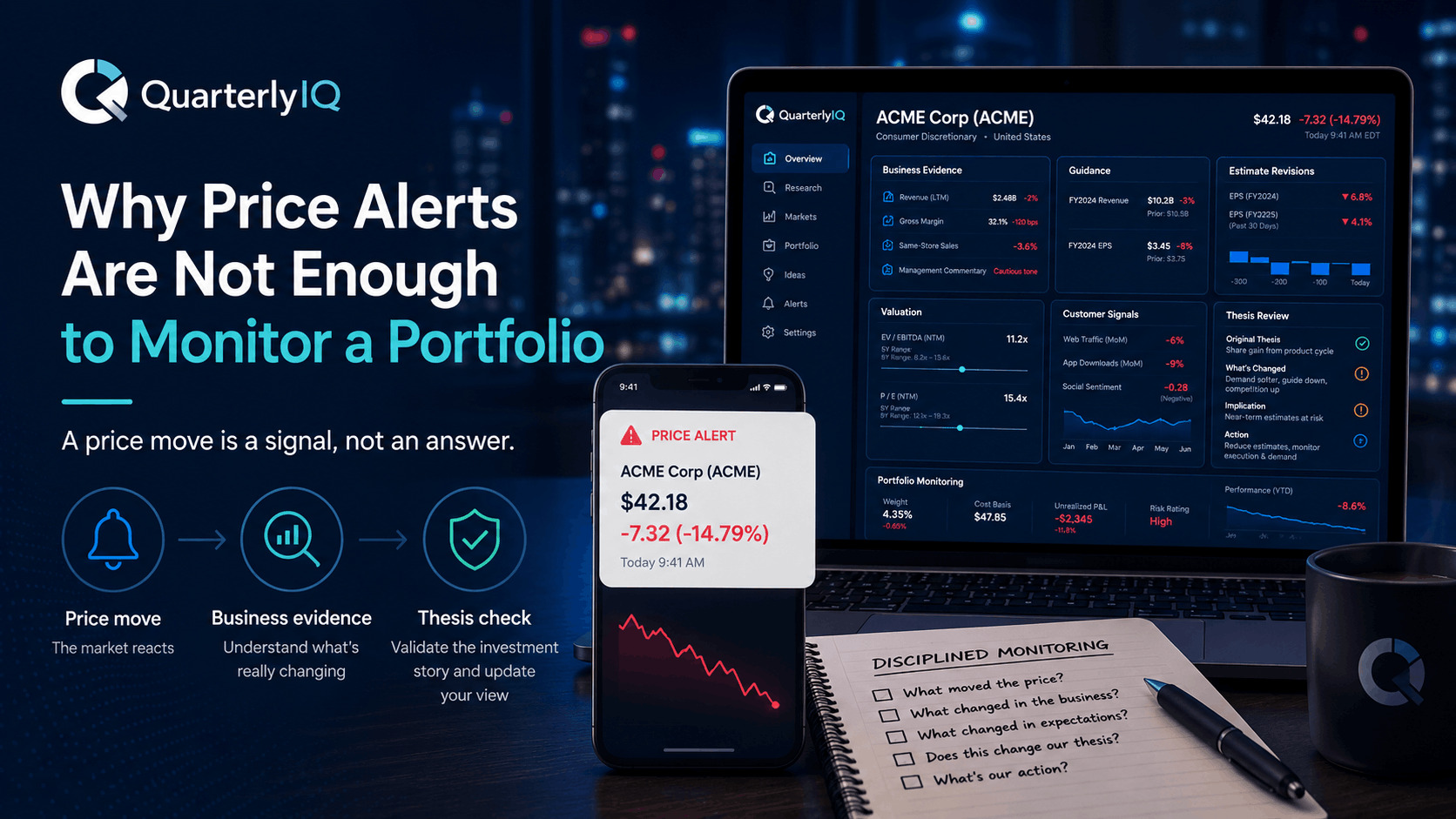
A stock in your portfolio falls 8 percent before lunch.
Your phone sends an alert. You open your brokerage account, scan the chart, and search for an explanation.
Maybe the company released earnings. Maybe an analyst lowered a price target. Maybe the entire sector is falling. Maybe interest rates moved. Maybe there is no obvious explanation at all.
The alert did its job. It told you that the price changed.
But it did not tell you whether your investment thesis changed.
That distinction is at the center of effective portfolio monitoring.
A price alert can open the investigation. It should not complete it.
Price alerts solve a narrow problem
Price alerts are useful because investors cannot watch every holding throughout the day.
They can notify you when:
- A stock rises or falls by a certain percentage
- The price crosses a level you selected
- Trading volume increases
- A stock reaches a new high or low
These alerts help direct your attention. They tell you that something unusual may be happening.
But a price alert has almost no context.
It does not know why you own the stock. It does not know which assumptions support your investment thesis. It does not know whether the business is improving, weakening, or behaving exactly as expected.
The same 10 percent decline can mean very different things for different companies.
For one company, it may reflect temporary market volatility.
For another, it may follow a serious reduction in guidance.
For a third, it may be a valuation reset after expectations became too optimistic.
The percentage alone cannot tell you which situation you are facing.
Price movement is not the same as business change
Stock prices respond to more than changes in the underlying business.
They also respond to:
- Market sentiment
- Interest rates
- Economic expectations
- Sector rotations
- Investor positioning
- Valuation changes
- Short-term trading activity
- Differences between reported results and market expectations
This is why a falling stock does not automatically mean the company is deteriorating.
A profitable business can report solid results and still see its shares decline because investors expected even stronger growth. A company can continue executing well while its valuation multiple falls. An entire industry can sell off because of a macroeconomic concern that affects every company in the group.
The reverse is also true.
A stock can rise even when parts of the business are weakening. Enthusiasm about a new product, improving market sentiment, or broad speculative interest can temporarily outweigh deteriorating fundamentals.
Price is important. It reflects the market’s changing assessment of the future.
But it does not explain that assessment.
One price move can have several explanations
When a stock moves sharply, investors often look for a single cause.
Markets are rarely that simple.
A decline might reflect broad market pressure, changing industry conditions, company-specific news, or several forces acting together.
Broad market movement
Sometimes the stock is falling because almost everything is falling.
A change in interest-rate expectations can pressure growth stocks. A recession concern can affect cyclical businesses. A geopolitical event can reduce risk appetite across the market.
In these situations, the company may not have released any new information.
That does not make the decline irrelevant. Market conditions can affect valuation, financing costs, customer demand, and future earnings.
But broad market pressure should not automatically be interpreted as proof that the company’s thesis has weakened.
Sector or industry pressure
A stock may decline because investors are reassessing the entire industry.
This can happen when:
- Commodity prices change
- A competitor reports weak demand
- New regulations are proposed
- Industry inventory increases
- Pricing pressure emerges
- A major customer reduces spending
Sector-level information may eventually affect the company. The important task is determining how exposed the specific business is.
A weak report from one competitor may reveal a shared industry problem. It may also reflect poor execution at that competitor alone.
Company-specific evidence
Some price movements follow information that directly affects the investment thesis.
Examples include:
- Revenue growth slowing more than expected
- Management lowering guidance
- Margins deteriorating
- Customer losses increasing
- Free cash flow weakening
- Debt becoming more difficult to manage
- A major product falling behind
- Management failing to deliver on prior commitments
These developments deserve closer attention because they may change the assumptions behind the company’s future.
Even then, one disappointing result rarely tells the entire story. The investor still needs to determine whether the issue is temporary, isolated, or becoming persistent.
A valuation reset
A company can continue performing well while its stock falls because the market is no longer willing to pay the same valuation.
This often occurs when a stock was priced for unusually strong growth, high margins, or near-perfect execution.
The business may remain healthy. The expectations embedded in the previous price may simply have been too demanding.
This is an important distinction because the investment thesis may include both a view of the company and a view of what the market is already pricing in.
A strong business is not automatically a strong investment at every price.
Monitoring should begin with the investment thesis
A useful investment thesis explains why you believe the company may become more valuable over time.
It should identify:
- The company’s main growth drivers
- The source of its competitive advantage
- The assumptions behind future profitability
- The major risks
- The evidence that would support or weaken the thesis
Without that framework, every price movement can feel equally important.
A stock falling 7 percent may create panic because there is no written standard for deciding what matters. A rising stock may create false confidence because the investor has not identified which business assumptions still need to be tested.
A thesis gives the monitoring process structure.
Instead of asking only, “Why is the stock down?” you can ask:
- Did anything change in the reason I own this company?
- Which assumption is affected?
- Is the evidence strong enough to change my view?
- Is this a one-quarter issue or a developing pattern?
- What evidence should I watch next?
For a practical starting point, see What Is an Investment Thesis? A Simple Framework for Investors.
What effective monitoring adds to a price alert
A stronger monitoring process connects the price movement to several categories of evidence.
1. Business performance
Begin with the company itself.
Review whether anything meaningful changed in:
- Revenue growth
- Customer demand
- Pricing
- Margins
- Cash flow
- Balance-sheet strength
- Market share
- Competitive position
The goal is not to react to every fluctuation.
Businesses rarely improve in perfectly straight lines. Growth rates change, expenses move between quarters, and temporary disruptions occur.
The concern grows when several signals begin pointing in the same direction.
A revenue slowdown becomes more significant when it is accompanied by weaker margins, lower guidance, and declining customer retention.
2. Management execution
Compare management’s actions with its previous commitments.
Did the company deliver what it said it would deliver?
Did management explain the problem clearly?
Has the same explanation appeared for several quarters?
Are timelines repeatedly moving?
A single delay may be manageable. Repeated delays can indicate that management does not fully understand the problem or cannot execute its plan.
Monitoring management follow-through can be more useful than focusing only on whether a quarterly earnings number beat expectations.
3. Guidance and estimate revisions
Markets care about the future.
A company can report strong historical results while offering a weaker outlook. Analysts may respond by lowering future revenue or earnings estimates.
These revisions can matter because valuation is usually based on expected future performance, not just the most recent quarter.
Watch whether estimates are:
- Rising
- Stable
- Gradually declining
- Falling sharply
- Becoming more dispersed
A widening range of estimates can also signal increasing uncertainty, even when the average estimate has not changed significantly.
4. Valuation and expectations
Price changes can alter the investment setup even when the business remains unchanged.
After a decline, ask:
- Has the valuation become less demanding?
- What growth rate appears to be reflected in the current price?
- Is the market assuming a temporary slowdown or lasting deterioration?
- Does the valuation still require near-perfect execution?
After a large increase, ask:
- Have expectations risen faster than the business?
- Is the market pricing in growth that has not yet occurred?
- Has the investment become more vulnerable to a small disappointment?
Monitoring is not only about detecting deterioration.
It is also about recognizing when the balance between business quality, expectations, and valuation has changed.
For more on this distinction, read How to Tell if a Stock Is Overvalued Without One Magic Ratio.
5. Industry and macroeconomic context
A company does not operate in isolation.
Interest rates, inflation, labor costs, consumer demand, credit availability, and industry conditions can all affect its results.
The importance of each factor depends on the business.
A highly leveraged company may be especially sensitive to refinancing costs. A consumer company may depend on discretionary spending. A semiconductor company may be influenced by inventory cycles and capital spending. A bank may be affected by credit quality and the shape of the yield curve.
Portfolio monitoring should connect macroeconomic changes to the holdings that are actually exposed to them.
It should not treat every economic headline as equally important to every company.
6. Persistence and confirmation
One of the most important questions is whether a signal is isolated or persistent.
A temporary setback affects the current period. A weakening thesis affects the assumptions behind the future.
Look for confirmation across:
- Multiple quarters
- Several operating metrics
- Management commentary
- Analyst estimate changes
- Competitor results
- Industry data
- Customer behavior
No single metric needs to settle the answer.
Confidence grows when independent evidence begins to agree.
A practical framework for reviewing a price alert
When a holding triggers an alert, use the movement as the beginning of a structured review.
Step 1: Identify what moved
Record the size and timing of the price change.
Was the movement sudden or gradual? Did it occur during market hours, after earnings, or following a specific announcement?
This establishes the event, but it does not explain it.
Step 2: Compare the move with the market and sector
Check whether the broad market, sector, and close competitors moved in the same direction.
A company-specific decline deserves a different investigation from a market-wide decline.
Step 3: Look for new business evidence
Determine whether the company released meaningful information.
Focus on primary evidence when possible:
- Earnings releases
- Regulatory filings
- Investor presentations
- Management guidance
- Material company announcements
Headlines can help identify the topic, but they often simplify the significance.
Step 4: Connect the evidence to the thesis
Ask which part of your investment thesis is affected.
Does the development challenge the growth assumption? The margin opportunity? The competitive advantage? The balance sheet? Management’s credibility?
Some news may be negative without affecting the central thesis. Other news may appear small but challenge a critical assumption.
Step 5: Judge whether the change is isolated or persistent
Review previous quarters and earlier management statements.
Has this issue appeared before?
Is it spreading to other parts of the business?
Are competitors reporting something similar?
The purpose is to avoid treating every disappointment as permanent while also avoiding a pattern of repeatedly dismissing meaningful evidence.
Step 6: Define what should be watched next
End the review with a specific monitoring plan.
For example:
- Customer growth must stabilize next quarter
- Gross margin should recover as temporary costs decline
- Management needs to meet the revised product launch date
- Free cash flow should improve as inventory normalizes
- Analyst estimates should stop falling
- Debt levels should decline before refinancing becomes necessary
This turns monitoring into a repeatable process rather than a series of emotional reactions.
Why this becomes harder across a portfolio
Reviewing one company carefully is manageable.
Monitoring 15, 25, or 40 holdings is much more difficult.
Each company has different:
- Business drivers
- Reporting schedules
- Risk factors
- Valuation assumptions
- Competitors
- Industry conditions
- Relevant economic exposures
Price alerts can increase the noise.
During a volatile week, several holdings may trigger alerts at once. The investor is left trying to decide which movements deserve investigation and which reflect broad market conditions.
This creates two common risks.
The first is overreaction. The investor treats every decline as evidence that something is wrong.
The second is neglect. The investor becomes overwhelmed by alerts and begins ignoring all of them, including the developments that matter.
Effective portfolio monitoring requires prioritization.
The goal is not to watch every movement. It is to identify meaningful changes, connect them to the original thesis, and determine what deserves closer attention.
How QuarterlyIQ approaches portfolio monitoring
QuarterlyIQ helps investors follow the companies they own and research by organizing information around practical questions:
- What changed?
- Why does it matter?
- Which part of the investment thesis is affected?
- Is the evidence isolated or persistent?
- What should be watched next?
The purpose is not to predict the next stock-price move.
It is to help investors distinguish between market movement and business change, while following the evidence across multiple holdings.
Investors can also use the QuarterlyIQ stock research section to review company fundamentals, valuation, and other business evidence in a more structured way.
The takeaway
Price alerts are useful signals of activity.
They are not complete monitoring systems.
A price alert tells you that the market’s assessment changed. It does not tell you whether the change came from broad market noise, sector pressure, changing expectations, valuation, or deterioration in the company.
That requires a wider review.
Start with the investment thesis. Examine the business evidence. Consider valuation and market expectations. Look for persistence and confirmation. Then define what you need to watch next.
The goal is not to react to every headline or price movement.
It is to recognize when the evidence supporting a holding begins to change.
Related reading
- How to Monitor a Stock After You Buy It
- Stock Price Down, Business Intact: How to Tell the Difference
- How to Know When an Investment Thesis Is Weakening
- What Is an Investment Thesis? A Simple Framework for Investors
For informational purposes only. Not investment advice. QuarterlyIQ provides descriptive, rules-based analysis of company fundamentals and does not recommend buying or selling any security.