What Actually Moves a Stock Before Earnings? | QuarterlyIQ
A clearer way to understand the forces shaping stock prices before earnings season arrives.
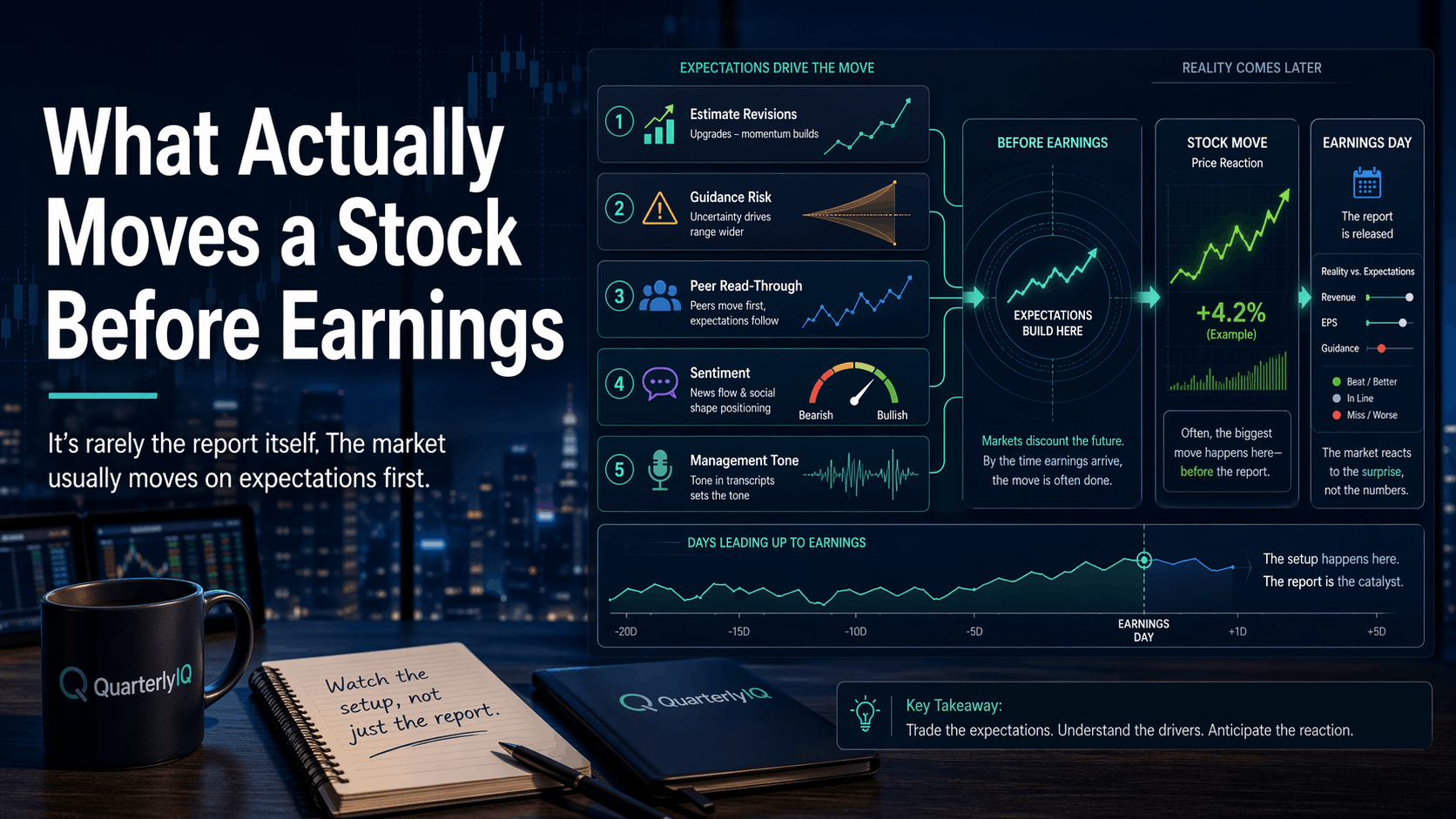
Most investors are not short on information. They are short on clarity.
Every day, the market throws another headline across the screen. Inflation is cooling. Rates may stay higher. Oil is rising. Consumer spending is slowing. Tech is resilient. Earnings expectations are falling. By the end of the week, many people have read a hundred pieces of market news and still feel no closer to a smart decision.
That frustration is real. And it is one of the biggest reasons investors get pulled into noise.
Because the truth is, stocks do not usually move on information alone. They move on which information matters most right now, how that information changes expectations, and whether it affects the next chapter of a company’s story.
That chapter is often the next earnings report.
For all the speed and drama of modern markets, businesses are still judged quarter by quarter. Revenue, margins, guidance, demand, costs, confidence. That is where expectations meet reality. That is where stories get tested. And that is why investors who want better decision-making need a better question.
Not, “What happened today?”
But, “What is changing between now and the next earnings report?”
That is the lens we believe matters most.
The market is noisy. Earnings are where the noise gets sorted out.
A stock can bounce around for dozens of reasons in a single week. A headline. A rumor. A Fed comment. A sector move. A chart pattern. A viral post. Some of that matters. A lot of it does not last.
Earnings are different.
An earnings report forces the market to deal with something more concrete. Did the company grow? Did margins improve or weaken? Is demand holding up? Did management raise expectations or lower them? Did the last few months actually make the business stronger, or just sound dramatic on social media?
That is why the weeks leading into earnings matter so much. Investors are not only reacting to what already happened. They are constantly updating what they believe is about to happen.
And stock prices often move before earnings because the market is trying to price in that future before the official numbers arrive.
So the real challenge is not simply watching the stock. It is understanding what is shaping expectations beneath the surface.
The three forces that usually matter most
Before the next earnings report, most stocks are being influenced by some mix of three forces:
- the macro environment
- the sector or industry backdrop
- the company’s own business-specific drivers
These forces do not affect every stock equally. That is the whole point. A rising-rate environment might matter a great deal for homebuilders and regional banks, while a change in ad spending might matter far more for digital media and platform companies. Lower energy prices might help one business and hurt another.
The edge does not come from tracking everything. It comes from knowing which forces matter most for the stock you care about.
Let’s walk through them.
1. Macro conditions set the backdrop
The economy is like the weather system around the market. It does not explain every move, but it shapes the environment everyone has to operate in.
Inflation, interest rates, employment, wages, consumer spending, credit conditions, and growth trends all affect how businesses perform. They influence what customers can afford, how much companies pay to borrow, whether margins get squeezed, and how confident management teams feel about the quarter ahead.
This is why macro data matters. Not because every new release should cause panic, but because it changes the backdrop that companies are operating in.
If inflation is easing, some businesses may get cost relief. If rates stay high, financing-sensitive sectors may struggle. If the labor market is weakening, consumer demand may start to cool. If growth is stabilizing, cyclicals may get breathing room.
The mistake many investors make is treating macro news like a scoreboard. Up is good. Down is bad. But markets are rarely that simple.
What matters is how a macro shift changes the odds for future earnings.
A cooling inflation number, for example, might help a consumer brand if input costs are falling. The exact same number might worry investors if it also signals weaker demand. One data point can travel through different businesses in very different ways.
That is why context matters more than headlines.
2. Sector trends often explain more than people realize
Sometimes a stock is not really moving because of the company alone. It is moving because money is flowing into or out of its entire corner of the market.
This happens all the time.
Semiconductors may rise together because demand expectations improve. Retail stocks may weaken together because consumers look stretched. Energy names may move with oil. Banks may swing with yield spreads and credit fears. Software companies may rerate together when spending trends change.
This matters because even strong companies do not trade in isolation.
A business can execute well and still get dragged down by a weak industry mood. Another can post decent results and surge simply because sentiment in the group is improving. That may not feel fair, but it is part of how markets work.
Investors who only study the company and ignore the sector often end up confused. They are looking at one tree and wondering why the whole forest feels different.
The better question is: what is happening to the industry around this stock, and how might that shape expectations into earnings?
Because very often, the market is not only asking whether a company is good. It is asking whether conditions are improving or worsening for the kind of business it is.
3. Company-specific drivers still matter most in the end
Macro and sector conditions matter, but earnings still become personal at the company level.
This is where the details live.
Is demand growing or slowing? Are customers pulling back? Is pricing power holding up? Are costs rising? Is the company gaining market share? Did management set expectations too high? Are analysts underestimating a shift in the business?
These are the drivers that make one stock outperform its peers and another disappoint.
A company may benefit from a strong economic backdrop and still miss because execution slipped. Another may face a difficult economy and still win because management adapted faster than expected. That is why stock selection still matters. The backdrop shapes the game, but the company still has to play it.
The key is understanding which business-specific signals are likely to matter before earnings, not after everyone has already reacted.
That could mean watching pricing trends, shipment data, customer activity, margins, guidance history, inventory changes, or the handful of outside factors that have repeatedly shown a strong relationship with the stock or business.
Not every metric deserves your attention. The goal is to focus on the few that actually move the story.
Why so many investors feel overwhelmed
Because this all sounds like a lot. And in fairness, it is.
The market asks ordinary people to absorb an extraordinary amount of information, often with too little help separating signal from noise. That is why so many investors end up doing one of two things.
They either overreact to every new headline.
Or they tune out completely.
Neither feels good. Neither builds confidence. And neither is a reliable path to better decisions.
Good investing has always rewarded people who can stay steady while others chase every flash of motion. There is still an edge in slowing down long enough to ask a calmer, smarter question.
What actually matters for this stock between now and the next earnings report?
That question changes everything.
It turns the market from a firehose into a filter.
It shifts your attention from noise to probabilities.
It replaces endless reaction with a more grounded process.
This is where QuarterlyIQ fits in
QuarterlyIQ was built around a simple belief: investors need more than data. They need perspective.
Not vague commentary. Not black-box predictions. Not a louder version of the same market noise. Real perspective. The kind that helps you understand what factors are most relevant, what may be changing beneath the surface, and how confident anyone should be in the signal.
That is the difference between information and usable intelligence.
Our approach is built around the quarterly window that matters most to public companies and to many investors following them. We look at the market through that practical horizon because it is long enough to matter and short enough to act on.
That means asking better questions, such as:
- Which macro forces are most likely to affect this company before its next report?
- Which sector trends are strengthening or weakening?
- Which signals have historically had the strongest relationship with performance?
- Where is confidence high, and where is uncertainty still elevated?
The goal is not to promise certainty. No serious investor should trust anyone who does.
The goal is to improve clarity.
To help investors spend less time drowning in headlines and more time understanding what is likely to shape the next quarter.
A better way to think about stock movement
When people ask what moves a stock, they are often hoping for one answer.
The Fed. Inflation. AI. Oil. Rates. Consumer spending. Guidance. Sentiment.
But the market rarely works that way.
A stock moves when the market decides something meaningful has changed about future expectations. Sometimes that change comes from the economy. Sometimes it comes from the industry. Sometimes it comes from inside the company itself. Usually, it is some combination of all three.
The real skill is learning how to weigh those forces without getting lost in them.
That takes practice. It takes patience. And it takes the willingness to stop chasing every update as if it deserves equal importance.
Some of the best investing decisions still come from doing something that feels almost old-fashioned now: stepping back, thinking clearly, and focusing on what truly matters.
The takeaway
If you remember one thing, let it be this:
Stocks often move before earnings not because the market knows the future, but because it is constantly trying to price it in.
That future is usually shaped by a mix of macro conditions, sector trends, and company-specific drivers. When you understand which of those forces matter most, you begin to see the market differently. More clearly. More calmly. More usefully.
You do not need to react to everything.
You do need a framework.
That is the real advantage.
Not more noise. Better filters. Not more prediction theater. Better preparation. Not more panic. More perspective.
Because in the end, better investment planning is not about pretending to know everything.
It is about learning how to focus on what matters next.
If you'd like, I can now turn this into a polished publish-ready version with a title tag, meta description, subheadline, and CTA tailored for QuarterlyIQ.

