Macro, Sector, Company: A Simple Framework for What Drives Returns
A practical investor framework for understanding when returns are driven by the economy, the sector, or the company itself.
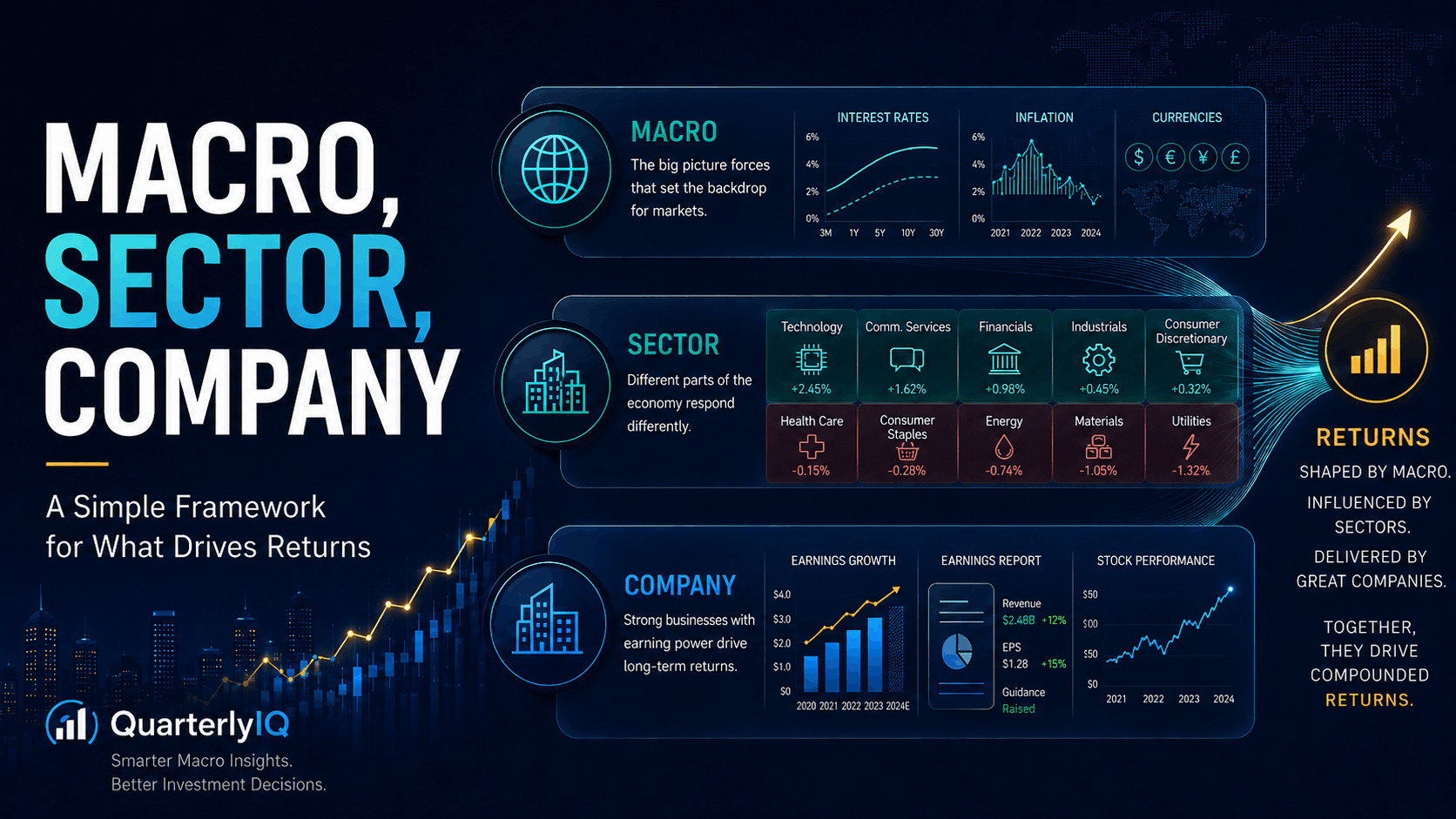
Most investors ask a simple question:
“Is this a good company?”
That is a reasonable place to start. But it is not enough.
A good company can be a bad stock in the wrong environment. A mediocre company can rally if its sector suddenly becomes attractive. And even a strong earnings report can disappoint if expectations were already too high.
The better question is:
“What is driving this stock right now?”
That answer usually sits at the intersection of three forces:
Macro. Sector. Company.
Think of it this way:
Macro sets the weather. Sector determines who gets wet. Company execution decides who makes it through the storm.
That simple framework can help investors cut through a lot of market noise.
1. Macro: The Environment Every Company Lives In
Macro is the broad backdrop: interest rates, inflation, economic growth, employment, credit conditions, liquidity, and central bank policy.
These forces affect nearly every company, but not equally.
Higher interest rates may hurt expensive growth stocks because future earnings become less valuable when discounted at higher rates. But the same rate environment may help certain banks or cash-rich companies.
Inflation may pressure retailers with thin margins, while commodity producers may benefit from higher prices. A strong dollar may hurt multinational companies that earn a lot overseas, while helping businesses that import goods.
The mistake many investors make is treating macro as a simple headline.
“Inflation is bad.” “Rate cuts are good.” “The economy is strong.”
Markets are rarely that simple.
The real question is:
How does this macro condition flow through this business model?
Does it affect revenue? Margins? Financing costs? Valuation? Customer demand? Competitive advantage?
Macro does not move all stocks the same way. It changes the rules of the game.
2. Sector: Where Macro Becomes Investable
Sector is the layer many investors skip.
They hear a macro headline and jump straight to a ticker. But macro usually reaches companies through sectors first.
A shift in oil prices affects energy, airlines, shipping, chemicals, and consumer spending differently. A rise in interest rates affects banks, real estate, utilities, software, and small caps in different ways. A surge in AI infrastructure spending may benefit semiconductors, data centers, power providers, software platforms, and industrial suppliers, but not all at the same time or to the same degree.
That is why sector analysis matters.
Sector is the transmission layer between the economy and the company.
When money rotates, it often rotates by theme first and ticker second. Institutions do not usually wake up and randomly buy one company in isolation. They respond to a broader setup: rates, earnings revisions, margins, growth expectations, liquidity, policy, or risk appetite.
Then they decide which sectors benefit.
Then they decide which companies inside those sectors are best positioned.
Retail investors often arrive at the last step first.
That creates blind spots.
A stock may look cheap compared with its own history, but if its entire sector is losing earnings momentum, that “cheapness” may be a warning rather than an opportunity.
A stock may look expensive, but if its sector is entering a powerful upgrade cycle, the valuation may be less important than the acceleration in forward expectations.
The sector tells you whether the company is swimming with or against the current.
3. Company: Where the Market Tests the Story
Company-level analysis still matters. A lot.
Revenue growth, margins, earnings quality, debt, cash flow, guidance, management credibility, customer demand, and competitive positioning are still central to returns.
But company analysis works best when it is interpreted inside the right macro and sector context.
For example, imagine two companies both grow revenue by 12%.
One is doing it in a sector where demand is accelerating, margins are expanding, and capital is flowing in. The other is doing it in a sector where demand is weakening, margins are compressing, and investors are rotating out.
The same growth number does not mean the same thing.
Or imagine two companies both miss earnings.
One misses because of a temporary cost issue in an otherwise healthy sector. The other misses because demand is deteriorating across the entire industry.
Those are very different signals.
Earnings are not just reports about the past. They are moments when the market updates its view of the future.
That is why a stock can rise after “bad” earnings or fall after “good” earnings. The market is not reacting only to the headline number. It is reacting to expectations, guidance, margins, tone, positioning, and what the report implies about the next quarter.
The Non-Obvious Point: The Dominant Driver Changes
The biggest mistake is assuming the same driver always matters most.
Sometimes company execution dominates.
Sometimes macro overwhelms everything.
Sometimes sector rotation explains more than either.
The investor’s job is not just to decide whether a company is good. It is to identify which layer is currently in control.
Here is a simple way to think about it:
| Market Setup | Likely Dominant Driver | Key Question |
|---|---|---|
| Normal expansion | Company execution | Is the business growing profitably? |
| Inflation shock | Macro | Can the company protect margins? |
| Rising-rate cycle | Macro + valuation | Is the stock sensitive to discount rates? |
| Sector rotation | Sector | Is capital moving into or out of this industry? |
| Earnings season | Company + expectations | What changed about the next quarter? |
| Recession scare | Macro + balance sheet | Can the company withstand weaker demand? |
| Innovation cycle | Sector + company | Who captures the economics, not just the hype? |
This is where many analysts and news outlets fall short.
They explain the market using the most visible story, not always the most important driver.
A stock falls, and the headline says it was because of earnings. But maybe the entire sector sold off. Or maybe bond yields moved sharply. Or maybe the company’s guidance confirmed a macro slowdown that had already been building.
The headline is often about the event.
The return is usually about the interaction.
A Simple Investor Checklist
Before buying or selling a stock, investors should ask five questions:
1. What macro force matters most right now?
Is the market focused on inflation, rates, growth, credit stress, labor, liquidity, or policy?
Not every macro factor matters equally at every moment.
2. Is the sector helped or hurt by that force?
Some sectors benefit from higher rates. Some suffer. Some are defensive. Some need easy money. Some depend on commodity prices. Some depend on consumer strength.
The sector tells you how macro becomes practical.
3. Is this company more or less exposed than its peers?
Two companies in the same sector can respond very differently. One may have pricing power. Another may have higher debt. One may be gaining share. Another may be protecting margins by cutting growth.
Peer comparison matters.
4. What is already priced in?
A good company is not automatically a good investment. If expectations are already too high, even strong results may not be enough.
Returns are driven by the gap between expectations and reality.
5. What could change before the next earnings report?
This is the question investors often ignore.
The next quarter may include an inflation report, Fed meeting, jobs release, commodity shock, guidance update, sector downgrade, credit event, or competitor earnings report.
Stocks do not wait for annual reviews. They reprice as the next quarter comes into focus.
Why This Matters for QuarterlyIQ
QuarterlyIQ is being built around a simple belief:
Investors need better context before the market forces them to react.
Most platforms show data in pieces. One page for macro. One page for charts. One page for earnings. One page for news. One page for analyst ratings.
But investors do not make decisions in pieces.
They need to understand how the pieces connect.
That is the purpose of the macro, sector, company framework.
At the macro level, investors need to know the environment. Are rates helping or hurting valuations? Is inflation pressuring margins? Is growth accelerating or slowing?
At the sector level, they need to know where capital may rotate. Which industries are benefiting from the current environment? Which ones are vulnerable?
At the company level, they need to know what actually drives the next quarter. Which factors have mattered historically? Which risks are rising? Which signals are changing?
QuarterlyIQ is designed to bring those layers together in a practical way: macro signals, sector context, company drivers, factor correlations, confidence scores, and quarter-ahead analysis.
Not to replace investor judgment.
To sharpen it.
The Bottom Line
Stock returns are rarely driven by one clean story.
They come from the interaction of broad conditions, industry positioning, company execution, and expectations.
That is why “good company or bad company” is too simple.
A better framework is:
Macro tells you the environment. Sector tells you where the pressure flows. Company analysis tells you who is best positioned.
The edge is knowing which layer matters most right now.
Because in markets, the obvious story is usually already priced in.
The opportunity is often found one layer deeper.