Monthly Outlook: The Quarterly Setup for May
Growth, Rates, and What to Watch Next
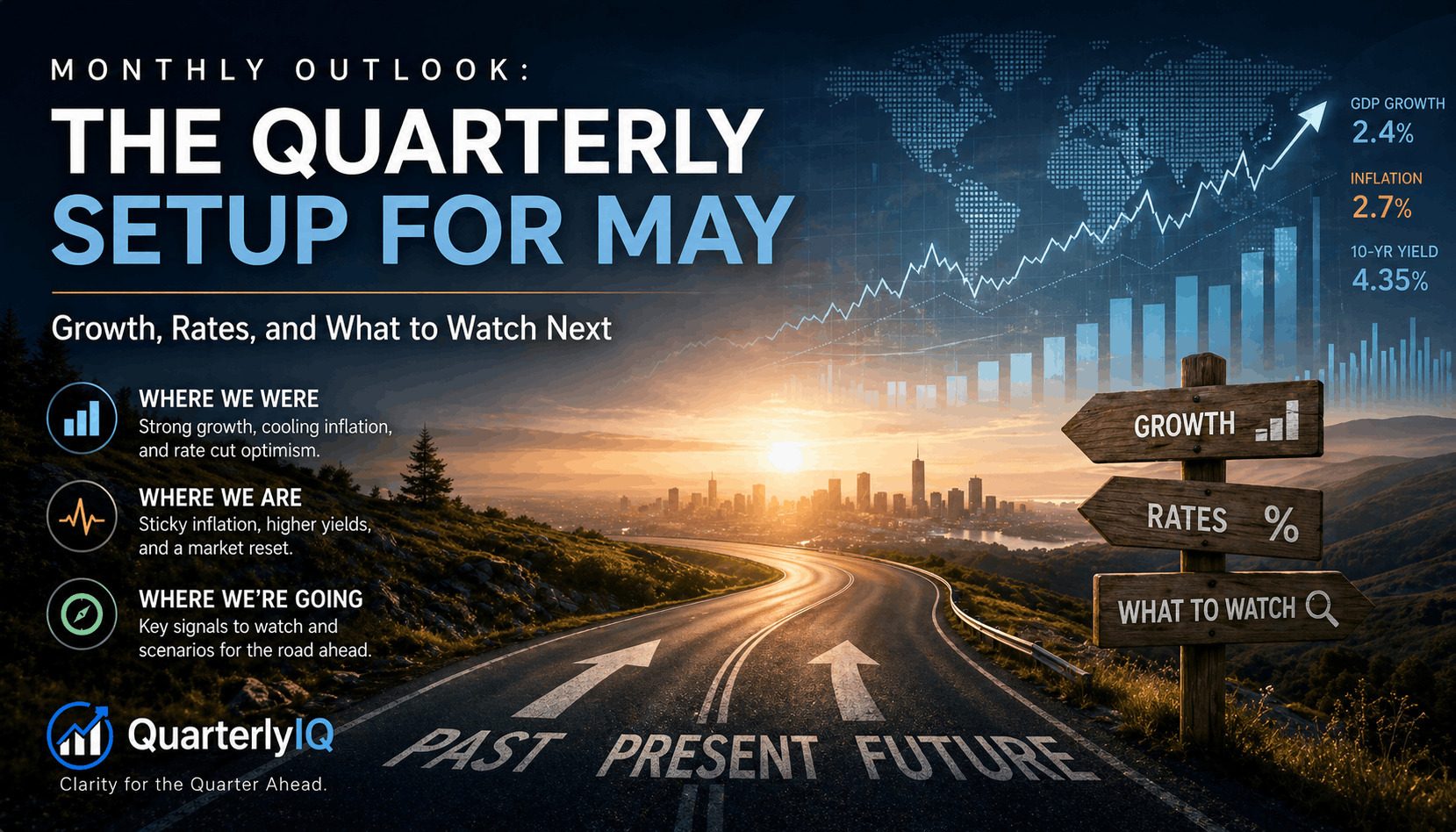
The Setup: From Confidence to Friction
A few months ago, the story felt clean.
Growth was steady. Inflation was cooling. Markets were pricing a soft landing with confidence. The idea was simple. The Fed would ease, earnings would hold up, and risk assets would grind higher.
That narrative worked until it didn’t.
As we moved through April, the data began to lose its smoothness. Not enough to break the expansion, but enough to introduce friction. In markets, friction is where positioning starts to matter more than direction.
The setup for May is not about a clear macro shift. It is about tension building beneath the surface.
Where We Were: A Goldilocks Narrative
Coming into Q2, the macro backdrop had three defining features:
1. Growth was resilient Real activity, whether measured through GDP proxies, consumption, or labor stability, remained firm. The economy refused to slow meaningfully despite higher rates.
2. Inflation was trending lower but not convincingly Disinflation was happening, but the pace was uneven. Goods had cooled. Services, especially housing and labor-driven categories, remained sticky.
3. Markets were priced for easing Expectations for rate cuts pulled forward aggressively. Financial conditions loosened. Risk appetite expanded.
This created a powerful but fragile alignment. Strong growth, falling inflation, and expectations of Fed easing.
The problem is that alignment requires everything to cooperate at once. That rarely lasts.
Where We Are: The “Higher for Longer” Reality Check
April forced a reset.
The data did not collapse, but it did not confirm the optimistic path either. Instead, it introduced a more complicated environment.
Growth: Still Holding, But Not Accelerating
The economy is not rolling over. It is also not re-accelerating in a way that justifies aggressive bullish positioning.
You are seeing:
- Stable consumption, but more selective behavior
- A labor market cooling at the margin, not breaking
- Business investment that is cautious, not collapsing
This is what late-cycle resilience looks like. Strong enough to avoid recession, but not strong enough to remove risk.
Inflation: The Problem That Didn’t Fully Go Away
The biggest shift is here.
Instead of a smooth move lower, inflation has:
- flattened in key components
- shown stickiness in services
- and in some cases re-accelerated on a short-term basis
This matters because it changes how the Fed responds.
The conversation is no longer about when cuts begin. It is now about whether there is enough progress to justify cutting at all.
Rates: The Market Had to Reprice Reality
With inflation proving stubborn, rate expectations adjusted.
- Rate cuts were pushed further out
- Yields moved higher
- Financial conditions tightened
This repricing is critical because it feeds directly into equity valuations, credit spreads, and risk appetite.
Markets did not break, but they lost their tailwind.
The Core Tension: Strong Enough to Delay Cuts, Weak Enough to Matter
This is the defining setup for May.
The economy is:
- Too strong for the Fed to ease aggressively
- Not strong enough to ignore higher rates indefinitely
That creates a narrow path forward.
Narrow paths are where volatility tends to increase.
What the Market Is Trying to Figure Out
There are three key questions driving positioning right now.
1. Is growth starting to roll over or just normalizing?
If growth remains stable, markets can tolerate higher rates.
If growth begins to soften meaningfully, higher rates become a problem.
This is the line that matters most.
2. Is inflation stuck or just noisy?
If inflation is structurally sticky:
- The Fed stays restrictive longer
- Real rates remain elevated
- Valuations compress
If inflation resumes its downward trend:
- The path to easing reopens
- Risk assets regain support
Right now, the answer is unclear. That uncertainty is the story.
3. How tight do financial conditions become?
Markets do not wait for policy. They react to expectations.
Higher yields and tighter liquidity:
- impact housing
- pressure credit
- and eventually feed into earnings
The question is not whether tightening matters. It is when it starts to take effect.
The May Setup: Transition, Not Resolution
May is unlikely to deliver a clean answer.
Instead, it looks like a transition month where:
- Growth signals either begin to soften or prove resilient
- Inflation either re-accelerates or resumes its decline
- Markets either stabilize or continue to reprice
This is not a high-conviction directional environment.
It is a high-information environment.
What to Watch Next (The Signals That Actually Matter)
Rather than focusing on headlines, the next phase comes down to a few key signals.
1. Labor Market Direction
Not just job growth, but:
- wage trends
- hours worked
- participation
The labor market connects growth and inflation.
2. Services Inflation
This is where persistence shows up.
If services inflation remains elevated:
- rate cuts stay delayed
- policy remains restrictive
3. Financial Conditions
Watch:
- yields
- credit spreads
- equity volatility
This is how macro conditions flow into markets.
4. Earnings Guidance (Quietly the Most Important)
Macro matters, but earnings confirm it.
What companies say about:
- demand
- pricing power
- margins
will tell you more about the next quarter than any single macro print.
The Bigger Picture: This Is What a Late-Cycle Environment Feels Like
There is a tendency to look for clean regimes such as expansion, recession, or recovery.
Most of the time, markets operate in between.
That is where we are now.
- Growth is slowing but not weak
- Inflation is falling but not solved
- Policy is restrictive but not tightening further
This creates a landscape where:
- macro signals matter more than narratives
- timing matters more than direction
- expectations drive volatility
The QuarterlyIQ Lens
At QuarterlyIQ, the focus is not on predicting the next headline. It is on understanding the next quarter’s setup.
Right now, the setup is clear.
The market is transitioning from a confidence-driven rally to a data-dependent environment.
That shift does not end trends immediately, but it changes how they behave.
Final Thought: From Momentum to Decision
April was about repricing.
May will be about decision-making.
- Does growth hold or fade?
- Does inflation cooperate or persist?
- Does the Fed regain flexibility or stay constrained?
Those answers will not come all at once.
But the signals will start to build.
In this environment, the edge does not come from reacting fast. It comes from understanding what actually matters before the market fully prices it in.
QuarterlyIQ. Clarity for the Quarter Ahead.