Skip to content
Blog/Investment Strategy

How to Use QuarterlyIQ to Build a Smarter Investment Planning Routine

A simple, repeatable process for using macro signals, company drivers, and quarterly thinking to make calmer investment decisions.
By Daniel Ikeda··10 min read
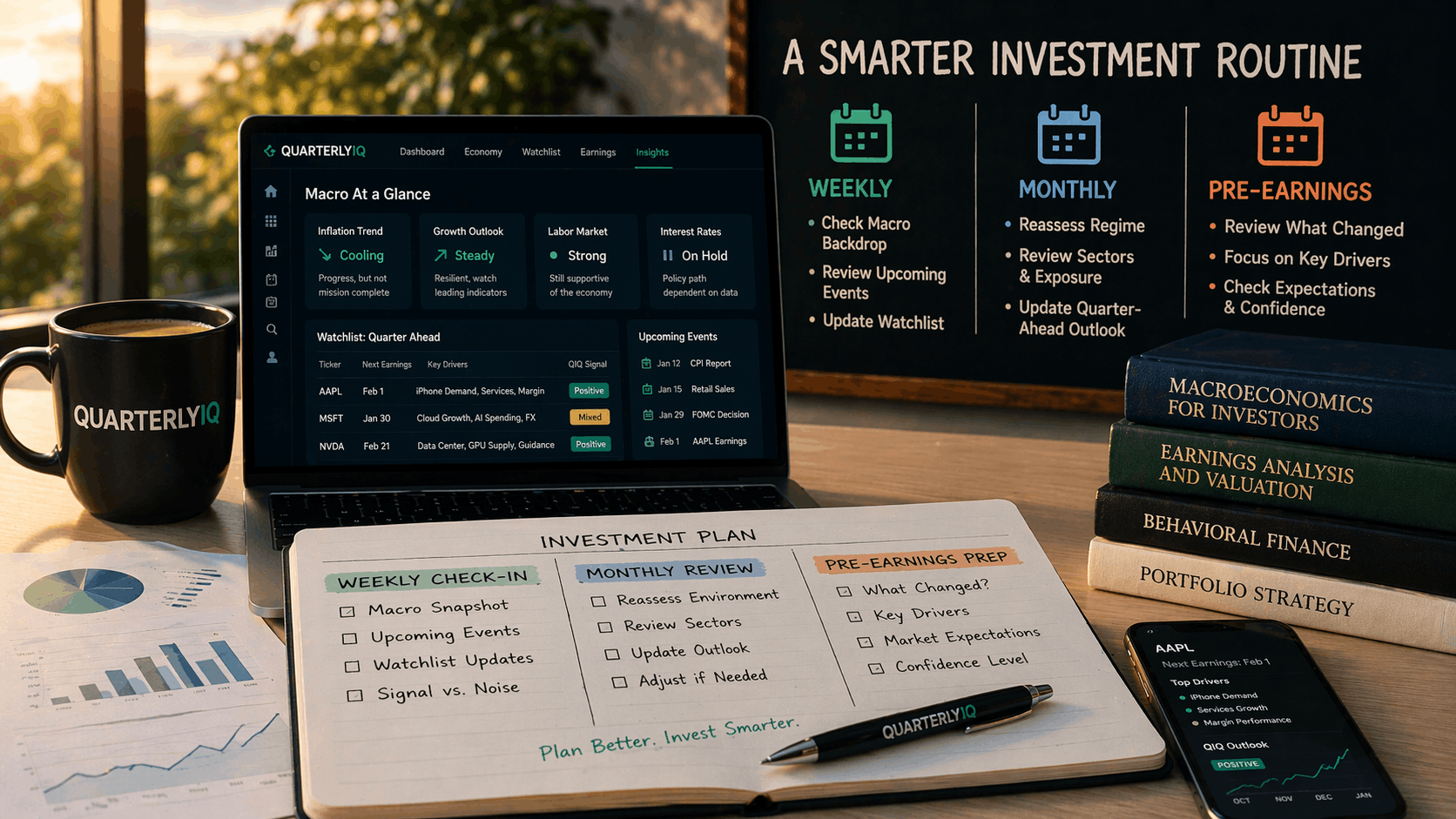
A warm, professional investment-planning workspace with a laptop showing a financial dashboard, a notebook outlining weekly, monthly, and pre-earnings routines, a coffee mug, charts, books, and a smartphone, all arranged to reflect a calm, structured investing process.

Most people do not struggle with investing because they lack opinions.

They struggle because they lack a process.

A headline breaks. A stock jumps. Inflation comes in cooler than expected. A Fed speaker shifts the mood. Earnings season starts to heat up. Suddenly the market feels alive again, and with that energy comes a familiar temptation: react quickly, follow the noise, and hope you are moving in the right direction.

That may feel productive in the moment. But for most investors, it leads to a scattered routine built around urgency instead of clarity.

The better approach is quieter.

It is not about watching every move. It is about building a repeatable habit for understanding what matters, what is changing, and what deserves your attention between now and the next quarter.

That is the kind of routine QuarterlyIQ is built to support.

Not prediction theater. Not endless alerts. A smarter investment planning rhythm grounded in perspective, discipline, and clearer signals.

Good investing usually looks less dramatic than people expect

There is a certain myth in markets that the best investors are always reacting in real time, always jumping on the next development, always one step ahead of the crowd.

In reality, many strong decisions come from something much less flashy.

They come from preparation.

They come from knowing what you are watching before the market gets emotional. They come from understanding which signals matter most for your portfolio, your watchlist, and the kind of environment companies are operating in.

That is what a routine gives you.

It reduces guesswork. It lowers emotional whiplash. It helps you stop treating every headline like it deserves the same level of attention.

And perhaps most importantly, it gives you a way to stay engaged without feeling consumed.

That is a valuable thing.

Because investing should support your life, not take it over.

What QuarterlyIQ is designed to help you do

QuarterlyIQ is built around a simple but powerful idea: investors need quarter-to-quarter clarity, not just more daily noise. The platform is designed to turn macroeconomic, market, and company-level data into clearer signals for the practical horizon that often matters most: the next earnings cycle. It emphasizes transparent factors, confidence-aware interpretation, and explainable intelligence rather than black-box outputs.

In practical terms, that means helping investors answer questions like:

  • What is changing in the macro backdrop?
  • Which factors are most likely to influence a company before its next earnings report?
  • Which signals look meaningful, and which ones are just noise?
  • Where does the data suggest confidence, and where is uncertainty still high?

That makes QuarterlyIQ especially useful as part of a routine.

Not a one-time check. Not a novelty. A structured tool for thinking more clearly over time.

The goal is not to do more. It is to do the right things consistently.

Many investors assume a better routine means spending more hours on research.

Usually it means the opposite.

It means focusing on a handful of questions that actually improve decisions.

A good investment planning routine should help you:

  • understand the broader environment
  • identify what matters for the companies you follow
  • prepare for the next major inflection points
  • review risk before emotion takes over
  • update your views when the facts change

That is enough.

You do not need to become a full-time macro analyst or read every earnings transcript the moment it drops. You need a structure that helps you stay informed without getting dragged into constant reaction.

Here is a simple routine QuarterlyIQ can support.

The weekly routine: stay oriented without drowning in the market

A good weekly check-in should feel like a reset, not a panic session.

Its purpose is simple: understand the current backdrop and notice what has changed.

1. Start with the macro picture

Before looking at individual stocks, get a feel for the broader environment.

Is inflation easing or staying stubborn? Is growth holding up or softening? Are rates becoming more supportive or more restrictive? Is the labor market still strong? What does the yield curve suggest about expectations?

This matters because individual stocks do not trade in a vacuum. They live inside a larger environment. A company can be strong and still feel pressure if the broader backdrop is changing against it.

Starting with macro helps you avoid the common mistake of studying a stock too narrowly.

You are reminding yourself what kind of weather the market is operating in.

2. Review the most important upcoming events

Every week has its own rhythm.

Maybe it is a major inflation report. Maybe a Fed meeting. Maybe jobs data. Maybe the beginning of a busy earnings stretch in a sector you care about.

A smart routine includes knowing what is coming before it arrives.

Not because you need to predict every move, but because context matters. If you know a major macro release or earnings event is approaching, you are less likely to mistake anticipation for conviction.

Preparation calms the mind.

3. Revisit your watchlist through a quarterly lens

This is where QuarterlyIQ becomes especially useful.

Instead of just asking whether you still “like” a stock, ask better questions:

  • What factors are most relevant for this company right now?
  • Have those factors improved, weakened, or stayed mixed?
  • Is sentiment outrunning the underlying setup?
  • What could matter most before the next earnings report?

That is a more grounded way to think.

It turns a watchlist into something more than a collection of names. It becomes a living set of stories, each shaped by changing conditions.

4. Separate signal from motion

A stock moving sharply does not always mean something important changed.

Sometimes it does. Sometimes it is just the market being loud.

The weekly routine is a good time to ask:

  • Did expectations really shift?
  • Did the company’s setup materially change?
  • Or are people simply reacting to short-term noise?

This habit alone can save investors from a lot of unnecessary churn.

The monthly routine: step back and update the bigger picture

Weekly reviews help you stay oriented. Monthly reviews help you stay honest.

This is where you zoom out and ask whether the broader story is changing.

1. Reassess the macro environment

Markets often turn gradually before they turn obviously.

A monthly review helps you see trends that daily headlines can hide.

Ask:

  • Is inflation trending down, stalling, or reaccelerating?
  • Is growth becoming more resilient or more fragile?
  • Are financial conditions easing or tightening?
  • Is the labor market cooling gently or weakening more sharply?

These are not just economics questions. They are market questions. They shape sector leadership, earnings expectations, valuation pressure, and investor sentiment.

2. Revisit sector exposure

Sometimes the most important shift in your portfolio is not about a single company. It is about where the strength or pressure is moving across the market.

Are rate-sensitive areas under pressure? Are cyclical sectors improving? Are defensives starting to lead? Are investors rewarding quality, growth, value, or balance-sheet strength?

A monthly review helps you see where the wind may be changing.

Not every move deserves action. But seeing the environment clearly helps you avoid sleepwalking through a rotation.

3. Update your quarter-ahead expectations

This is one of the most useful habits an investor can build.

At least once a month, pause and ask:

What do I believe is most likely over the next quarter? What would challenge that view? What am I most confident about? Where am I still uncertain?

That kind of reflection makes your thinking more deliberate.

It is also one of the easiest ways to reduce emotional decision-making later. When volatility rises, you already have a framework. You are not building one in the middle of the storm.

The pre-earnings routine: this is where preparation pays off

For many investors, this is the moment that matters most.

Earnings are where the market tests the story.

The goal is not to predict every result perfectly. It is to enter the event with a clearer understanding of what matters, what has changed, and what the market may already be pricing in.

Here is a strong pre-earnings checklist.

1. What has changed since last quarter?

Start there.

Has the macro backdrop improved or worsened? Have input costs changed? Has demand looked stronger or weaker? Have rates or credit conditions shifted? Has the sector become more favorable or more fragile?

A stock may look the same on the chart while the underlying conditions around it have changed meaningfully.

2. Which factors matter most for this company right now?

Not every earnings report is driven by the same forces.

For one company, it may be consumer demand. For another, margins. For another, cloud spending, credit quality, ad pricing, energy costs, or financing conditions.

The key is narrowing your focus.

A better question than “What do I think will happen?” is: “What are the few factors most likely to shape this report and guidance?”

That is where useful preparation begins.

3. What does the market already expect?

This is where many investors trip themselves up.

A company can report decent numbers and still fall if expectations were too high. Another can deliver imperfect results and rise because fears were worse than reality.

So before earnings, it helps to ask:

  • Is the market optimistic, cautious, or confused?
  • What seems priced in?
  • Would a “good” report actually be enough?

That is a much more mature way to approach event risk.

4. Where is confidence high, and where is it low?

This may be the most important question of all.

Confidence matters.

If the setup looks clear, that is useful. If the data is mixed and uncertainty is high, that is also useful. Both can improve decision-making.

One of the biggest mistakes investors make is confusing activity with conviction. Sometimes the smartest move is not pressing harder. It is recognizing that the picture is still cloudy.

That is not weakness. That is discipline.

The biggest mistakes a routine can help you avoid

A strong routine does more than keep you informed. It protects you from predictable mistakes.

Overreacting to headlines

Without a process, every update feels urgent.

With a process, you can place new information in context and decide whether it actually changes the story.

Ignoring the macro backdrop

Many investors focus so tightly on company news that they miss the environment around it.

A routine forces you to zoom out and remember that stocks are affected by the wider market climate too.

Treating every signal as equally important

Some signals matter a lot. Others barely matter at all.

A disciplined routine helps you weigh what is actually relevant instead of giving every headline the same emotional volume.

Confusing uncertainty with failure

Not every situation will be clear.

That is normal.

A good routine helps you recognize when the evidence is strong and when it is still mixed. That alone can improve patience and risk control.

What a realistic QuarterlyIQ routine might look like

This does not need to be complicated.

A practical version could look like this:

Once a week

  • review the macro backdrop
  • check upcoming economic and earnings events
  • scan your watchlist for meaningful factor changes
  • note where expectations may be shifting

Once a month

  • reassess the broader regime
  • review sector positioning
  • update your quarter-ahead view
  • identify what would strengthen or weaken your current thesis

Before major earnings reports

  • review what changed since last quarter
  • focus on the most important drivers
  • compare likely outcomes with current expectations
  • decide whether confidence is high, mixed, or low

That is a calm system.

And calm systems tend to outperform emotional ones over time.

Why this kind of routine feels different

Because it brings you back to something older and sturdier in investing.

Preparation. Patience. Perspective.

There is still a quiet advantage in being the person who does not need to react to every burst of noise. The person who understands what they are watching. The person who knows that better planning often beats faster opinion.

That kind of investing may not feel flashy. But it leaves a better impression on your portfolio and, just as importantly, on your peace of mind.

The takeaway

A smarter investment routine is not built on constant action.

It is built on better questions, better filters, and a steadier rhythm.

QuarterlyIQ is most useful when it becomes part of that rhythm. Not as a machine for certainty, but as a tool for clarity. A way to understand what may matter most between now and the next quarter, where confidence is stronger, and where caution still belongs.

You do not need to follow everything.

You need a process you can trust.

That is how better planning starts.

And over time, it is often how better decisions do too.