QuarterlyIQ vs. Stock Rover: Which Is Better for Stock Research and Portfolio Monitoring?
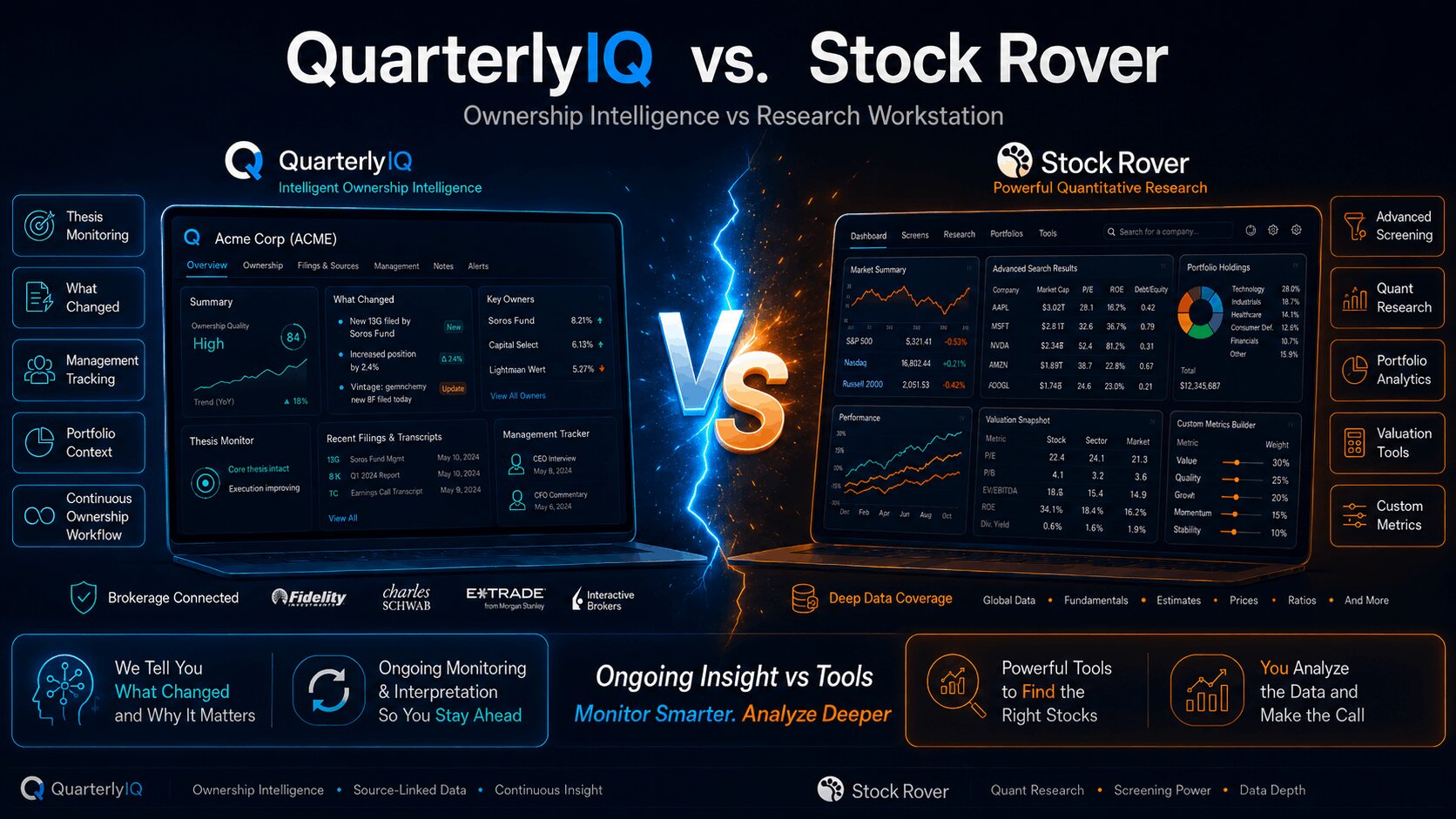
The more powerful an investing platform becomes, the more work it can sometimes leave for the investor.
More metrics. More charts. More models. More ways to slice a portfolio.
But eventually every investor faces a simpler question:
What changed in the companies I own, and does it actually matter?
That is where the difference between Stock Rover and QuarterlyIQ becomes especially clear.
Stock Rover is one of the most capable quantitative research platforms available to self-directed investors. It combines sophisticated stock and ETF screening, hundreds of metrics, historical fundamentals, valuation tools, research reports, portfolio analytics, charting, rebalancing, dividend analysis, alerts, and Monte Carlo simulation.
QuarterlyIQ is built around a different idea.
The research system should keep working after the investor stops researching.
QuarterlyIQ combines stock discovery, source-linked company Reports, management-execution tracking, investment-thesis monitoring, brokerage-connected portfolios, fund look-through, portfolio-aware macro context, Weekly Briefs, and selective alerts into one continuous ownership workflow.
The simplest distinction is:
Stock Rover gives investors more tools for performing their own analysis. QuarterlyIQ does more of the ongoing analytical work required to understand what changed, why it matters, and whether the reason for owning a company still holds.
For investors who enjoy building screens, configuring metrics, modeling portfolios, testing allocations, and performing detailed quantitative analysis themselves, Stock Rover is exceptionally strong.
For investors who want the system to continuously interpret the businesses they own and tell them what deserves attention, we believe QuarterlyIQ is the stronger overall choice.
QuarterlyIQ vs. Stock Rover at a glance
| Capability | QuarterlyIQ | Stock Rover | Stronger choice |
|---|---|---|---|
| Primary purpose | Stock discovery, company research, thesis monitoring, and portfolio intelligence | Quantitative research, screening, comparison, and portfolio analytics | QuarterlyIQ for ongoing monitoring |
| Company research | Source-linked Report covering condition, growth, quality, management, valuation, risk, thesis, and what changed | Detailed research reports combining scores, valuation, financials, peers, dividends, analyst data, and warnings | Different strengths |
| Investment-thesis monitoring | Explicit thesis state with reasons and ongoing monitoring | Ratings, scores, warnings, and configurable metric alerts | QuarterlyIQ |
| Management execution | Tracks stated management objectives and whether they are later confirmed or disproved | Extensive financial and analyst data | QuarterlyIQ |
| Stock screening | Business condition, growth, quality, management, valuation, risk, thesis, cycle, macro sensitivity, and fair-value filters | Hundreds of metrics, custom equations, historical screening, ranking, percentile filters, and advanced ETF screening | Stock Rover for customization, QuarterlyIQ for research-driven screening |
| Historical fundamentals | Current-condition focused | Up to 20 years on higher plans | Stock Rover |
| Custom metrics and equations | Not a core workflow | Extensive customization | Stock Rover |
| Valuation | Multi-method valuation and what-is-priced-in context | DCF, fair value, margin of safety, ratios, and valuation charts | Different strengths |
| Portfolio analysis | Performance, concentration, risk, thesis health, attention items, income, tax, macro, and fund exposure | Deep performance, risk, attribution, correlation, income, and allocation analytics | Different strengths |
| Quantitative portfolio risk | Concentration, volatility, drawdown, and benchmark context | Beta, volatility, drawdown, Sharpe, Sortino, correlation, and more | Stock Rover |
| Rebalancing | Not a central workflow | Target allocations, drift, and proposed trades | Stock Rover |
| Monte Carlo simulation | Not a central workflow | Yes | Stock Rover |
| Brokerage connections | Read-only through SnapTrade | Read-only through Yodlee | Both |
| Fund look-through | Underlying company exposure plus available company research and thesis monitoring | Fund look-through for sector and geographic exposure plus extensive fund reports | Different strengths |
| Fund research breadth | Focused supported fund universe | Thousands of ETFs and mutual funds | Stock Rover |
| Personalized weekly review | Weekly Brief based on the investor's own holdings | Weekly Market Brief focused on the broader market and economy | QuarterlyIQ |
| Alerts | Selective thesis and material-change monitoring | Highly configurable price, valuation, technical, and metric alerts | Different strengths |
| Macro context | Connected directly to the investor's holdings and screens | Market and economic research plus sector tools | QuarterlyIQ for personalization |
| Technical charting | Not a primary differentiator | Extensive | Stock Rover |
| Options analysis | Not a core feature | Available on higher plans | Stock Rover |
| Ease of interpretation | Guided, plain-English conclusions | Highly configurable, data-dense analytical environment | QuarterlyIQ |
| Best fit | Investors who want continuous interpretation and portfolio monitoring | Investors who want maximum quantitative control | QuarterlyIQ for most monitoring-focused investors |
Stock Rover is a serious analytical platform
A fair comparison has to begin by acknowledging that Stock Rover is not simply a stock screener.
It is much broader than that.
Stock Rover describes itself as a combined screening, research, and portfolio-management environment. Its current platform supports more than 14,000 North American stocks, thousands of ETFs, extensive mutual-fund data, and hundreds of financial, operational, valuation, analyst, and market metrics. Higher plans unlock historical screening, custom equations, custom metrics, percentile analysis, advanced ETF screening, longer financial histories, analyst tools, insider data, options, and more.
Its plan comparison shows just how deep the platform has become.
That quantitative depth is one of Stock Rover's biggest strengths.
It is also the beginning of the philosophical difference between the products.
Stock Rover gives investors an extremely powerful analytical workstation.
QuarterlyIQ tries to reduce how much of that workstation the investor needs to operate manually.
Both platforms have powerful stock screeners, but they solve different problems
Stock Rover is difficult to beat on raw screening flexibility.
Its current screening tools support hundreds of metrics, more than 150 prebuilt strategies, equation-based screens, ranked screens, historical screening, custom metrics, advanced ETF criteria, and screener snapshots that let investors compare results over time.
For an investor who wants to construct a highly specific quantitative screen, Stock Rover is excellent.
QuarterlyIQ takes a different approach.
Its stock screener uses many of the same analytical dimensions that appear in QuarterlyIQ company Reports, including:
- Business condition
- Growth
- Quality
- Management performance
- Valuation
- Risk
- Thesis state
- Sector
- Market capitalization
- Business-cycle position
- Price relative to fair value
- Macroeconomic sensitivity
- Signs that company conditions may be rolling over
QuarterlyIQ also provides curated discovery groups such as:
Quality Compounders Higher-quality companies that continue to grow.
Deep Discount to Fair Value Companies trading meaningfully below QuarterlyIQ's fair-value analysis.
Cheap and Up-Cycle Companies trading below fair value while their sub-industry cycle appears to be improving.
Robust Condition Companies showing stronger overall business fundamentals.
Rolling Over Companies whose recent business conditions appear to be weakening.
Under Pressure Companies showing fragile or impaired conditions.
The distinction is important.
Stock Rover gives investors more ways to construct the quantitative screen themselves.
QuarterlyIQ gives investors more ways to screen using the interpreted condition of the business.
For example, a QuarterlyIQ investor can search for a combination such as:
- Strong quality
- Strong management
- Improving growth
- Intact or healthy thesis conditions
- Favorable industry cycle
- Attractive price relative to fair value
- Moderate risk
The company can then be opened directly into the same research framework used to generate those screening characteristics.
If it later enters a portfolio, that research follows it.
That continuity is one of QuarterlyIQ's biggest advantages.
Both platforms produce company research, but the Reports answer different questions
It would be inaccurate to say Stock Rover only gives investors raw numbers.
Stock Rover's Research Reports are substantial.
Its current reports combine thousands of data points into an eight-page company analysis that can include:
- Overall Score
- Intrinsic value
- Margin of safety
- Value, Growth, Quality, and Sentiment assessments
- Financial statements
- Peer comparisons
- Dividend analysis
- Analyst expectations
- Earnings surprises
- Seasonality
- Investor warnings
That is a powerful research product.
QuarterlyIQ's Report is built differently.
Rather than beginning with a large collection of metrics and turning them into scores, QuarterlyIQ starts with the business and investment case.
A QuarterlyIQ Report can separately examine:
- Business condition
- Growth
- Quality
- Management performance
- Valuation
- Risk
- Financial condition
- Earnings
- Industry conditions
- Macro sensitivity
- Material events
- Investment thesis
- What changed
- What to watch next
QuarterlyIQ rebuilds covered company Reports after each market close using sources such as SEC filings, earnings-call transcripts, market data, analyst estimates, fund holdings, and government economic data. The supporting evidence remains connected to the analytical conclusions. You can see the research philosophy in How QuarterlyIQ Works.
The result is a different kind of research experience.
Stock Rover gives investors a highly detailed quantitative report.
QuarterlyIQ gives investors a continuously updated interpretation of the business and investment case.
For investors who enjoy doing the final synthesis themselves, Stock Rover provides tremendous depth.
For investors who want more of that synthesis already performed and explained, QuarterlyIQ has the advantage.
The biggest difference is what happens after you buy
This is where we believe QuarterlyIQ separates itself most clearly.
Buying a stock does not end the research problem.
It changes it.
Before investing, the question may be:
Is this company attractive?
After investing, the questions become:
- Did anything important change?
- Is management still executing?
- Are the assumptions behind the thesis still reasonable?
- Has growth weakened?
- Is valuation becoming harder to support?
- Did the business change, or did only the stock price move?
- Which of my holdings deserves attention now?
Stock Rover can help investors monitor many of the underlying variables.
Its powerful alert system can track prices, valuation conditions, technical criteria, financial metrics, and other configurable triggers across portfolios and watchlists.
QuarterlyIQ approaches monitoring at a higher level.
It asks:
Did the evidence supporting the reason I own this company materially change?
QuarterlyIQ maintains a thesis condition for covered holdings and attaches a plain-English explanation to that assessment. The objective is not to predict the next stock-price movement or tell an investor to sell.
The objective is to distinguish between market noise and deterioration in the underlying investment case.
That is a fundamentally different type of monitoring.
A metric can change without the thesis changing
Imagine revenue growth slows from 18 percent to 14 percent.
That is a measurable change.
But is it important?
Maybe the company expected the slowdown.
Maybe margins improved.
Maybe management deliberately reduced low-quality revenue.
Maybe the broader industry entered a temporary down-cycle.
Maybe the slowdown directly contradicts a critical assumption in the investment thesis.
The metric itself does not answer the question.
The investor still has to interpret it.
Stock Rover gives investors excellent tools for seeing that the metric changed.
QuarterlyIQ is designed to help determine whether that change matters to the investment case.
This is why we believe the most important comparison is not:
Which platform has more data?
Stock Rover does.
The better question is:
How much interpretation does the investor still have to perform after the data arrives?
QuarterlyIQ tracks management execution
One of the more distinctive differences is management monitoring.
QuarterlyIQ extracts stated management objectives from filings and earnings calls, then follows those commitments through future reporting periods.
The system can evaluate whether important objectives were subsequently confirmed or disproved.
That matters because numbers only tell part of the story.
A company might post respectable financial results while management repeatedly fails to deliver on the strategic priorities it established for shareholders.
Or a difficult quarter may still represent good execution if management achieved the objectives it previously described.
QuarterlyIQ is designed to preserve that continuity.
Stock Rover provides extensive historical financial information, analyst data, estimates, ratings, and other company metrics. In the current Stock Rover materials we reviewed, we did not find an equivalent first-class workflow centered on systematically tracking management's own stated commitments from quarter to quarter.
That gives QuarterlyIQ a different lens:
A ratio tells you what happened. Management monitoring helps you ask whether leadership did what it said it would do.
Portfolio analytics is where Stock Rover is exceptionally strong
This is one area where we would not claim QuarterlyIQ has the broader feature set.
Stock Rover has some of the deepest portfolio analytics available to individual investors.
Its portfolio tools can include:
- Money-weighted returns
- Time-weighted returns
- Benchmark comparison
- Beta
- Volatility
- Maximum drawdown
- Sharpe ratio
- Sortino ratio
- Correlation
- Holding contribution
- Dividend projections
- Asset and sector allocation
- Rebalancing
- Trade planning
- Monte Carlo future simulations
Stock Rover can establish target allocations, measure drift, calculate suggested rebalancing trades, and model proposed changes before the investor makes them.
Its portfolio management tools are a clear strength.
Investors who want to engineer, model, optimize, and rebalance a portfolio will find functionality in Stock Rover that QuarterlyIQ does not currently attempt to replicate.
QuarterlyIQ's advantage is different.
It brings the condition of the underlying businesses into the portfolio.
QuarterlyIQ makes the company part of the portfolio analysis
QuarterlyIQ's Portfolio Manager combines traditional portfolio information with company research.
That can include:
- Portfolio value
- Gains and losses
- Money-weighted performance
- Risk relative to the S&P 500
- Volatility
- Position concentration
- Sector concentration
- Diversification
- Thesis health
- Holdings needing attention
- Upcoming earnings and material events
- Dividend expectations
- Tax and unrealized gain or loss information
- Direct and indirect company exposure
- Macro conditions affecting the portfolio
The distinction is subtle but important.
Stock Rover is stronger at answering:
How is my portfolio behaving quantitatively?
QuarterlyIQ is stronger at answering:
What is happening inside the businesses in my portfolio, and which changes deserve my attention?
Those are both portfolio-analysis problems.
They are not the same problem.
Both platforms now look through funds
This comparison has become more interesting because Stock Rover recently expanded its fund capabilities.
Stock Rover's Portfolio Performance Report now looks through ETFs and mutual funds when calculating underlying sector and geographic exposure. Its Ultimate-tier Fund Reports also cover thousands of ETFs and mutual funds, with detailed analysis of holdings, allocation, geography, risk, income, fees, peer comparisons, and, for bond funds, areas such as duration and credit quality.
Stock Rover clearly wins on fund-research breadth.
QuarterlyIQ's advantage is more specific.
QuarterlyIQ looks through supported funds to identify the actual companies an investor owns indirectly, combines those holdings with companies owned directly, and then applies available QuarterlyIQ company research to the underlying businesses.
That makes it possible to see:
- How much of a company is owned directly
- How much is owned through funds
- Which funds create the exposure
- Where duplicate exposure exists
- Whether a covered underlying company has weakened
- Whether a thesis issue exists inside a fund even though the ETF ticker itself may appear unchanged
For example, an investor might hold Microsoft directly while also owning it through multiple ETFs.
Both platforms can help expose the underlying concentration.
QuarterlyIQ goes further by treating Microsoft as the same monitored business regardless of whether the exposure comes from a direct position or through a fund.
That is the difference we believe matters most.
Stock Rover provides broader fund analysis.
QuarterlyIQ provides deeper company-level ownership intelligence inside supported funds.
Stock Rover lets you define the alert. QuarterlyIQ watches for meaning.
Both platforms have legitimate monitoring systems.
Stock Rover's configurable alerts are powerful.
Investors can create conditions around price, valuation, financial metrics, technical indicators, and other measurable criteria. Alerts can be applied across portfolios and watchlists.
That is extremely useful for investors who know exactly what conditions they want to monitor.
QuarterlyIQ uses a different model.
Its alerts are designed around material research changes, particularly changes that affect the investment thesis.
Instead of requiring the investor to anticipate every important metric and define a threshold in advance, QuarterlyIQ continuously evaluates new company evidence and can surface when that evidence meaningfully changes the investment case.
So the distinction is not:
Stock Rover has alerts and QuarterlyIQ does not.
Both do.
It is:
Stock Rover lets you define the trigger. QuarterlyIQ is designed to identify when the underlying investment story itself has changed.
The Weekly Brief may be the clearest difference
Stock Rover publishes Rover's Weekly Market Brief.
It is a useful recap of developments in the broader US market and economy.
QuarterlyIQ also has a Weekly Brief, but the similarity mostly ends with the name.
QuarterlyIQ's Weekly Brief is generated from the investor's tracked holdings.
It is designed to answer:
- What changed since the last review?
- Which holdings need attention?
- Which holdings remained quiet?
- Which investment theses weakened?
- What upcoming earnings matter?
- Which economic developments are relevant to this portfolio?
- What deserves attention next?
That creates one of the simplest distinctions between the products:
Stock Rover has a weekly market brief. QuarterlyIQ has a weekly brief about your investments.
For investors who only have 20 or 30 minutes each week to review their portfolio, this matters.
Stock Rover gives them powerful tools to perform the review.
QuarterlyIQ performs more of the prioritization for them.
Macroeconomic data becomes more useful when it knows what you own
Stock Rover provides market and economic research and strong tools for comparing sectors, industries, stocks, and funds.
QuarterlyIQ connects macro conditions more directly to the research and portfolio workflow.
Rates, inflation, growth, employment, the yield curve, and broader sector conditions can influence:
- Company Reports
- Stock screening
- Portfolio analysis
- Weekly Briefs
The goal is not to predict market returns.
It is to answer a more practical question:
Which economic developments actually matter to the companies I own?
An investor heavily exposed to banks faces a different economic sensitivity than one concentrated in software or industrial companies.
QuarterlyIQ's advantage is making that macro context portfolio-specific instead of forcing the investor to perform the connection manually.
Where Stock Rover is clearly stronger
QuarterlyIQ is not a replacement for every Stock Rover capability.
Stock Rover is the stronger platform for investors who want maximum quantitative depth.
Historical analysis
Higher Stock Rover tiers provide as much as 20 years of fundamental history and long histories for pricing and dividends.
Custom metrics and equations
Stock Rover allows power users to build custom formulas, metrics, screens, and rankings.
Portfolio engineering
Stock Rover is stronger for rebalancing, target allocations, drift analysis, trade planning, correlation, performance attribution, and Monte Carlo simulations.
Charting and technical analysis
Stock Rover offers significantly deeper charting with fundamental overlays and technical indicators.
Fund breadth
Stock Rover analyzes thousands of ETFs and mutual funds. QuarterlyIQ's current fund look-through universe is intentionally much smaller.
Dividend analytics
Stock Rover provides extensive dividend histories, screening, income projections, and security-level dividend metrics.
Analyst and insider data
Higher Stock Rover tiers offer detailed analyst-rating and price-target tools along with insider-transaction analysis.
Options
Stock Rover Ultimate includes options-related metrics and options-chain functionality.
These are meaningful advantages.
An investor who wants a highly configurable quantitative workstation may genuinely prefer Stock Rover.
Where QuarterlyIQ is stronger
QuarterlyIQ's strongest advantages come from interpretation and continuity.
Investment-thesis monitoring
QuarterlyIQ continuously asks whether the evidence supporting the investment case still holds.
We did not find an equivalent first-class thesis-state workflow in Stock Rover's current product documentation.
Management-execution tracking
QuarterlyIQ follows stated management objectives through future reporting periods and evaluates whether those commitments were confirmed or disproved.
Personalized portfolio prioritization
QuarterlyIQ identifies which holdings need attention instead of expecting the investor to manually inspect every position.
Source-linked research
QuarterlyIQ emphasizes keeping source evidence attached to the analytical conclusion itself.
Portfolio-aware macro context
Economic developments are connected to actual holdings and sectors.
Company intelligence through funds
QuarterlyIQ carries available company research and thesis monitoring into businesses owned indirectly through supported ETFs and funds.
Weekly portfolio intelligence
The Weekly Brief is personalized to the investor's portfolio rather than functioning as a general market publication.
Lower interpretation burden
QuarterlyIQ deliberately presents business condition, growth, quality, management, valuation, risk, and thesis as understandable conclusions rather than requiring the investor to configure hundreds of metrics.
This may be QuarterlyIQ's most important practical advantage.
Stock Rover is more powerful when you want to build the analysis yourself. QuarterlyIQ is more useful when you want the analysis continuously performed, explained, and carried into the portfolio for you.
Which platform is better for common investor situations?
Finding stock ideas
Stock Rover for maximum quantitative flexibility. QuarterlyIQ for research-driven discovery.
Stock Rover's screening engine is exceptionally deep and supports hundreds of metrics, custom equations, ranking, historical analysis, and advanced screening techniques.
QuarterlyIQ is stronger when the investor wants to discover companies through interpreted characteristics such as business condition, management quality, thesis state, cycle position, macro sensitivity, risk, and price relative to fair value.
Researching one company in detail
Different strengths
Stock Rover is stronger for investors who want to manipulate extensive financial history, peer comparisons, scores, charts, analyst data, custom metrics, and quantitative models.
QuarterlyIQ is stronger for investors who want an updated analytical narrative explaining what the business is doing, how management is executing, what valuation implies, what the thesis depends on, and what could change the current read.
Monitoring 20 individual stocks
Stronger choice: QuarterlyIQ
Once the portfolio exists, the problem becomes prioritization.
QuarterlyIQ is designed to identify which company changed, why the change matters, whether the thesis weakened, and what should be watched next.
Managing a portfolio quantitatively
Stronger choice: Stock Rover
Investors focused on correlation, Sharpe and Sortino ratios, rebalancing, allocation drift, Monte Carlo simulation, trade planning, and detailed performance attribution will find Stock Rover more capable.
Managing a portfolio without spending hours every week
Stronger choice: QuarterlyIQ
QuarterlyIQ performs more of the interpretation and prioritization.
The Weekly Brief is specifically designed to help investors understand what changed across their holdings without manually reviewing every position.
Understanding ETFs and mutual funds
Different strengths
Stock Rover wins decisively on fund breadth and dedicated fund analysis.
QuarterlyIQ has the stronger workflow for understanding company-level economic exposure across direct positions and supported funds, then carrying available company research and thesis monitoring into those underlying holdings.
Dividend investing
Stock Rover for deep dividend analytics. QuarterlyIQ for dividend holdings in context.
Stock Rover offers more extensive dividend histories, metrics, and income-analysis tools.
QuarterlyIQ connects expected portfolio income with the broader condition and thesis of the businesses paying those dividends.
Retirement and withdrawal modeling
Stronger choice: Stock Rover
Its Monte Carlo simulation, future-income tools, rebalancing, and fund-analysis capabilities make Stock Rover particularly compelling for investors focused on long-range portfolio modeling.
Monitoring whether a stock thesis is weakening
Stronger choice: QuarterlyIQ
This is a central QuarterlyIQ workflow rather than a collection of user-defined metric alerts.
Pricing and value
At current annual list prices, Stock Rover offers several paid tiers:
- Premium: $348 per year
- Premium Plus: $588 per year
- Ultimate: $948 per year
- Ultimate Pro: $1,788 per year
Higher tiers progressively unlock deeper screening, historical data, research reports, custom metrics, fund reports, analyst detail, insider tools, options functionality, and larger limits. See Stock Rover's current pricing and plan comparison.
QuarterlyIQ currently offers:
- Free: $0
- Plus: $250 per year
- Premium: $390 per year
See current QuarterlyIQ pricing.
QuarterlyIQ's pricing model reflects a different philosophy.
Every plan uses the same underlying research system. Paid tiers primarily increase the number of stocks and portfolios that can be tracked and add features such as brokerage import and delivered Briefs.
Stock Rover's tiers increasingly unlock additional analytical capabilities.
That leads to a useful distinction:
Stock Rover increasingly charges for more analytical power. QuarterlyIQ primarily charges for how much of your portfolio you want the same research system to cover.
That does not mean QuarterlyIQ provides every Stock Rover feature for less money.
It does not.
Stock Rover Premium Plus and Ultimate include advanced capabilities that QuarterlyIQ does not attempt to replicate.
But investors primarily paying for ongoing company research, thesis monitoring, and portfolio intelligence may find QuarterlyIQ's pricing more aligned with the job they actually need done.
Final verdict
Stock Rover is one of the best quantitative investing workstations available to self-directed investors.
Its screening depth, historical data, customizable metrics, valuation tools, charting, portfolio analytics, rebalancing, dividend research, fund breadth, and Monte Carlo simulation are genuinely impressive.
QuarterlyIQ should not be chosen because it has more of those tools.
It does not.
QuarterlyIQ should be chosen because it asks the research system to do something different.
It continuously evaluates the companies an investor owns, tracks whether management is delivering, monitors the evidence behind the investment thesis, carries company intelligence through supported funds, connects macro conditions to actual holdings, and tells the investor what deserves attention.
Choose Stock Rover when you want:
- Maximum quantitative screening flexibility
- Hundreds of customizable metrics
- Long historical datasets
- Deep charting and technical analysis
- Portfolio optimization and rebalancing
- Monte Carlo simulations
- Detailed dividend analytics
- Broad ETF and mutual-fund research
- Analyst, insider, and options tools
- A powerful workstation you can configure yourself
Choose QuarterlyIQ when you want:
- Research-driven stock discovery
- Source-linked company Reports
- Investment-thesis monitoring
- Management-execution tracking
- Company research connected directly to your portfolio
- Direct and indirect company exposure through supported funds
- Portfolio-aware macro context
- Holdings automatically prioritized for attention
- A personalized Weekly Brief
- Selective alerts tied to meaningful research changes
- Less time configuring analysis and more clarity about what changed
For a quantitative power user who enjoys building models and deeply customizing an analytical workspace, Stock Rover may be the stronger choice.
For a self-directed investor who wants a system to continuously help interpret the companies they own and monitor whether those investments are still behaving as expected, we believe QuarterlyIQ goes further.
Stock Rover gives you the analytical workstation. QuarterlyIQ keeps watch over the investment case.
Frequently asked questions
Is QuarterlyIQ a Stock Rover alternative?
Yes.
QuarterlyIQ is a particularly strong Stock Rover alternative for investors who want stock screening and portfolio analysis but prefer ongoing company research, investment-thesis monitoring, management-execution tracking, fund look-through, and personalized portfolio intelligence over a highly configurable quantitative workstation.
Which has the better stock screener?
Stock Rover is stronger for maximum quantitative flexibility. Its screeners use hundreds of metrics and can include custom equations, historical screening, ranking, and advanced criteria.
QuarterlyIQ is stronger for investors who want to screen companies using interpreted business characteristics such as condition, quality, management, valuation, risk, thesis state, industry cycle, macro sensitivity, and price relative to fair value.
Which is better for stock research?
It depends on how the investor prefers to work.
Stock Rover is stronger for deep quantitative analysis, financial history, peer comparisons, scores, custom metrics, and charting.
QuarterlyIQ is stronger for investors who want the system to synthesize the evidence into a current business read, investment thesis, management assessment, valuation context, risks, and specific items to watch.
Which is better for portfolio monitoring?
For quantitative portfolio analysis, Stock Rover is stronger.
For company-aware portfolio monitoring, we believe QuarterlyIQ is stronger.
QuarterlyIQ carries company research and thesis health into the portfolio and prioritizes which investments deserve attention.
Which platform is better after buying a stock?
QuarterlyIQ.
Stock Rover provides excellent ongoing data, metrics, research reports, warnings, and configurable alerts.
QuarterlyIQ is specifically built to keep evaluating whether the evidence behind the investment thesis has changed.
Do both connect to brokerage accounts?
Yes.
QuarterlyIQ uses supported read-only SnapTrade connections. Stock Rover uses read-only brokerage aggregation through Yodlee. Institution and account availability depend on the respective connection providers.
Does Stock Rover look inside ETFs and mutual funds?
Yes.
Stock Rover's newer portfolio reporting can look through funds to calculate underlying sector and geographic exposure, and its higher-tier Fund Reports provide detailed analysis across thousands of ETFs and mutual funds.
QuarterlyIQ's distinction is that it can carry available company research and thesis monitoring into the underlying businesses owned indirectly through supported funds.
Which is better for portfolio rebalancing?
Stock Rover.
It provides target allocations, drift analysis, trade planning, and rebalancing tools that are not a central QuarterlyIQ workflow today.
Which is easier to use?
That depends on the investor.
Stock Rover's depth and customization are major strengths for analytical power users.
QuarterlyIQ is deliberately more guided. It performs more of the interpretation and presents business condition, management, valuation, risk, thesis health, and attention items in plain language.
Can QuarterlyIQ and Stock Rover be used together?
Yes.
A power user could use Stock Rover for advanced quantitative screening, historical analysis, portfolio modeling, and rebalancing, while using QuarterlyIQ for ongoing company interpretation, thesis monitoring, management tracking, and personalized portfolio Briefs.
For investors who primarily want to understand what changed across the companies they already own, QuarterlyIQ can serve as the central monitoring platform.
Methodology and disclosure
This comparison is written and published by QuarterlyIQ. It is not presented as an independent third-party review.
We reviewed current QuarterlyIQ product pages, documentation, company research, stock screening, portfolio workflows, pricing, fund look-through, alerts, and Weekly Brief functionality. We also reviewed Stock Rover's current product pages and official documentation covering screening, Research Reports, portfolio management, brokerage connections, alerts, fund analysis, V12 features, valuation, rebalancing, Monte Carlo simulation, charting, analyst tools, and pricing.
We gave Stock Rover full credit for capabilities supported by its current product documentation, including areas where Stock Rover clearly provides deeper functionality than QuarterlyIQ.
Stock Rover did not review or approve this article. Features, plan limits, coverage, supported institutions, and prices may change.
This article is for informational purposes only. QuarterlyIQ does not provide personalized investment advice or recommend buying or selling any security.